


Tables
Accessible tables organize information into rows and columns so that screen readers can interpret them accurately. They should be used only for presenting data, not for formatting or layout purposes.
Why are accessible tables important?
Sighted students can visually scan a table and understand how the information is arranged. Students using screen readers, however, experience tables cell by cell, from left to right and top to bottom.
Accessible tables ensure that:
- Information is read in a logical order
- Header cells are properly associated with their data
- All students can access and interpret the same information
How do I make a table accessible?
Review the various methods for creating accessible tables in different systems such as Microsoft Word and D2L. Each section highlights best practices to help ensure tables are readable and accessible to all users.
Column Headers:
Make sure that the first row of the table clearly states what type of information is contained in each of the columns.
| ⇒Assignment | ⇒Due Date | ⇒Point Value |
| Discussion Board 1 | January 28 | 15 |
| Discussion Board 2 | February 10 | 15 |
| Quiz 1 | February 26 | 10 |
| Quiz 2 | March 3 | 10 |
| Assignment 1 | March 12 | 50 |
| Assignment 2 | March 24 | 50 |
-
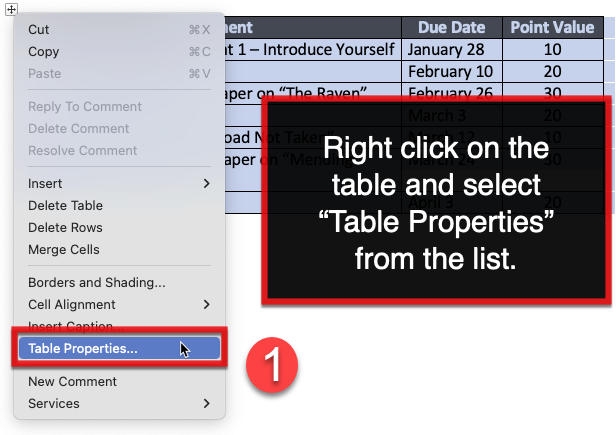
Add an alternative description to the table by right clicking anywhere inside the table and selecting the “Table Properties” option from the listing.
-
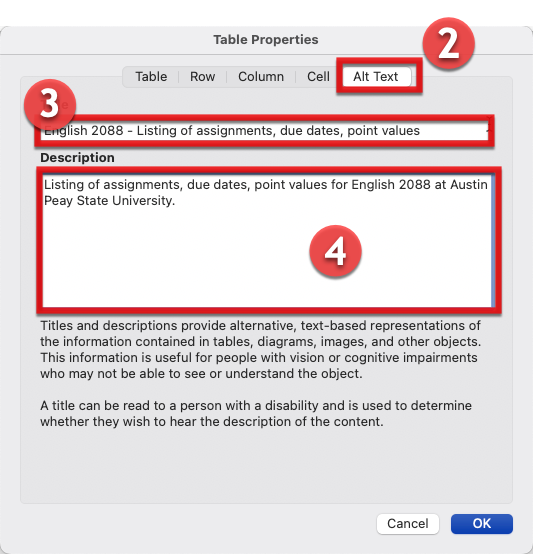
Locate and select the “Alt Text” tag from the main ribbon.
-
Give the table a title in the “Title” field.
-
Provide a brief description about the table in the “Description” field, making sure the full context of the table is supplied.
-
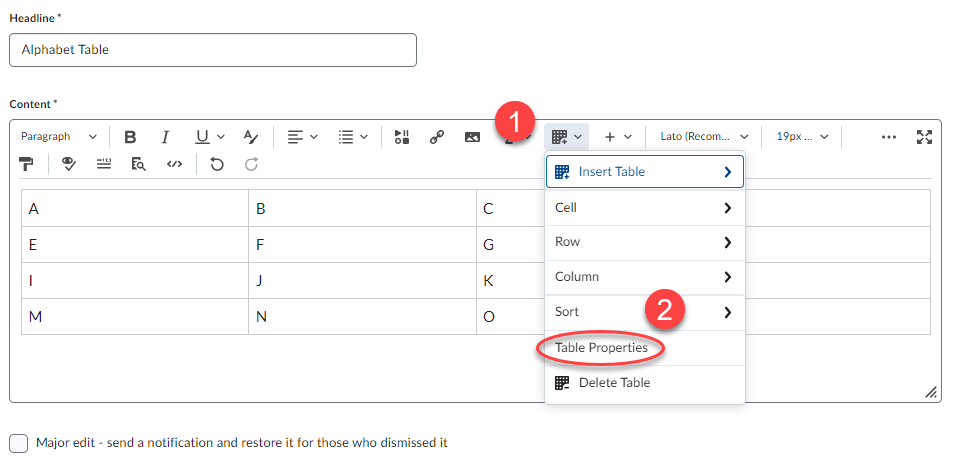
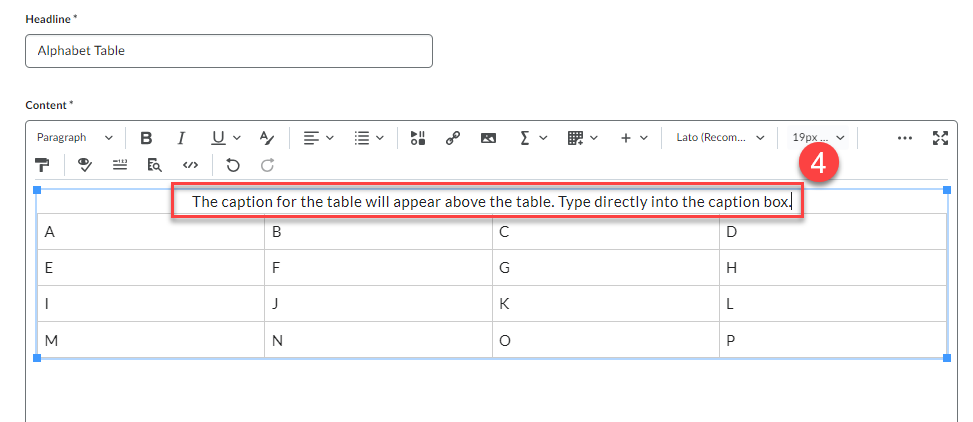
Click on the desired table and then the table icon in the nav bar.
-
Select "Table Properties" from the drop down menu.
-
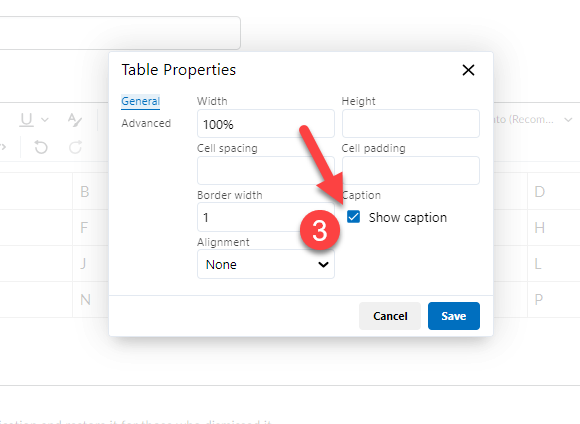
Make sure the "Show caption" box is checked.
-
Type the alternative text directly into the caption text box of the table.
You will want to make sure that you are repeating your table headers in the event that you have a table that spills from one page to the next. To do this:
-
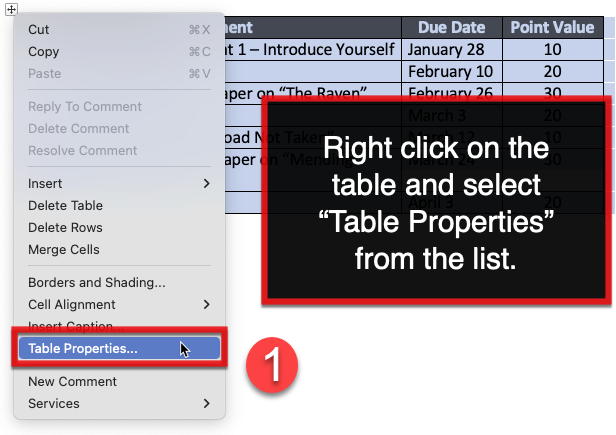
Right click anywhere inside the table & select “Table Properties” from the list of options.
-
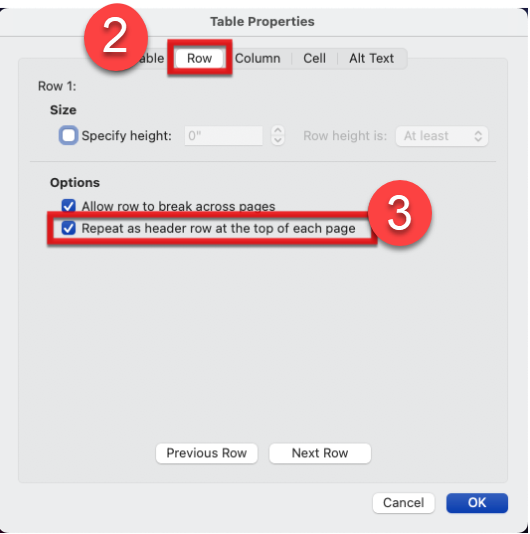
Locate and select the “Row” tab from the menu ribbon.
-
Under the “Options,” check the box to the left of “Repeat as header row at the top of each page.”
Captions and Table Summaries
Both captions and table summaries help provide important context for users, but they serve different purposes and are used in different ways.
Captions
-
Displayed visibly above or below the table.
-
Provide a brief, descriptive title that tells all users what the table is about.
-
Help both sighted and non-sighted users quickly identify the table’s purpose or topic.
Example: “Table 1. Assignment Due Dates and Point Values.”
Summaries
-
Typically hidden from view and used primarily by screen readers.
-
Offer a more detailed explanation of how the data is organized, how to interpret it, or any patterns or relationships it shows.
-
Especially useful for complex tables where visual layout alone may not convey meaning.
Example: “This table lists all graded assignments in chronological order, showing due dates and their corresponding point values.”
When to Use Captions and Summaries in Different Systems
Microsoft Word
-
-
Captions can be added through the References tab using “Insert Caption.” They appear visibly and help label tables clearly (for example, “Table 1. Course Schedule and Assignments”).
-
Microsoft Word does not have a separate field for table summaries. If more context is needed, include it in the Alt Text “Description” field so screen readers can provide users with the same information.
-
D2L Brightspace
-
-
Captions are available under Table Properties. Check the “Show Caption” box and add a short label that summarizes what the table contains.
-
D2L does not offer a summary field. When additional explanation is needed, include it in the Alt Text “Description” box or in the surrounding page text.
-
Tips & Tricks:
-
Use tables only for displaying data, not for layout or design purposes.
-
Include appropriate headers, captions, and summaries to provide context and improve navigation for screen reader users.
-
Avoid merged or split cells that can disrupt the logical reading order.
-
Avoid leaving cells blank whenever possible, as empty cells may confuse users with visual impairments and suggest missing information.
-
Do not use screenshots or images of tables, since screen readers cannot interpret the content in an image format.
Create Accessible Tables in Word Video - In this tutorial, learn how to build tables in Microsoft Word that are fully accessible and screen-reader friendly.
WebAIM Accessible Tables Website - Practical guidance with examples of headers, captions, and summary text for data tables.
W3C WAI Tables Tutorial - Official W3C tutorial explaining how to structure headers, captions, and simple tables for accessibility.