


Institute for National Security
and Military Studies Speaker Series
Upcoming Sessions
Rogue Allies: The Strategic Partnership between Iran and North Korea
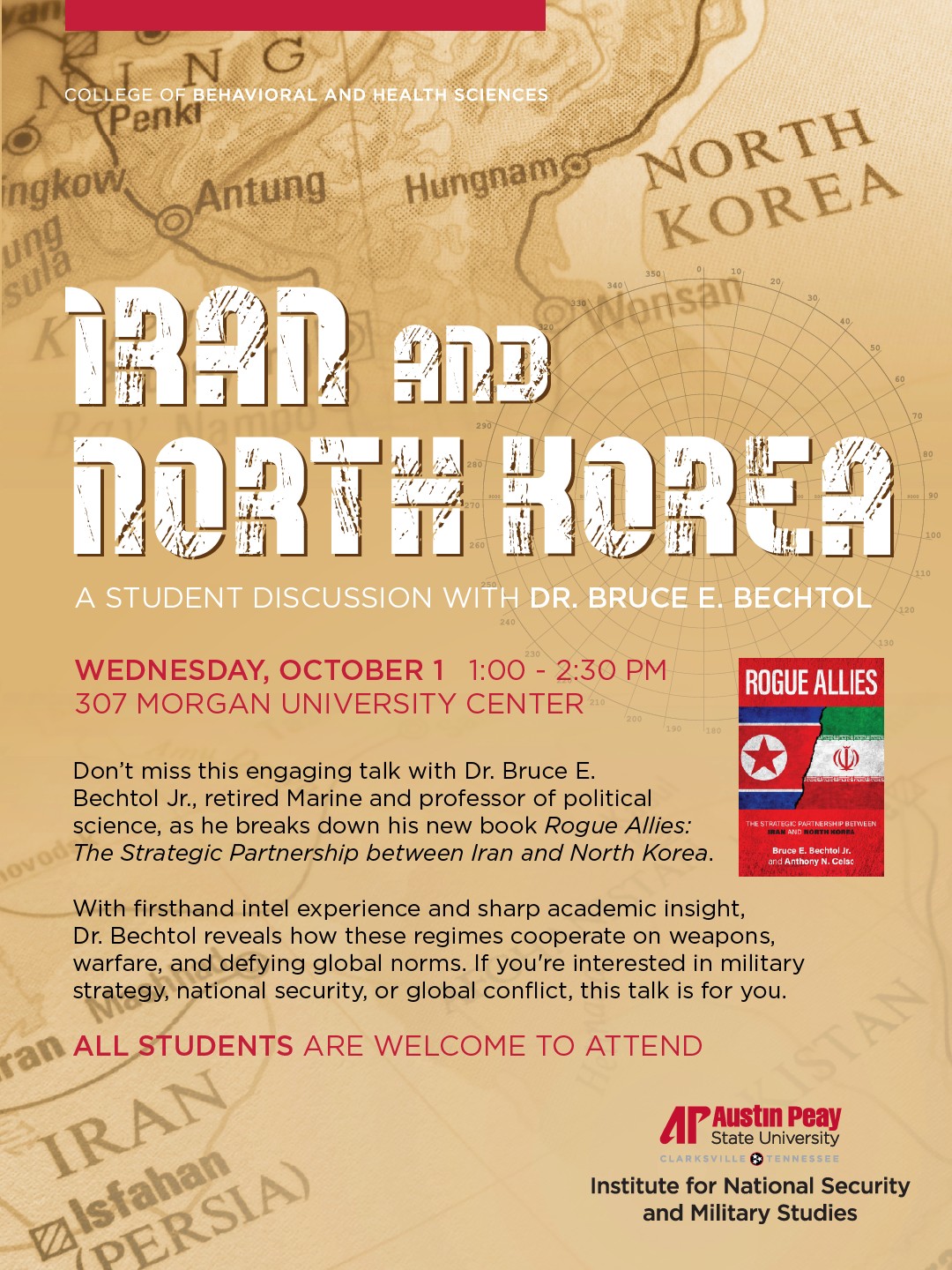
October 1, 2025
1:00-2:30 P.M.
MUC - 307
Dr. Bruce E. Bechtol Jr.
Are you interested in learning more about the partnership between North Korea and Iran? Join us for firsthand intelligence experience and academic insight on how these two competitors cooperate on warfare, arms deals and security cooperation against the West.
Dr. Bruce E. Bechtol Jr. is a former Intelligence Officer in the United States Marine Corps and a current Professor of Political Science in the Department of Security Studies and Criminal Justice at Angelo State University in San Angelo, Texas. Dr. Bechtol is widely recognized for his research on North Korea's role in developing Iran's military capabilities, including ballistic missiles and hardened underground facilities.
Following the lecture on campus, the Institute for National Security and Military Studies and the College of Behavioral and Health Sciences will co-host a Discussion with Dr. Bruce E. Bechtol Jr. at Old Glory Distillery in Clarksville from 5 - 7pm. This event is open to the public.
RSVP Form
Event Parking
Please contact our office at mifsudr@apsu.edu or at 931-221-1492 if you need assistance prior to the event.
Previous Sessions
- Topic: Transition Training: How National Security Professionals can Cultivate Professional and Personal Resiliency in New Roles and Environments.
- Speaker: Dr. Kelsey Larsen
- Topic: The FBI: One Agent' Story
- Speaker: Patrick Hayes
- Topic: The US Civil-Military Relationship
- Speaker: Major General William J. Walker
- Topic: A State in Disguise of a Merchant: Tech Companies and the Reconfiguration of Geopolitics.
- Speaker: Dr. Treston Wheat
-
Topic: Cyber Resiliency: In Pursuit of Practical National Security Strategy
-
Speaker: Commander Matt Caylor
-
Topic: The US-China-Russia Great Power Competition
- Watch the Recording Here!
“Conventional rhetoric has described the current global landscape as a strategic competition
between three “great powers”. What has developed is something quite different. There
is no question that these three nations are interacting in ways that will determine
the future shape of the global security, economic and information architecture. The
question is, are they all “great” and if so, why? To fully understand this, we must
move “beyond the rhetoric” in our discussion of great power competition.”
- General Hooper