STANDARD 6.0 PROGRAM RESOURCES
6.1.1 The institution provides adequate financial support to the program so that it can achieve its stated mission and goals.
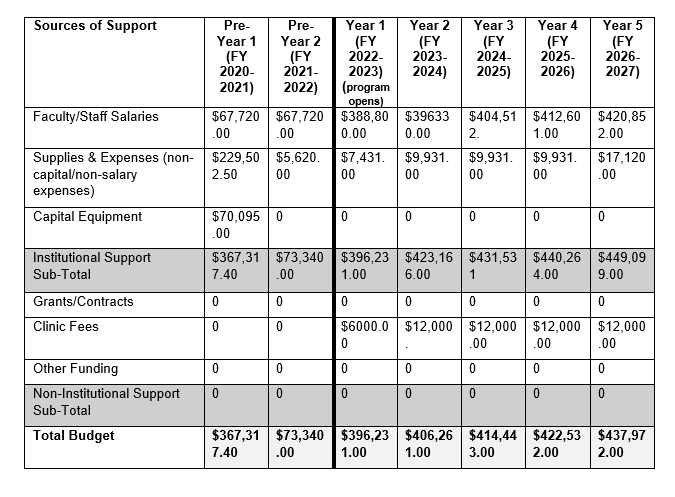
6.1.2 Report the main sources and amounts of support for all components (i.e., residential, distance education, satellite) of the program, as applicable, in the first academic year.
The following table was sent the CAA on June 29, 2021. The request for the expanded budget table was for a seven-year period. The table shows sources of support for all components of the program.
***6.1.2 Report the main sources and amounts of support for all components (i.e., residential, distance education, satellite) of the program, as applicable to reflect financial information for 7 years. The data should include information for 2 planning years prior to the program opening (i.e. during the CAA’s review) and the first 5 years of the program.
 6.1.3 Indicators of institutional commitment to the accredited program
Evidence and narrative to augment information presented in the Official Application on pp.123.
APSU has shown a financial commitment to the development of the Master of Speech-Language Pathology (MSLP) Program beginning in 2018 when it commissioned a feasibility study to determine the need for undergraduate and graduate programs in the discipline. Based on these findings a faculty line was funded 2018 to launch an undergraduate concentration in Communication Sciences and Disorders to serve as a feeder program for the MSLP.
The faculty member salary allocation included release time to lead the development of the MSLP Program which included participation in a rigorous self-study and external review by the Tennessee Higher Education Commission (THEC) and application process to the Southern Association of Colleges and Schools Commission on Colleges (SACSCOC). Both THEC and SACSCOC required the University to submit a 5-year projection of budget information as part of the approval processes. The state approval process was initiated in January 2019 with final approval in May of 2020.
- Support for professional development
- Internal opportunities for professional development through the university
- Academic Affairs provides a number of workshops and meetings to support programs and effective learning each fall before the start of term, presemester calendar: https://www.apsu.edu/academic-affairs/faculty/
- Distance education provides a myriad of resources for faculty in a number of formats to enhance teaching and learning: https://www.apsu.edu/online/faculty/
- Each academic each faculty member is allocated $1,000.00 for conference participation/presentation and have the opportunity to apply for another $1,000.00 grants through the Office of Distance Education
- Faculty are provided release time for professional development “Institutional Leave” for conference participation
- Internal opportunities for professional development through the university
- New faculty lines: Although no graduate students will be enrolled until the academic
year 2022-2023, contingent on an award of Candidacy Status, the university has funded
a new doctoral faculty line dedicated to the MSLP program in each of the pre-program
years (AY-2020-201 & AY 2021-2022). This brings the faculty composition to three fully
funded lines for doctorally prepared faculty to deliver the didactic and clinical
components of the program.
- AY 2018-2019 New faculty line funded for HHP to hire doctorally prepared faculty to serve the MSLP program
- AY 2020-2021 New faculty line funded for HHP to hire doctorally prepared faculty to serve the MSLP program
- AY 2021-2022 New faculty line funded for HHP to hire doctorally prepared faculty to serve the MSLP program
- New staff lines
- AY 2022-2023 New faculty line funded for HHP to hire master’s prepared or clinical doctorate prepared faculty (Clinical Assistant Professor) to serve the MSLP program as the Clinical Education Coordinator
- New facilities
- The MSLP program has been assigned to move into the new Health Professions Building upon completion
- Additional space
- The Space Allocation Committee approved additional office space for HHP to accommodate the faculty needs of the MSLP program. The office space is in the Marion Street Apartment Building on the second level above the APSU Speech-Language and Swallowing Community Clinic.
- Provost Cronley allocated $70,095.00 to renovate the Marion Street Apartment Space for the APSU Speech-Language and Swallowing Community Clinic.
- APSU continues to provide adequate financial support to develop the MSLP program in a way that supports the program mission. Through advocacy efforts by the Dean of the College of Behavioral and Health Sciences, in March of 2021, Provost Conley allocated $221,500.00 to the MSLP program for the purchase of materials and equipment for clinical education and service delivery.
|
Video observation and recording equipment and software |
$50,502.00 |
|
MSLP furniture and storage |
$5,000.00 |
|
Swallowing |
$70,000.00 |
|
Speech sound production/fluency/voice and resonance |
$24,500.00 |
|
Language and social aspects of communication |
$6,500.00 |
|
Cognition |
$30,000.00 |
|
Augmentative and alternative communication |
$30,000.00 |
|
Supplemental treatment materials |
$5,000.00 |
|
|
$221,502.00 |
- *Full funded equipment requests by Provost Cronley through advocacy of Dean Brown
- Student support
- The Health and Human Performance Department funded a full time Graduate Assistant assigned to the Program Director of the MSLP program for the 2021-2022 and 2022-2021 Academic Years. An HHP undergraduate who completed the Communication Sciences and Disorders Concentration was hired for the 2021-2022 AY.
Additional support to ensure the clinical education component of the program would have financial support for sustainability was completed when in March 2021 the APSU Board of Trustees approved a proposed $150.00 per student per semester fee for students who will enroll in the MSLP program. This
Physical Facilities
6.3 The program has adequate physical facilities (classrooms, offices, clinical space, and research laboratories) that are accessible, appropriate, safe, and sufficient to achieve the program’s mission and goals.
Evidence: Marion Street Apartment Space Renovation
Program Equipment and Materials
6.4 The program’s equipment and educational and clinical materials are appropriate and sufficient to achieve the program’s mission and goals.
6.4.1 Describe the processes the program uses to evaluate the quantity, quality, currency, and accessibility of the program’s materials and equipment to determine whether these processes are sufficient to meet the mission and goals of the program.
Evidence: Equipment Inventory
6.4.2 Describe the mechanisms that the program will use to determine whether the equipment is in good working order and, where appropriate, whether the equipment meets standards established by the American National Standards Institute (ANSI) or other standards-setting bodies.
Evidence: Audiometer Calibration