APSU Eriksson College of Education expands doctoral program
CLARKSVILLE, Tenn. – The Austin Peay State University Eriksson College of Education’s doctoral program is expanding with two new concentrations. The concentrations, socioscientific studies and literacy studies, will be available for new and current students enrolled in the Doctor of Education (Ed.D.) degree.
“These new concentrations are an important addition to our program offerings,” Dr. Prentice Chandler, dean of the Eriksson College of Education, said. “These concentrations allow us to distinguish our Ed.D. program as a leading program of choice for teachers interested in exploring the intersection of educational research and real-world application.”
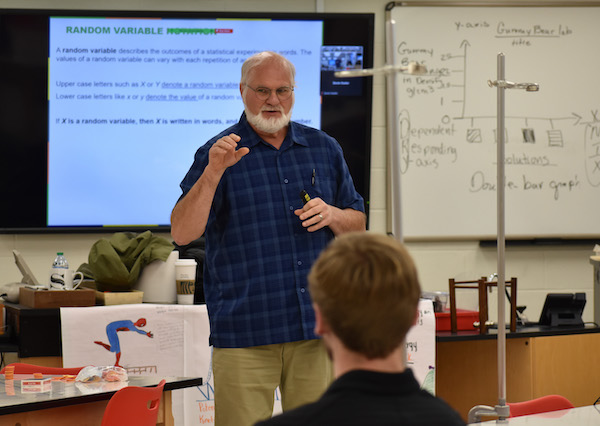
Socioscientific studies focus on scientific topics that envelope broader issues in society, such as impacts from climate change, genetic testing, environmental justice and equity in health care. Dr. Philip Short, associate professor, said socioscientific studies represents a growing need in science education, and it opens the field to a more diverse group of students.
“We’re wanting to make science more relevant for students’ own lives and communities and the world at large,” Short said. “It’s a science education leadership program, but with a big nod to all those social factors that have to be taken into consideration.”
Teachers and others with a background or interest in science are encouraged to explore this new concentration. Socioscientific studies affords opportunities to conduct research that will enhance one’s preparation for leadership, scholarly work and effective teaching in elementary, secondary and postsecondary institutions, as well as other corporate, nonprofit and government careers (e.g., environmental education, museums, zoo education, etc.). Short encourages those interested in research and exploring the “intersection between what is known and what is yet to be learned” to apply.
“Those who are interested in the connections between scientific findings and societal good as a whole would be a good candidate,” Short said.
Literacy studies allows Ed.D. candidates the opportunity to apply prominent literacy and educational theories to current problems of practice. The degree prepares graduates to work successfully in various K-12 and postsecondary settings, as well as government agencies and nonprofits. Graduates can use this knowledge in roles as reading specialists, adult education or English as a Second Language instructors, departmental administrators, etc.
“This degree prepares individuals to draw on educational theory and research elevated with practical case study vignettes,” Dr. Benita Bruster, APSU professor of education, said. “Candidates will collaborate with colleagues and faculty to address the pressing literacy crisis facing teachers in today’s classrooms.”
Austin Peay’s first doctoral program prepares students to excel in public and private education settings. The program is 60 credit hours, with a focus on leadership theory and practice, organizational and educational policy analysis, data-driven decision making and dissertation research. Interested candidates are encouraged to apply now.
Dr. Andrea Lee, assistant professor, notes the “personalized attention” available to APSU Ed.D. students, with full-time faculty members providing instruction and support.
“You’re going to have more of that one-on-one connection with your professor,” Lee said.
In addition to the new concentrations, existing offerings in the doctoral program include a focus in K-12 leadership, higher education administration or nurse educator.
For more information about program requirements or to apply, visit www.apsu.edu/grad-studies/graduateprograms/EdD.php. For more information about APSU’s Eriksson College of Education, visit www.apsu.edu/education.
News Feed
View All News
Austin Peay State University's Full Spectrum Learning program celebrates its 10th anniversary with Autism Awareness Week events April 13-18. Free and open to the public, the week features workshops, a student showcase, a forum, and an anniversary celebration honoring a decade of supporting neurodiverse students.
Read More
The 268-page book, "Teaching Labor History in the United States, 1850-2020," brings together scholars and educators to address what Attwood identifies as a significant gap in secondary education: the marginalization of labor history in standard social studies curricula for grades 6-12.
Read More
McConnell, a former secondary science teacher, has served the Eriksson College of Education in multiple leadership roles, most recently as interim dean. He previously served as associate dean of assessment and accreditation, chair of the Department of Educational Specialties, and professor of educational research.
Read More