


Say Yes to Recess: APSU community sparks national movement after state legislature extends recess time
By: Ethan Steinquest September 29, 2025
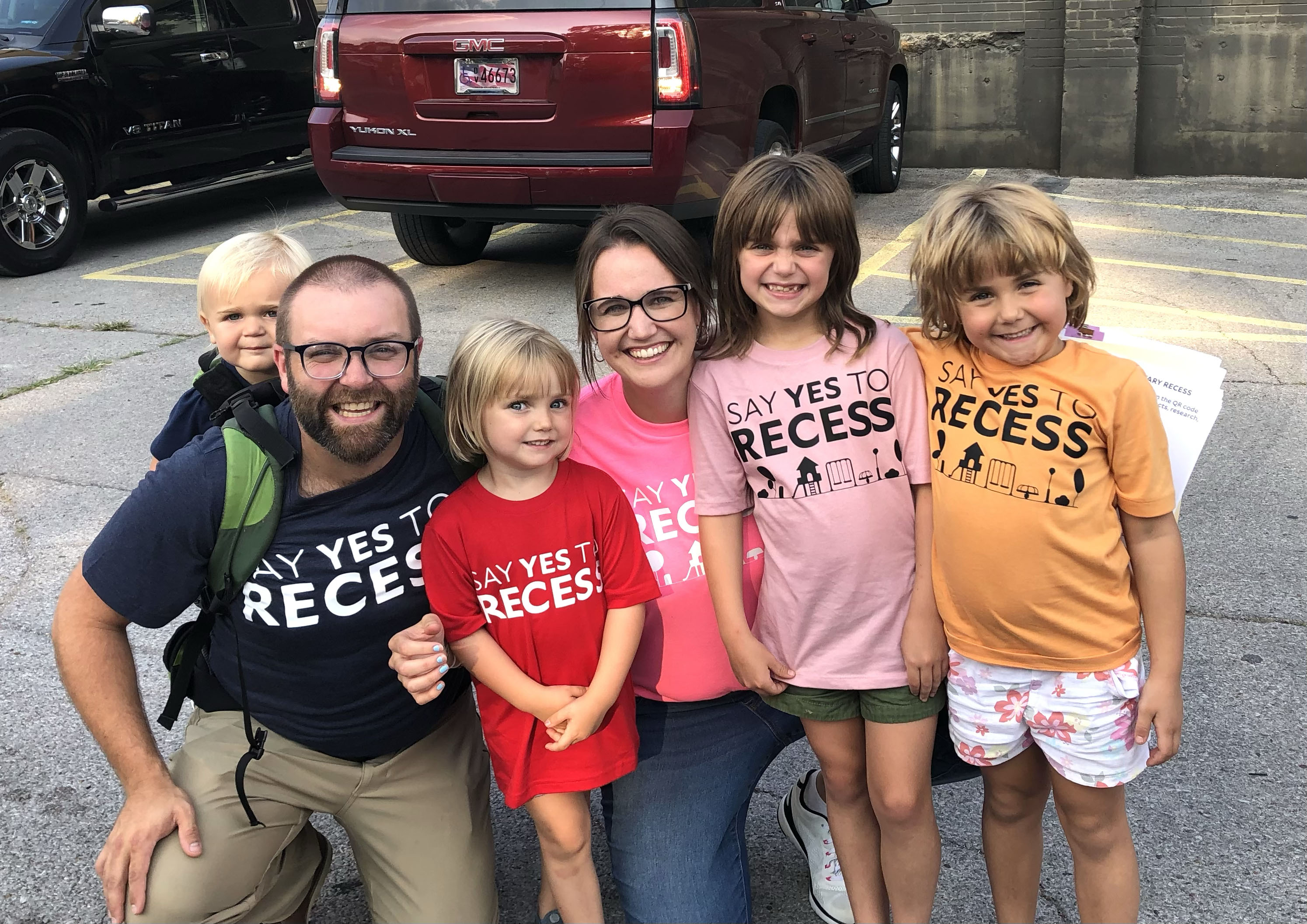
Rachel Bush, a graphic design professor at Austin Peay State University and one of the cofounders of Say Yes to Recess, with her family. | Contributed photo
CLARKSVILLE, Tenn. - What started as a mother’s concern about her anxious kindergartener has become a nationwide movement that increased recess time for Tennessee’s elementary schoolers from 15 to 40 minutes per day - with parents working toward the same outcome in a growing number of states.
Rachel Bush, a graphic design professor at Austin Peay State University, collaborated with Clarksville mothers Morgan Garner and Kathryn Truman to create Say Yes to Recess, a nonprofit advocating for more recess time in schools.
Their efforts led to one of the most significant changes to Tennessee’s elementary education requirements in recent years. Now, the group is building chapters across the U.S., championing recess in grades 6-12, and working to fund playground equipment for low-income schools.
“I feel like we’ve become a voice for a very large group of people,” Bush said. “We’ve seen this work resonating across the country because people are realizing how important recess is, and it’s needed now more than ever after COVID.”
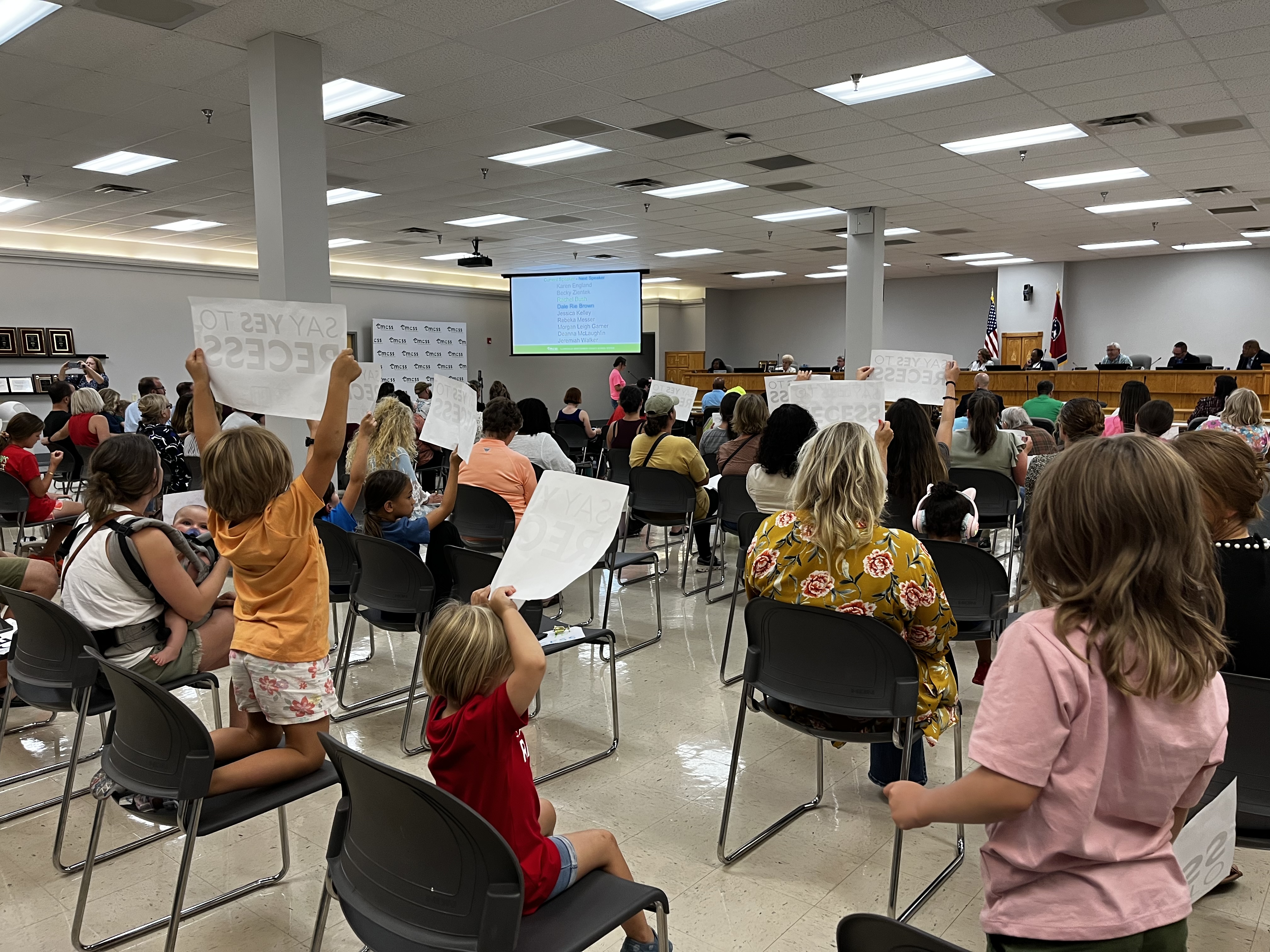
Community members show their support for Say Yes to Recess at a Clarksville-Montgomery County Schools (CMCSS) School Board meeting. | Contributed photo
Starting a movement
Like many parents, Bush’s advocacy began when she noticed her daughter acting differently.
“My daughter is a very anxious kid, and when she gets overwhelmed or nervous she goes outside,” Bush said. “I realized something was wrong when she started kindergarten three years ago and came home more nervous than when she left. I thought they were going outside multiple times a day, but she let me know they weren’t.”
From there, she connected with mothers like Garner and Truman through social media and realized there were children struggling across the district.
“As a mom of four boys, my kids were my biggest inspiration,” said Truman, whose children often came home from school filled with restless energy. “I felt like the school day was not formulated with basic child development in mind. The long instructional blocks paired with only 15 minutes of recess was very eye-opening to me.”
The group soon met with school administrators and gathered grassroots support through social media, eventually going before the Clarksville-Montgomery County Schools (CMCSS) School Board in September 2023.
After securing 30 minutes of daily recess at the county level, Bush and her team set their sights on the state legislature, establishing Say Yes to Recess as a nonprofit to advocate for more recess time.
“Realizing that no one was actively pursuing advocacy really drove me to push for legislative change,” Garner said. “Experts in childhood development have been emphasizing for decades the importance and benefits of free play during school. They needed the community to get behind them and spread the word - and that’s exactly what we did.”
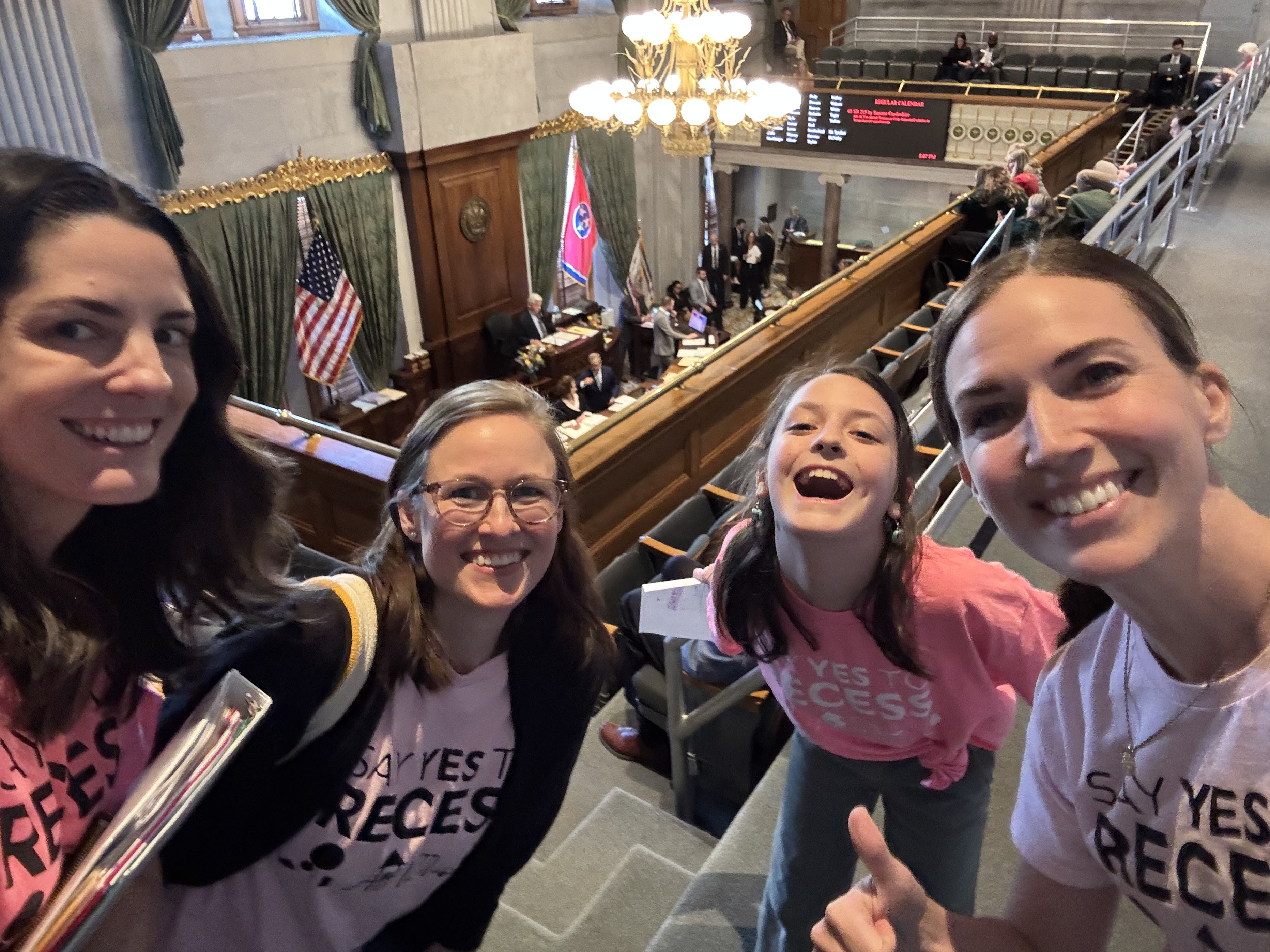
Members of Tennessee’s Say Yes to Recess chapter at the State Capitol. The organization attended several legislative hearings to advocate for increased recess time in schools. | Contributed photo
Building a case for change
The APSU community played a critical role in supporting the initiative. Dr. Jodi Carrier, the district lead social studies teacher for Middle College at APSU, helped connect Bush with faculty from the Eriksson College of Education (CoE) who wanted to assist.
“Rachel and I have children who have been in school together since kindergarten, so we have seen firsthand the struggles that our children have faced,” said Carrier, who worked as a graduate assistant for CoE while earning her doctorate. “I was able to connect her with Dr. Donna Short, [an associate professor in the Department of Teaching and Learning], and they worked with the current dean, Dr. John McConnell, to arrange a presentation for faculty.”
Several professors gathered dozens of academic articles on the benefits of increased recess time, which Bush used as evidence during legislative hearings.
“Play nurtures essential soft skills such as cooperation, communication, and conflict resolution, while also enhancing cognitive growth through imagination and critical thinking,” Short said. “These skills directly benefit subjects like art, where creativity and self-expression thrive, as well as math and science, which require problem-solving, experimentation, and analytical thinking.”
Dr. Eve Rice, the director of APSU’s School of Nursing, also championed the cause, noting that her experience as a parent was similar to what Bush and others saw with their children.
“During my college sons’ time in grade school, they did not receive enough physical activity through physical education classes that only met a few times a week,” Rice said. “They also had very little recess time each day to expend their built-up energy … This bothered me as a parent because I knew my sons were not meant to sit still at a desk for hours.”
As a mother who witnessed these challenges firsthand and a nursing professional familiar with the research, Rice knew the nonprofit could make a lasting impact across Tennessee.
“Parents and educators can feel confident that regular recess has a big impact on students’ success,” she said. “Kids who stay active often do better in school - they earn higher grades, attend more regularly, and show stronger focus and behavior in the classroom. Recess gives children a chance to recharge so they come back ready to learn.”
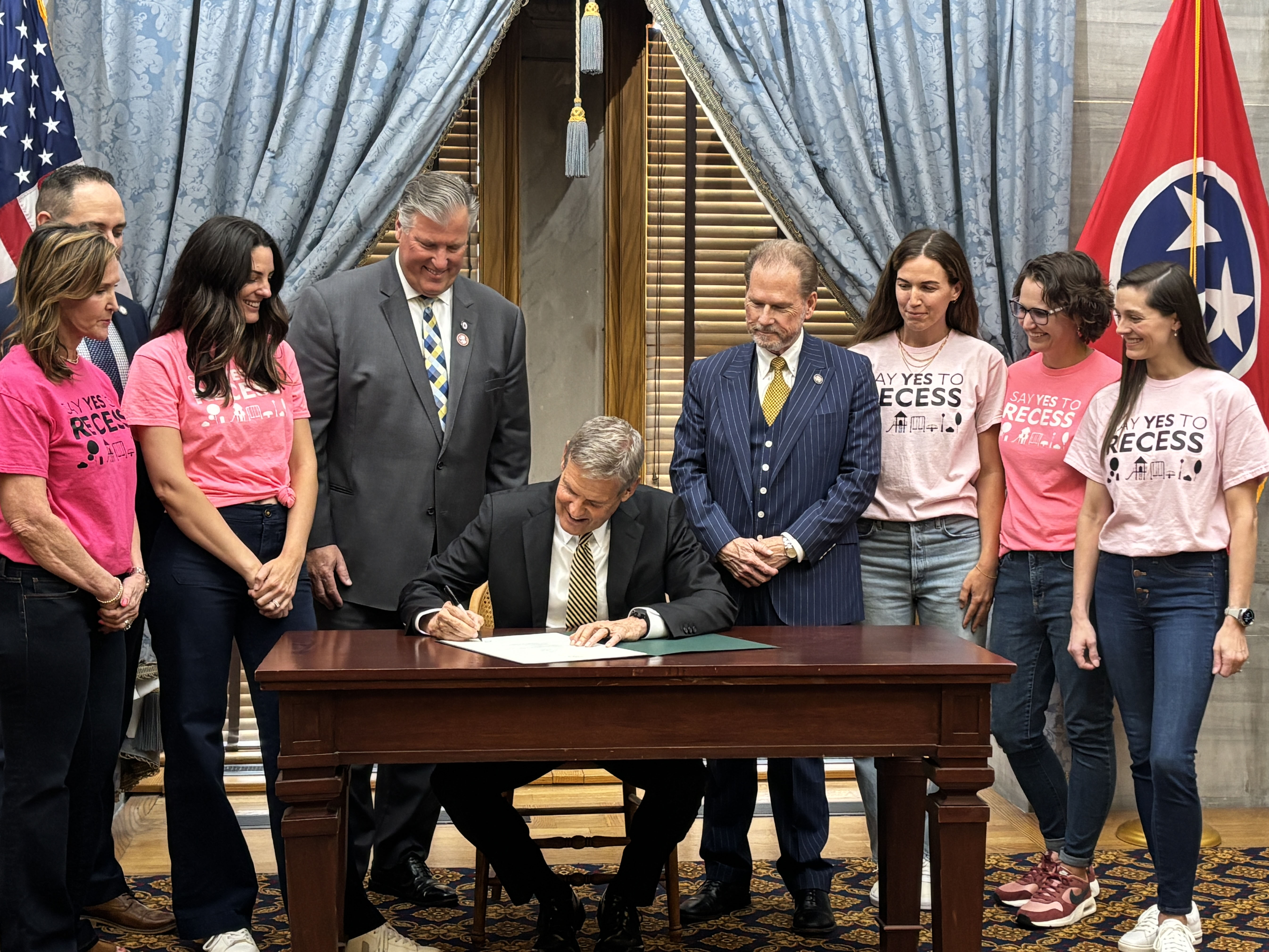
Gov. Bill Lee signs a piece of legislation requiring 40 minutes of daily recess time in Tennessee’s elementary schools. | Contributed photo
Seeing the results
That message connected with legislators, and the bill passed through the state House and Senate with nearly unanimous support. Bush noted that hundreds of parents contacted their representatives to advocate for the bill, highlighting its importance to communities statewide.
“We were extremely proud to lead the way with this legislation in Tennessee, but our work is just getting started,” Truman said. “The fact that this resonated with so many parents across the country is proving that this is an overdue change. The decline in recess time over the past few decades has had detrimental effects and we hope to change this one state at a time.”
Say Yes to Recess has since added several chapters in other states and partnered with Activ8, a Canadian company, to provide recess equipment boxes to low-income schools.
“These boxes have everything from jump ropes to pickleball paddles, and an AI app that will help you come up with games,” Bush said. “Let’s say I have four soccer balls, I’m inside because it’s raining, I have three kids, and 16 feet of space. It will generate a game to play based on that.”
Several local businesses have already sponsored Activ8 donations to CMCSS, adding to the benefits parents are seeing from the increased recess time.
“Last year, my son cried about going to school every day,” Garner said. “He complained that all they did was ‘work, work, work.’ This year, not only did our principal seamlessly incorporate 40 minutes of recess, but she also hired a new PE teacher - so now the kids have PE three days a week. My son is excited to go to school this year. He comes home much calmer, and I can tell he feels more regulated throughout the day.”
Bush said the organization is hearing similar messages from parents across Tennessee, and their success is inspiring advocates nationwide.
“We were just on The 1000 Hours Outside Podcast, a major health podcast with over 12 million downloads,” Bush said. “Since then, we’ve gotten a lot more attention, and over 10 more states have reached out about starting chapters.”
Say Yes to Recess also received the Friend of Children Award from the Tennessee Chapter of the American Academy of Pediatrics in August, and the organization plans to continue advocating for recess in middle and high schools while helping implement quality programs.
Looking to the future
“We don’t just want 40 minutes of recess - we want to systematically change the game,” Bush said. “We’re already having phone calls and meetings about middle school recess, and we want to apply for grants for new playground equipment and help our schools however we can.”
Long-term, the nonprofit hopes to see a positive impact on test scores, childhood obesity, and mental health as students spend more time on physical activity.
“It is no secret that we are experiencing a mental health epidemic in America,” Carrier said. “I see firsthand the emotional struggles that high school students go through, and I firmly believe that this can be mitigated if students are given more opportunities to move, interact, and learn to socialize with each other at a younger age and throughout their education … it is our responsibility to create a healthy, educational environment for our children so that they don’t spend their whole lives chasing the childhood they were denied.”
For educators like Short, the benefits of increased recess time extend far beyond the playground, especially when backed by public involvement.
“Parents and communities can support extended recess by advocating for policies that prioritize outdoor play, volunteering to supervise or organize activities, and promoting outdoor participation beyond school hours,” Short said. “Ultimately, extended recess contributes to improved physical health, social and emotional skills, cognitive development, and increased motivation for lifelong learning, making it a crucial investment in students’ holistic development.”
How to get involved
Those looking to support Say Yes to Recess can contact the organization through Facebook, Instagram, or sayyesstorecesstn@gmail.com.
“We are just getting started,” Truman said. “Our state chapters are working hard to pass strong recess legislation, and we love supporting their operations because of all the children this could positively impact. Beyond that, we hope to support schools in implementing legislation where things like logistics and supply come into play. Now that we are increasing access and the time children can play, we hope to increase the quality of play as well.”