


Austin Peay State University Strategic Plan Progress Report
Austin Peay State University's strategic plan is built on four foundational pillars that guide our mission to serve students, faculty, staff, and the broader community. This progress report highlights our achievements and ongoing initiatives across each pillar, demonstrating our commitment to excellence in education, student success, employee development, and community engagement. Each pillar represents a critical area of focus as we work toward our vision of being a premier regional university.
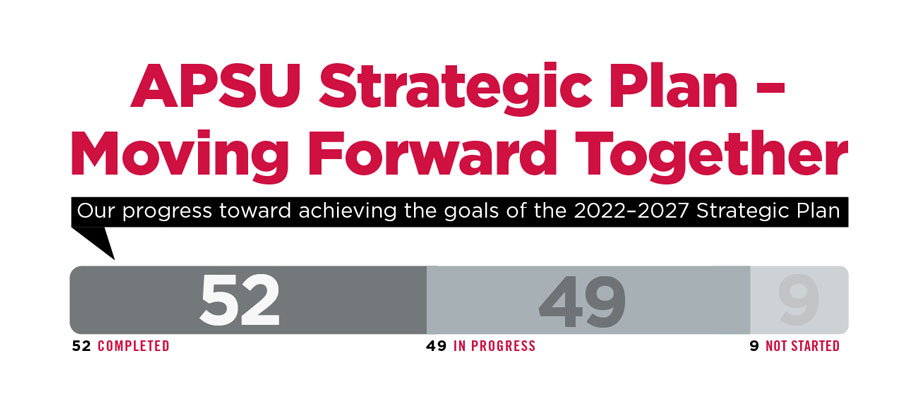
Goal Progress:
-
52 Goals Completed
-
49 Goals In Progress
-
9 Goals Not Started
Pillar 1: The Academic Experience
Champion: Provost and Vice President of Academic Affairs Dr. Mitch Cordova
Pillar 1 emphasizes a student-centered academic experience by advancing teaching excellence, fostering creative scholarship, and meeting workforce and community needs.
Goal 1: Premier Regional University Excellence
Progress Toward Goals
-
Adjunct Faculty Training: We have successfully developed and implemented both in-person and online training sessions through CAFE, which are now required annually for all incoming adjuncts.
-
Faculty Engagement in Distance Education: The capacity to meet demand for faculty engagement is in place, with all faculty who teach online now engaged in some way with the distance education office. The ongoing goal is to continue improving the quality of these engagements.
-
Faculty Leadership and Mentorship: The Faculty Leadership Program has been redesigned, and CAFE has improved the new faculty mentorship program at both institutional and college levels. Outside speakers have been incorporated into the budget, with a committee selecting speakers annually, and colleges also developing their own speaker series.
-
Faculty Development Funds Investment: New funds have been allocated to the Colleges to support faculty development for the 2025-2026 AY. Specifically, each faculty member has been allocated $1,500 towards their professional development. Moreover, the professional development funds use guidelines have been updated to reflect that faculty can use these funds in a myriad of ways (e.g. travel, conferences, webinars, supplies, etc.) where funds are not solely restricted to professional travel.
Goal 2: Academic Program Evolution
Progress Toward Goals
-
Quality Enhancement Plan (QEP): The new QEP, Peay Composed, completed its first full implementation year supporting students' writing outcomes, metacognition, and help-seeking behavior through targeted faculty development and student engagement. Twenty-five Peay Composed course sections were taught in 2024-25 with 483 students enrolled. In addition, 20 faculty participated in the Peay Composed Faculty Community of Practice to prepare for teaching a future Peay Composed course. The QEP also held its first two student engagement events in the Woodward Library.
-
Curricular Alignment: Curriculum maps submitted by degree programs were reviewed and used to inform a new university process for degree program assessment launching in August 2025. In the new process, programs will align outcomes and curriculum with university-level learning categories and career competencies to support alignment across disciplines. Seven academic programs were reviewed by external reviewers in 2024-25, including evaluation of curricular alignment. Five programs received were rated excellent, and two programs were rated good on the curricular alignment criterion.
-
IE Redesign for Academic Programs: The Office of Institutional Effectiveness, Assessment, and Research redesigned the IE process for degree and certificate programs, empowering assessment coordinators to ensure quality in ways most aligned with their academic areas. This includes aligning our IE efforts with external professional accreditors, where applicable.
Goal 3: Institutional Infrastructure Optimization
Progress Toward Goals
-
Curriculum Audit & CourseDog: The curriculum audit is complete, and we are developing procedures with CourseDog, which was purchased and will be fully in Fall 2025. This is expected to improve in-seat options for student demand, better utilize instructional and non-instructional spaces on campus, and better organize our course offerings through the catalog.
-
Records & Registration Technology: The Office of the Registrar has implemented Parchment, the leading credential issuing platform in higher education for issuing diplomas, transcript requests, and evaluating transfer credit for students. This has been a huge technological advance for this office as we are saving hundreds of people-power hours in handling these services.
-
Graduate Assistant Stipends: An increase in graduate assistant stipends was afforded through GA reallocation.
-
Strategic Enrollment Management (SEM): The SEM plan is in full implementation, having achieved many objectives, particularly concerning enrollment. We are also implementing several enhancements in curriculum, testing, communication, and student alerts to support retention, persistence, and graduation rates.
-
Academic Space Transition: The Health Professions Building will open for classes in Fall 2025. Faculty and staff are moving in phases to their office, and they are also ensuring the specialized laboratories are fully functioning by the start of fall classes. Many other academic departments and other academic support areas will be transitioning into other buildings throughout the Summer and Fall 2025 term as a result of the HPB receiving occupancy.
Pillar 2: Student Success and Well-being
Champions: Provost and Vice President of Academic Affairs Dr. Mitch Cordova and Vice President for Student Affairs Dr. Leonard Clemons
Pillar 2 highlights our commitment to fostering a supportive and engaging environment that promotes student well-being and academic achievement.
Goal 1: Student Support and Engagement
Progress Toward Goals
-
New community engagement and sustainability center: Fundraising and development efforts have launched to begin funding the project. A space has been secured, and donor engagement is underway.
-
Wellbeing: The Peayple's Wellbeing task force was launched to collaboratively evaluate the university's health and wellbeing efforts, benchmark across comparable institutions, and develop recommendations for initiatives to implement a campus-wide strategy to improve the health and wellbeing of students.
-
Disability Services: The Student Disability Resource Center has been reimagined and relaunched as the Office of Student Access Services to serve as a transformed, and centralized, campus hub for success of students with disabilities as we improve faculty/staff resource support, modernize practices of student services offered, develop programmatic efforts of engagement, and increase the sense of belonging for students with disabilities. This relaunch includes a new organization structure, college-aligned accommodation services, and department rebranding.
-
Early Arrival Program: The Govs Success Institute, a new residential early arrival program, has been developed to offer a preview of academic success, foster connections, and build a sense of belonging for first-time, full-time students with a high school GPA below 3.0 residing on campus.
-
Student Success Coaches: Student Success Coaches are available for all students through their second year, with specialized resources for first-generation and/or financially resourced students. While their primary offices are in McReynolds, coaches are accessible at various campus locations (e.g., library, academic colleges, cafeteria) for one to two days per week, ensuring students receive dozens of "touches" each term. However, a dedicated student success location/center does not exist.
Goal 2: Student Life and Engagement
Progress Toward Goals
-
New Clubs: The Govs Hockey Sport Club was launched and completed its inaugural season in 2024-25, securing sponsors and season ticketholders, and hosting hockey camps.
-
Engagement Platform: Govs Connect, a new platform for badging and centralized engagement opportunities, has been launched. This platform is helping provide data on student engagement and identify non-engaging populations.
-
Living-Learning Communities (LLCs): A new LLC Advisory Committee has chosen five LLCs for the 2025-26 academic year. New guidelines for LLCs at APSU have been established based on research, and a new submission process and advisory council were launched in Fall 2024.
-
Student Organization Experience: New student organization tiers, Greek Pillars of Excellence, and The Govs Guide (Student Organization Manual) implemented to create accountability, motivation, and guidance for thriving student organizations. This is coupled with the relaunch of FLEX, the fall leadership experience conference, to develop student leaders.
-
Engagement Outcomes: The Division of Student Affairs has implemented PERMA, rooted in positive psychology, as its theoretical framework to develop student learning outcomes for engagement and programming. This is being implemented in departments across the division.
Goal 3: Retention, Persistence, and Career Success
Progress Toward Goals
-
Summer Internship Program: The Career Success Center, in partnership with Workforce Essentials, launched an internship program funded by a $50K grant received to support career development.
-
Service Learning and Experiential Learning: We continue to seek new service-learning opportunities, with future plans to transition service learning from Student Affairs (SA) to Academic Affairs (AA). A very small summer pilot is underway in 2025. Opportunities and a new experience grant are available, but long-term funding is needed.
-
Career Success Center: Career Services has been reimagined as the Career Success Center, with a new organizational structure and career success coaches for each college. These coaches provide advising, expand employer engagement, and foster collaborative programming.
Pillar 3: Employee Experience and Development
Champions: Vice President Dr. Shahrooz Roohparvar and Chief of Institutional Culture and Title IX Coordinator LaNeeça R. Williams
Pillar 3 focuses on cultivating a positive and supportive environment for our faculty and staff, promoting their professional growth and well-being.
Goal 1: Leadership Development and Professional Growth
Progress Toward Goals
-
President's Leadership Development Program (PLDP): The inaugural year of the PLDP was successfully completed, graduating 14 campus-community constituents and one Honors Program student. The program provided Leader Scholars with valuable leadership development experiences, including monthly sessions with senior leadership and the development of personalized leadership philosophies.
-
Professional Development Space: A new professional development space is now available in the basement of the library for all employees, equipped with technology, a television for webinars, seating, and supplies for up to 25 people. The Office of Institutional Culture (OIC) supports this space and plans future professional development opportunities within it.
-
Supervisory Training: Conversations continue regarding providing supervisory training and professional development through Human Resources. The OIC has already committed to providing various opportunities, including training certifications, an inclusive leaders micro-credential with the College of Education, and conflict resolution/de-escalation workshops for employees working directly with students in distress.
-
Division Leadership Series: The Division of Student Affairs launched a five-month fall leadership development series designed to support and develop leadership skills, both professional and personal, among student affairs directors and associate/assistant directors.
-
Strengths Day: The Division of Student Affairs launched a half-day engaging professional development event for the campus, centered on leveraging strengths in meaningful ways as faculty/staff work with students and each other. It featured a Gallup-Certified strengths coach and a series of workshops on applicable practices.
Goal 2: Employee Engagement and Appreciation
Progress Toward Goals
-
Incentivizing Event Participation: The Employee Experience Committee discussed incentivizing employees to participate in campus events to encourage involvement and create a culture of engagement. This led to "Pop-Up" events providing swag and entry into a drawing for attendees, with $5,000 allocated from the OIC for funding.
-
Support for Affinity Groups and ERGs: The OIC is collaborating with HR to host "Learn, Grow, Lead" workshops to support Affinity Groups and Employee Resource Groups (ERGs). The goal is to help these groups register for campus benefits (like room registration and data lists for recruitment) and receive seed money of $200 from the OIC. These workshops are planned twice a year to foster diversity and representation.
-
Employee Appreciation Events: The Pillar Three Committee for "The Employee Experience" has actively promoted employee appreciation by attending various campus events (e.g., musical productions, MLK Day Breakfast, Plant the Campus Red) to distribute swag. The committee also assisted with the first campus-wide "Bosses Breakfast" and supported the first annual Employee Appreciation Day in April.
Pillar 4: Community Engagement and Partnerships
Champions: Vice President Dannelle Whiteside and Vice President Kris Phillips
Pillar 4 highlights our strategic efforts to strengthen ties with our community, foster economic development, and enhance our brand identity.
Goal 1: Professional Workforce Development and Corporate and Community Partnerships
Professional Workforce Development
-
Professional and Workforce Development Center (PWDC) Growth: The PWDC has experienced significant growth and expansion, with its learner base dramatically increasing to over 1,700 from 42 in 2023.
-
Program Expansion: PWDC has strategically partnered with the third largest lineman school in the U.S. and now boasts the largest EMT and phlebotomy programs in Tennessee. EMT completers can leverage their Validated Workforce Skills Credential for 18 credit hours towards the new AAS in Professional Services first responder program, with further expansion anticipated.
-
New Initiatives: A CDL trucking program has been launched, and a correctional officer training program is being developed with grant funding. The phlebotomy program is a key component of a $1.9 million rural healthcare grant secured by APSU. The English Language Institute has been repositioned to be free for APSU students. While an automotive repair program proved too costly, FIRE training and a face-to-face electricians program are being explored. An auto body collision repair course is tentatively scheduled for January 2025 at Fort Campbell.
-
Online Offerings: An estimated 700-800 students are taking self-paced online courses in various subjects, from project management to medical billing and coding.
Corporate and Community Partnerships
-
The Coleman Tractor APSU Farm Powered by Kubota partnership was officially announced, providing equipment to enhance operational capabilities and offering students invaluable hands-on experience.
-
A longstanding partnership with Fortera Credit Union is sustaining their scholarship for single parents, addressing a major barrier for these students.
-
The Career Success Center has implemented Handshake, an industry-standard portal, to facilitate partnerships and has held career fairs with increased attendance. Work with the APSU Leadership Exchange continues to build connections for internships and post-graduate job placement.
-
The senior director of corporate relations & strategic alliances has secured corporate partners and sponsorships for initiatives like Peayple in the Community - Day of Service.
-
The director of Community Engagement and Sustainability has partnered with organizations and local donors to support students through the S.O.S. Food Pantry.
Goal 2: Community Service and Economic Development
Economic Development
-
Partnerships with the Chamber of Commerce and BMW resulted in Veterans Week events like the BMW Block Party and Test Drive and the BMW Tailgate Party for our military community, students, and alumni.
-
APSU partnered with Parks and Rec to make the campus a focal point of the inaugural Clarksville Half Marathon.
-
Collaborations with local businesses like Byers and Harvey, McDonald's, and Regions Bank led to BEAT Days before home games, enhancing alumni and community partner visibility.
-
The APSU National Student Speech-Language Hearing Association (NSSLHA) hosted the fourth annual Kickin' it for CADS Kickball Fundraiser, supporting the Clarksville Association for Down Syndrome.
-
Public health and nursing students provided health screenings during Behavioral and Health Sciences Day during an APSU men's basketball game, broadening program exposure.
-
The College of Behavioral and Health Sciences partnered with Mt. Olive Cemetery Historical Preservation Society during Peayple in the Community - Day of Service for a headstone-cleaning event.
-
Master of Public Health students and faculty sponsored an event on public health importance, including suicide awareness training.
-
APSU's ROTC cadets planned and hosted the Junior ROTC (JROTC) Raider Challenge competition, with 14 teams participating.
-
Members of the Division of Alumni, Engagement and Philanthropy participated in the United Way Welcome Back Montgomery County by attending the first day of school openings across Montgomery County.
Community Engagement Events
-
Peayple in the Community - Day of Service: The second annual Peayple in the Community - Day of Service saw 1,575 volunteers contribute 3,622 service hours.
-
Small Business Support: The Tennessee Small Business Development Center (TSBDC) has partnered to offer resources to local small businesses, utilizing APSU students to assist with establishment and growth plans.
-
Leadership Exchange: The 2024-25 Leadership Exchange, completed in April 2025, combined CoSTEM and BHS to provide a thematic health professions focus, involving 11 attendees and building closer ties for internships and pre-professional opportunities.
-
Military/Veteran Partnership: Our ongoing work with Fort Campbell and other community partners continues to support our Military and Veterans Affairs Division.
-
Athletics Strategic Plan: The athletics strategic plan is approximately 85% complete (year three of a five-year plan), successfully growing campus engagement, increasing partnerships with campus and student organizations, and continuing in-game recognition of faculty, staff, and student organizations.
-
Community Open House: A community open house was held in conjunction with an APSU vs Alabama A&M game.
Goal 3: Alumni Engagement
Progress Toward Goals
-
Alumni Events ("Govs Gatherings"): FY24-25 saw three of our most successful alumni events in Texas, including a visit to San Antonio after over a decade, connecting with approximately 50 alumni. The previous fiscal year hosted the largest number of Govs Gatherings to date in various cities, connecting with dozens of alumni who had been disengaged.
-
Alumni Data Integrity: To strengthen alumni data, Wealth Engine (WE) has been purchased to screen and update contact information from sources like LinkedIn, significantly improving data integrity and reachability. The ability to update contact info has been added to communications and at alumni events.
-
Networking Events: We are working with the newly restructured Career Success Center to establish more specific networking events for alumni/friends and students. The "Lunch with Govs" mentorship program, focusing on PELP, was expanded to include the National Alumni Association Board, with plans to further expand by partnering with the Career Success Center for college-based networking events.
-
Alumni Center Engagement: The Pace Alumni Center hosted "Study on the Hill" for the second year, providing students a safe space to study for exams, enjoy food, and learn about becoming active alumni. This event actively supports students during exams. The expanded Run for Govs 5K (including the inaugural Valerie Hunter-Kelly Run/Walk for the Govs 1K) brought nearly 200 alumni and friends to Pace, raising funds and creating a new endowment.
-
Alumni in Recruitment: The National Alumni Association Board has been actively involved in recruitment, with members and other key alumni attending roadshow events to share their APSU impact. Plans are in place to increase alumni interaction at these events. Alumni are also sending letters to Legacy Scholarship recipients, and board leadership attends the Legacy Pinning ceremony.
-
Alumni Chapters: Chapters have been reestablished in Texas, and leadership has been secured for college-based alumni chapters. Discussions are underway to formally start a Washington, D.C. chapter. The Golden Alumni Chapter, focusing on alumni aged 60+, was also established, with its first event held in July.
Record Year of Giving
Austin Peay State University received a record 6,970 gifts from an all-time high of 2,762 donors, raising $15,663,385.27 in the 2025 fiscal year. Over the last four years, APSU has consistently increased its number of donors and gifts, culminating in this year's record success.