Go back

Austin Peay chemistry professor transforms glass door into light board for online teaching

Dr. Leslie Hiatt, a chemistry professor at Austin Peay State University, spent some of the summer transforming a scrapped glass door into a learning tool for students forced to take online classes during the COVID-19 pandemic.  She turned the glass door – donated by Nashville’s Flow Construction – into a light board, a teaching tool she uses to make YouTube videos to help connect her online students to the classroom.  “This is one more tool that makes it so that they’re able to conceptually understand the chemistry,” Hiatt said. “I knew the challenges (of learning during the pandemic) – just getting used to technology was going to be hard for students – so I wanted to do everything I could to make it easier for them.”  Hiatt needed about 20 hours to turn the glass door into a light board. She turned the door on its side, lined it with high-luminosity LED lights and bracketed it onto a homemade wooden stand. Two holes remain where the door’s handle used to be, but the resulting light board helps Hiatt craft compelling videos to help her students learn chemistry.  The lights work with the pens to deliver a vibrancy to the lessons and allow online students to see Hiatt’s face as she delivers the lecture (instead of seeing her back while she writes on a white board).  “I want them to have an equivalent experience with previous years, but watching me via Zoom is not the same as having me in the room with them,” Hiatt said.   Hiatt has made more than 30 videos this semester, mostly for her general chemistry students. She followed APSU Distance Education’s advice and tries to keep the videos short, between 5 and 10 minutes.  “I think it’s working, and I feel like the students are getting in there, they’re doing good,” she said. “They’ve all had very good attitudes about it. They’re all working hard.”  ‘Feel better about solving the problem’  Hiatt likes that she can look into the camera and point at the problem as she works through it.  “The students can see what I’m gesturing toward, how it fits in the equation and, hopefully, feel better about solving the problem,” she said.  She edits the recordings to add graphics and to flip the image so the students can read her writing (instead of the mirrored way it would show up without the edit).  The videos are supplemental to her live classes, which have a mix of in-person and online students each day. During the live sessions, she delivers lessons at a white board that online students watch on Zoom.  “They have to watch the lecture videos before they get to class, then they can ask questions while I’m doing stuff on the board,” she said. It’s a more real-time interaction, and they’ve already had time to process concepts, the math, what they need to learn.”  You can watch Hiatt’s light board videos at her YouTube playlist here.  Inspiration for Hiatt’s light board  Hiatt first thought to build a light board for her students while honing her statistics knowledge for a paper she’s preparing for the Journal of Chemical Education.  “They asked me to do something called a Bonferroni Correction, and I had no idea what that was,” she said. “I found this really awesome video where the instructor was using a light board.   “In addition to learning about the statistics, the board made it easier for me to learn,” Hiatt added. “I thought maybe this would make it easier for the students to learn chemistry.”  You can see the video that inspired Hiatt here.  “As you can tell (in the above linked video), they have very professional lighting and a cleaner board, but I am happy with our much cheaper setup,” Hiatt said. “I think I have less than $200 in the project.”  Most of the cost is for the extruded aluminum heat sink frame around the light board, she said.  She already had some of the pieces for the board – such as a light her husband had – but she needed to buy the LED lights and extruded aluminum.  Future plans  Hiatt plans to improve the lighting and sound of her videos, such as upgrading the wireless mic she already had at her house.  She plans to use the videos in her general chemistry classes all semester then expanding them to upper division classes starting next semester. She probably will continue the videos even after the pandemic passes.  The Journal of Chemical Education has accepted for publication the article Hiatt worked on with Dr. Anuradha Pathiranage and two students, Parth Patel (a May 2020 graduate) and Kristofer Conrad (a current APSU student), with statistics help from Dr. Sumen Sen. You can see the paper they recently published here.   To learn more  For more about the Department of Chemistry at Austin Peay, visit www.apsu.edu/chemistry.
Dr. Leslie Hiatt built a light board to help with online lectures.

(Posted Oct. 2, 2020)

Dr. Leslie Hiatt, a chemistry professor at Austin Peay State University, spent some of the summer transforming a scrapped glass door into a learning tool for students forced to take online classes during the COVID-19 pandemic.

She turned the glass door – donated by Nashville’s Flow Construction – into a light board, a teaching tool she uses to make YouTube videos to help connect her online students to the classroom.

“This is one more tool that makes it so that they’re able to conceptually understand the chemistry,” Hiatt said. “I knew the challenges (of learning during the pandemic) – just getting used to technology was going to be hard for students – so I wanted to do everything I could to make it easier for them.”

Hiatt needed about 20 hours to turn the glass door into a light board. She turned the door on its side, lined it with high-luminosity LED lights and bracketed it onto a homemade wooden stand. Two holes remain where the door’s handle used to be, but the resulting light board helps Hiatt craft compelling videos to help her students learn chemistry.

The lights work with the pens to deliver a vibrancy to the lessons and allow online students to see Hiatt’s face as she delivers the lecture (instead of seeing her back while she writes on a white board).

“I want them to have an equivalent experience with previous years, but watching me via Zoom is not the same as having me in the room with them,” Hiatt said.

Hiatt has made more than 30 videos this semester, mostly for her general chemistry students. She followed APSU Distance Education’s advice and tries to keep the videos short, between 5 and 10 minutes.

“I think it’s working, and I feel like the students are getting in there, they’re doing good,” she said. “They’ve all had very good attitudes about it. They’re all working hard.”

Dr. Leslie Hiatt, a chemistry professor at Austin Peay State University, spent some of the summer transforming a scrapped glass door into a learning tool for students forced to take online classes during the COVID-19 pandemic.  She turned the glass door – donated by Nashville’s Flow Construction – into a light board, a teaching tool she uses to make YouTube videos to help connect her online students to the classroom.  “This is one more tool that makes it so that they’re able to conceptually understand the chemistry,” Hiatt said. “I knew the challenges (of learning during the pandemic) – just getting used to technology was going to be hard for students – so I wanted to do everything I could to make it easier for them.”  Hiatt needed about 20 hours to turn the glass door into a light board. She turned the door on its side, lined it with high-luminosity LED lights and bracketed it onto a homemade wooden stand. Two holes remain where the door’s handle used to be, but the resulting light board helps Hiatt craft compelling videos to help her students learn chemistry.  The lights work with the pens to deliver a vibrancy to the lessons and allow online students to see Hiatt’s face as she delivers the lecture (instead of seeing her back while she writes on a white board).  “I want them to have an equivalent experience with previous years, but watching me via Zoom is not the same as having me in the room with them,” Hiatt said.   Hiatt has made more than 30 videos this semester, mostly for her general chemistry students. She followed APSU Distance Education’s advice and tries to keep the videos short, between 5 and 10 minutes.  “I think it’s working, and I feel like the students are getting in there, they’re doing good,” she said. “They’ve all had very good attitudes about it. They’re all working hard.”  ‘Feel better about solving the problem’  Hiatt likes that she can look into the camera and point at the problem as she works through it.  “The students can see what I’m gesturing toward, how it fits in the equation and, hopefully, feel better about solving the problem,” she said.  She edits the recordings to add graphics and to flip the image so the students can read her writing (instead of the mirrored way it would show up without the edit).  The videos are supplemental to her live classes, which have a mix of in-person and online students each day. During the live sessions, she delivers lessons at a white board that online students watch on Zoom.  “They have to watch the lecture videos before they get to class, then they can ask questions while I’m doing stuff on the board,” she said. It’s a more real-time interaction, and they’ve already had time to process concepts, the math, what they need to learn.”  You can watch Hiatt’s light board videos at her YouTube playlist here.  Inspiration for Hiatt’s light board  Hiatt first thought to build a light board for her students while honing her statistics knowledge for a paper she’s preparing for the Journal of Chemical Education.  “They asked me to do something called a Bonferroni Correction, and I had no idea what that was,” she said. “I found this really awesome video where the instructor was using a light board.   “In addition to learning about the statistics, the board made it easier for me to learn,” Hiatt added. “I thought maybe this would make it easier for the students to learn chemistry.”  You can see the video that inspired Hiatt here.  “As you can tell (in the above linked video), they have very professional lighting and a cleaner board, but I am happy with our much cheaper setup,” Hiatt said. “I think I have less than $200 in the project.”  Most of the cost is for the extruded aluminum heat sink frame around the light board, she said.  She already had some of the pieces for the board – such as a light her husband had – but she needed to buy the LED lights and extruded aluminum.  Future plans  Hiatt plans to improve the lighting and sound of her videos, such as upgrading the wireless mic she already had at her house.  She plans to use the videos in her general chemistry classes all semester then expanding them to upper division classes starting next semester. She probably will continue the videos even after the pandemic passes.  The Journal of Chemical Education has accepted for publication the article Hiatt worked on with Dr. Anuradha Pathiranage and two students, Parth Patel (a May 2020 graduate) and Kristofer Conrad (a current APSU student), with statistics help from Dr. Sumen Sen. You can see the paper they recently published here.   To learn more  For more about the Department of Chemistry at Austin Peay, visit www.apsu.edu/chemistry.
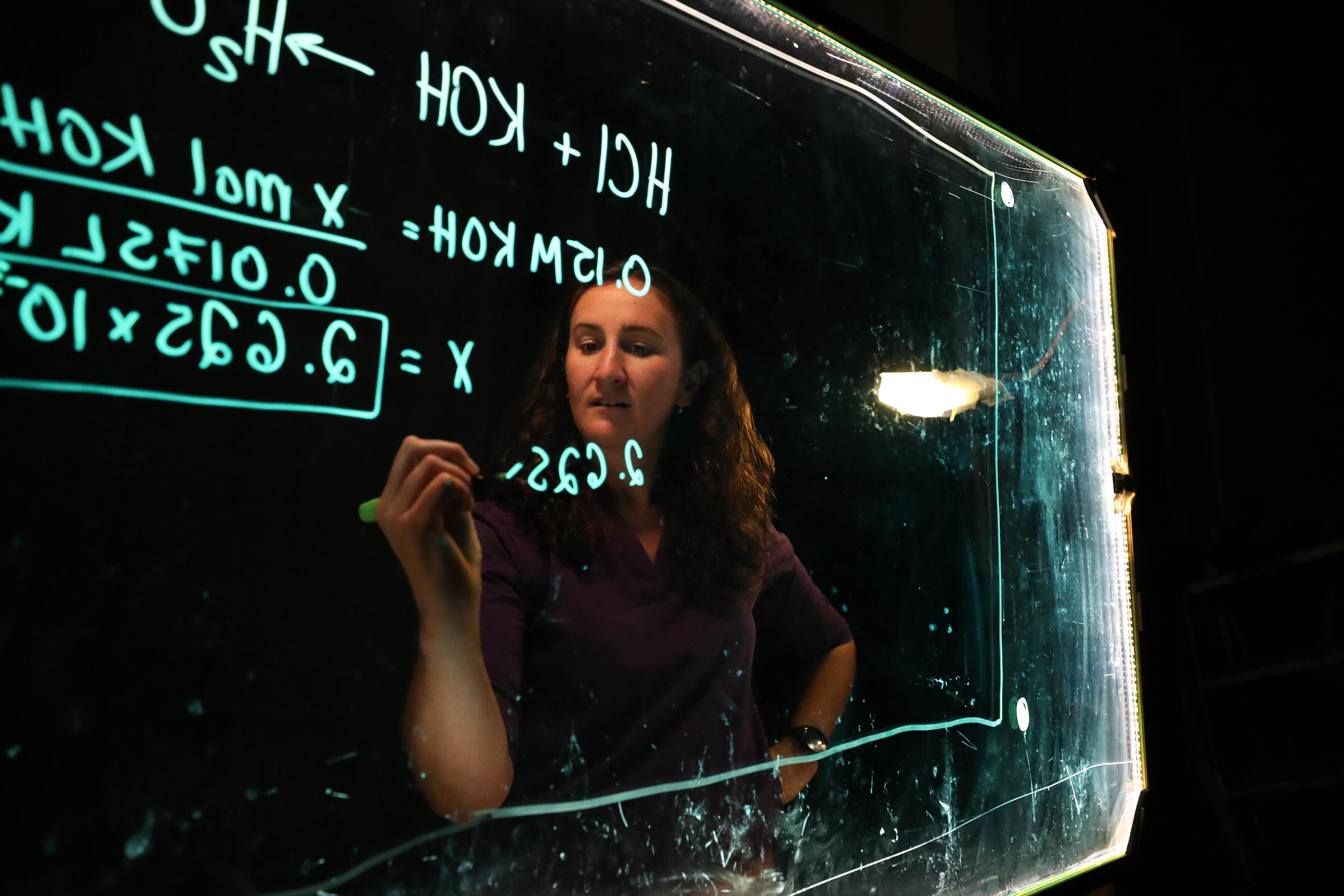
Hiatt came up with the idea after she learned a stastical concept on a light board.

‘Feel better about solving the problem’

Hiatt likes that she can look into the camera and point at the problem as she works through it.

“The students can see what I’m gesturing toward, how it fits in the equation and, hopefully, feel better about solving the problem,” she said.

She edits the recordings to add graphics and to flip the image so the students can read her writing (instead of the mirrored way it would show up without the edit).

The videos are supplemental to her live classes, which have a mix of in-person and online students each day. During the live sessions, she delivers lessons at a white board that online students watch on Zoom.

“They have to watch the lecture videos before they get to class, then they can ask questions while I’m doing stuff on the board,” she said. It’s a more real-time interaction, and they’ve already had time to process concepts, the math, what they need to learn.”

You can watch Hiatt’s light board videos at her YouTube playlist here.

Dr. Leslie Hiatt, a chemistry professor at Austin Peay State University, spent some of the summer transforming a scrapped glass door into a learning tool for students forced to take online classes during the COVID-19 pandemic.  She turned the glass door – donated by Nashville’s Flow Construction – into a light board, a teaching tool she uses to make YouTube videos to help connect her online students to the classroom.  “This is one more tool that makes it so that they’re able to conceptually understand the chemistry,” Hiatt said. “I knew the challenges (of learning during the pandemic) – just getting used to technology was going to be hard for students – so I wanted to do everything I could to make it easier for them.”  Hiatt needed about 20 hours to turn the glass door into a light board. She turned the door on its side, lined it with high-luminosity LED lights and bracketed it onto a homemade wooden stand. Two holes remain where the door’s handle used to be, but the resulting light board helps Hiatt craft compelling videos to help her students learn chemistry.  The lights work with the pens to deliver a vibrancy to the lessons and allow online students to see Hiatt’s face as she delivers the lecture (instead of seeing her back while she writes on a white board).  “I want them to have an equivalent experience with previous years, but watching me via Zoom is not the same as having me in the room with them,” Hiatt said.   Hiatt has made more than 30 videos this semester, mostly for her general chemistry students. She followed APSU Distance Education’s advice and tries to keep the videos short, between 5 and 10 minutes.  “I think it’s working, and I feel like the students are getting in there, they’re doing good,” she said. “They’ve all had very good attitudes about it. They’re all working hard.”  ‘Feel better about solving the problem’  Hiatt likes that she can look into the camera and point at the problem as she works through it.  “The students can see what I’m gesturing toward, how it fits in the equation and, hopefully, feel better about solving the problem,” she said.  She edits the recordings to add graphics and to flip the image so the students can read her writing (instead of the mirrored way it would show up without the edit).  The videos are supplemental to her live classes, which have a mix of in-person and online students each day. During the live sessions, she delivers lessons at a white board that online students watch on Zoom.  “They have to watch the lecture videos before they get to class, then they can ask questions while I’m doing stuff on the board,” she said. It’s a more real-time interaction, and they’ve already had time to process concepts, the math, what they need to learn.”  You can watch Hiatt’s light board videos at her YouTube playlist here.  Inspiration for Hiatt’s light board  Hiatt first thought to build a light board for her students while honing her statistics knowledge for a paper she’s preparing for the Journal of Chemical Education.  “They asked me to do something called a Bonferroni Correction, and I had no idea what that was,” she said. “I found this really awesome video where the instructor was using a light board.   “In addition to learning about the statistics, the board made it easier for me to learn,” Hiatt added. “I thought maybe this would make it easier for the students to learn chemistry.”  You can see the video that inspired Hiatt here.  “As you can tell (in the above linked video), they have very professional lighting and a cleaner board, but I am happy with our much cheaper setup,” Hiatt said. “I think I have less than $200 in the project.”  Most of the cost is for the extruded aluminum heat sink frame around the light board, she said.  She already had some of the pieces for the board – such as a light her husband had – but she needed to buy the LED lights and extruded aluminum.  Future plans  Hiatt plans to improve the lighting and sound of her videos, such as upgrading the wireless mic she already had at her house.  She plans to use the videos in her general chemistry classes all semester then expanding them to upper division classes starting next semester. She probably will continue the videos even after the pandemic passes.  The Journal of Chemical Education has accepted for publication the article Hiatt worked on with Dr. Anuradha Pathiranage and two students, Parth Patel (a May 2020 graduate) and Kristofer Conrad (a current APSU student), with statistics help from Dr. Sumen Sen. You can see the paper they recently published here.   To learn more  For more about the Department of Chemistry at Austin Peay, visit www.apsu.edu/chemistry.
Hiatt plans to expand her light board into upper-level classes.

Inspiration for Hiatt’s light board

Hiatt first thought to build a light board for her students while honing her statistics knowledge for a paper she’s preparing for the Journal of Chemical Education.

“They asked me to do something called a Bonferroni Correction, and I had no idea what that was,” she said. “I found this really awesome video where the instructor was using a light board.

“In addition to learning about the statistics, the board made it easier for me to learn,” Hiatt added. “I thought maybe this would make it easier for the students to learn chemistry.”

You can see the video that inspired Hiatt here.

“As you can tell (in the above linked video), they have very professional lighting and a cleaner board, but I am happy with our much cheaper setup,” Hiatt said. “I think I have less than $200 in the project.”

Most of the cost is for the extruded aluminum heat sink frame around the light board, she said.

She already had some of the pieces for the board – such as a light her husband had – but she needed to buy the LED lights and extruded aluminum.

Future plans

Hiatt plans to improve the lighting and sound of her videos, such as upgrading the wireless mic she already had at her house.

She plans to use the videos in her general chemistry classes all semester then expanding them to upper division classes starting next semester. She probably will continue the videos even after the pandemic passes.

The Journal of Chemical Education has accepted for publication the article Hiatt worked on with Dr. Anuradha Pathiranage and two students, Parth Patel (a May 2020 graduate) and Kristofer Conrad (a current APSU student), with statistics help from Dr. Sumen Sen. You can see the paper they recently published here.

To learn more

For more about the Department of Chemistry at Austin Peay, visit www.apsu.edu/chemistry.

News Feed

View All News

20260902-bridget-harper-portraits-7199
From Austin Peay to D.C.: Bridget Harper gains international experience through The Washington Center

Senior political science major Bridget Harper spent the summer in Washington, D.C., as one of only 12 students selected to intern with the Global Language Network through The Washington Center, building connections with diplomats as she works toward her goal of becoming a U.S. ambassador to South Korea.

Read More
destiny-birdsong
Award-winning author Destiny O. Birdsong to visit Austin Peay on Sept. 24

Austin Peay State University's Zone 3 Press, with support from the Center of Excellence for the Creative Arts, will host award-winning author Destiny O. Birdsong for a free public reading and book signing at 7 p.m. on Sept. 24 in Art + Design Room 120.

Read More
Austin Peay sets enrollment record for second straight year, welcomes largest freshman class in eight years

Austin Peay has set a new all-time enrollment record for the second consecutive year, with 11,338 students registered for Fall 2026. The growth is led by the university's largest incoming freshman class since 2018, with 1,918 first-time students, and by the highest proportion of military-affiliated students in Austin Peay's history. Active-duty service members, veterans, and military family members represent 35% of the student body.

Read More