


New scanning electron microscope brings meteorites, opportunity into focus at APSU
By: Colby Wilson July 20, 2026
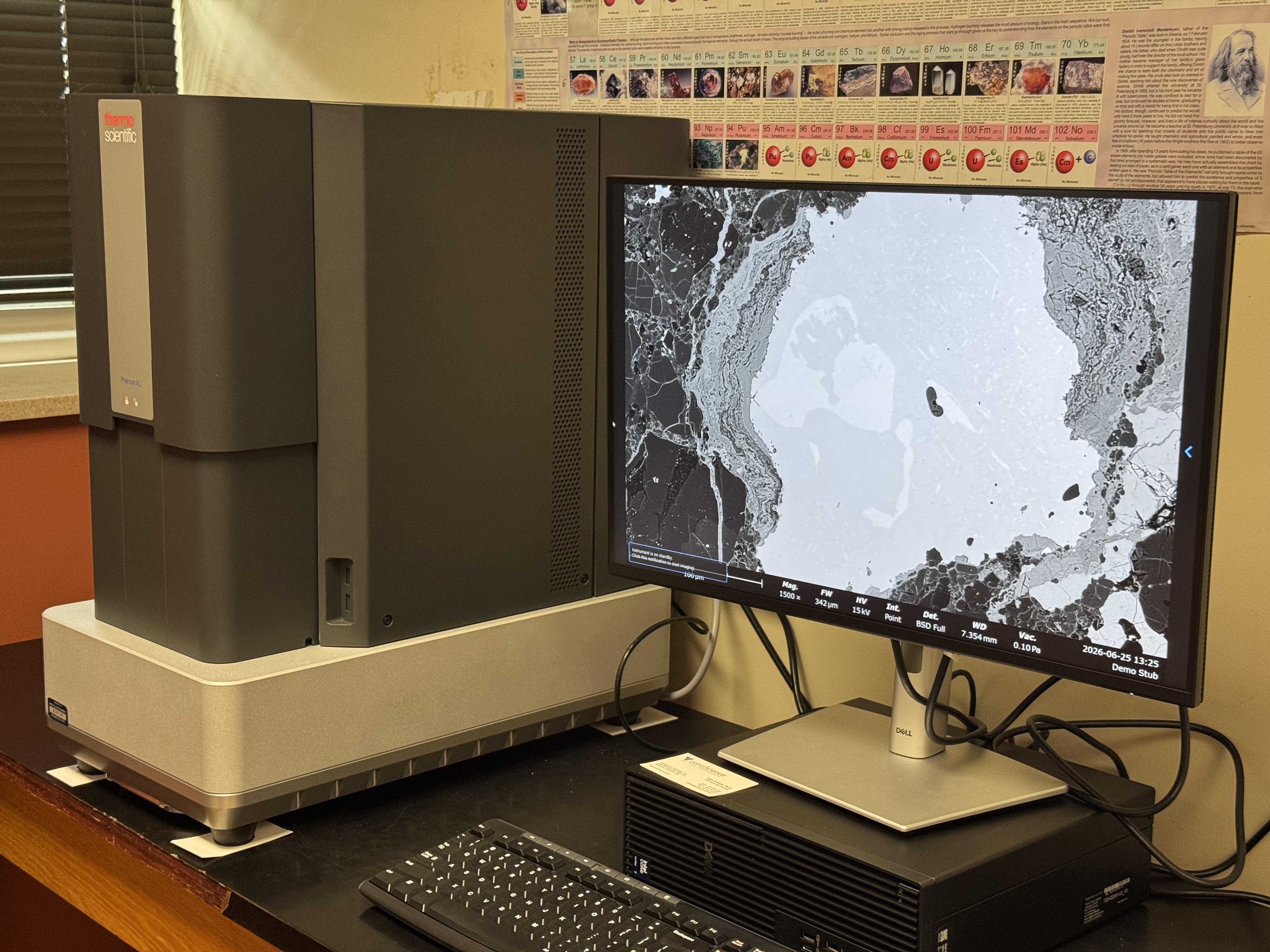
APSU’s new scanning electron microscope lets students view publication-quality images of meteorite samples, and its tabletop design allows for beginner-friendly analysis. | Photo by Colby Wilson
CLARKSVILLE, Tenn. — When Dr. Amanda Stadermann loads a meteorite sample into the Department of Earth and Environmental Science’s new scanning electron microscope (SEM), the ancient rock reveals secrets that have been locked away for billions of years.
The desktop-sized instrument significantly advances research capabilities for Austin Peay State University’s College of STEM, offering students publication-quality imaging and analysis previously accessible only at major research institutions.
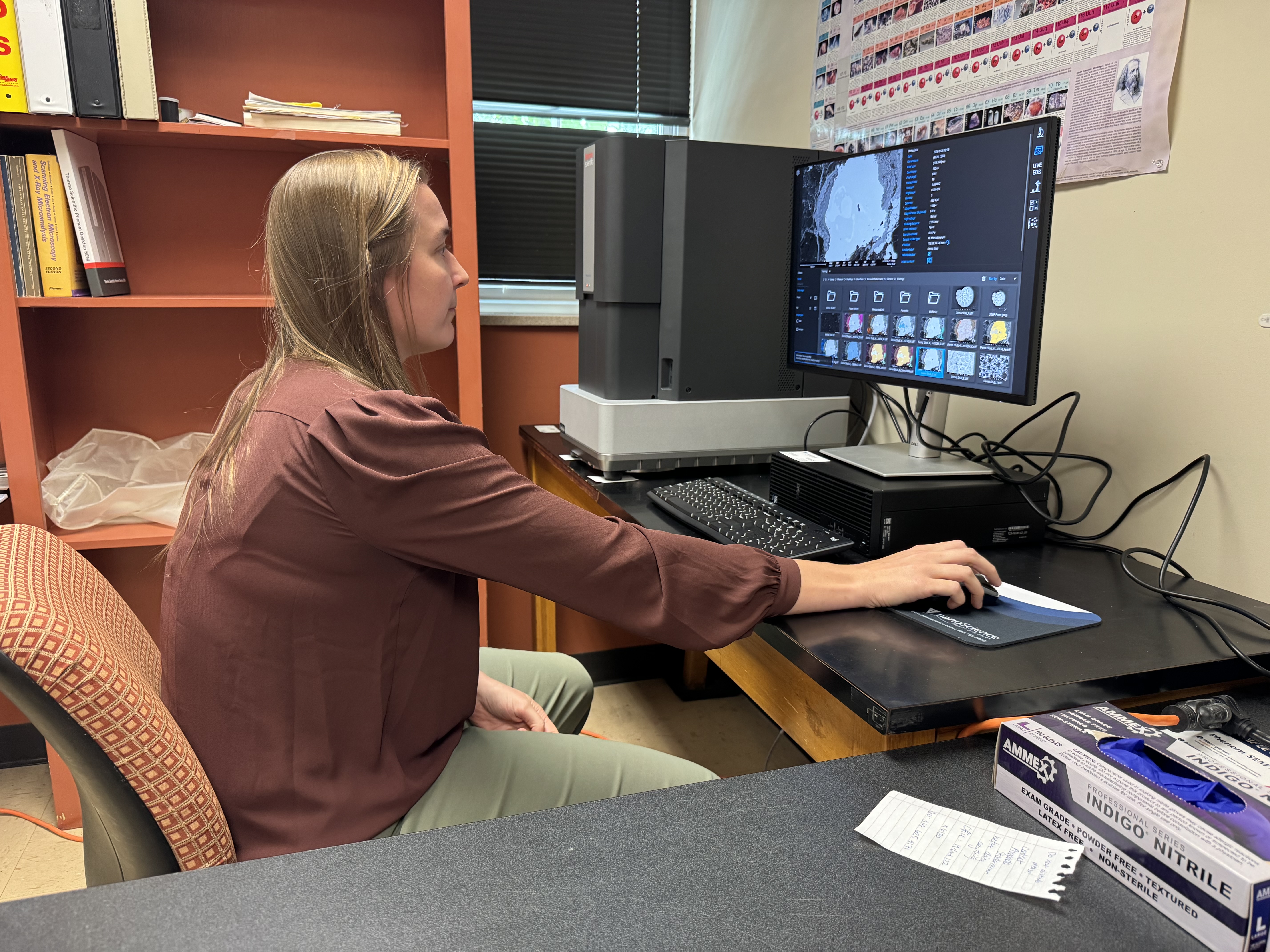
Dr. Amanda Stadermann, an assistant professor in the Department of Earth and Environmental Sciences, demonstrates the capabilities of the scanning electron microscope. | Photo by Colby Wilson
From Light to Electrons: A New Way of Seeing
Traditional light microscopy requires a sample to be sliced thin enough for light to pass through and has limits on the size of features that can be observed. The SEM takes a different approach entirely.
"Instead of using a beam of light, you're using a beam of electrons to look at a sample," said Stadermann, an assistant professor in the Department of Earth and Environmental Sciences. "Because of the way atoms are structured, with a nucleus and electrons around it, using a beam of electrons allows us to see things that are much smaller."
The technology reveals not just what samples look like, but their actual chemical composition. When the electron beam strikes the sample surface, it generates unique X-rays for each element present—creating what Stadermann calls "the real power of this instrument."
"Every single ray that you get is specific to the element that it came from," she said. "Students can poke around at different areas and see these different peaks shift in heights or see different elements, and that tells us about how the rock formed."
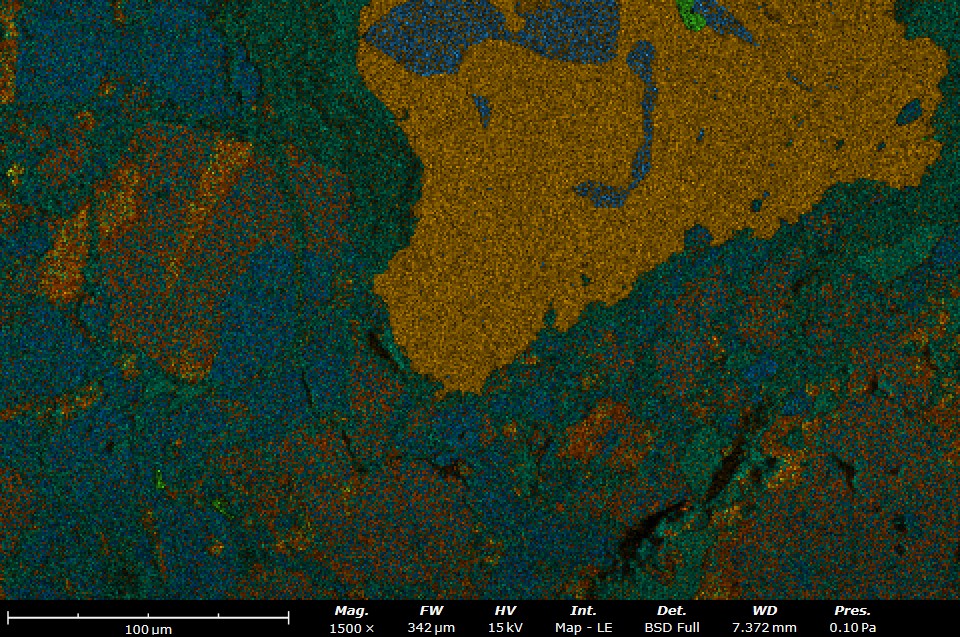
Students can view each element of a meteorite sample in detail through APSU’s new scanning electron microscope, combining their materials sciences or geosciences work with chemistry concepts.
Meteorites Meet the Classroom
Stadermann's research focuses on meteorites—samples that provide direct evidence of processes elsewhere in the solar system. Her specimens come from meteorite dealers working with nomadic peoples in the Sahara Desert, where the continuous landscape makes space rocks easy to spot against the sand.
Many of her samples were donated specifically for educational purposes, allowing undergraduates to examine materials that traveled millions of miles to reach Earth.
"This lets our students look at these meteorites and understand not just rocks on Earth, but rocks from space, which I think is very exciting," she said.
Before joining the faculty at Austin Peay, Stadermann worked with some of the most precious geological samples on Earth: Apollo mission rocks brought back from the moon in the 1960s and ‘70s. Her postdoctoral work at NASA’s Johnson Space Center in Houston involved characterizing these irreplaceable specimens housed in facilities similar to the lunar sample repositories.
Accessibility Across Disciplines
While large floor-model SEMs exist at major universities, they are often difficult to maintain and intimidating for beginners. Austin Peay's tabletop model changes that dynamic entirely.
"I think having something like this accessible and on campus is going to be great not just for myself and Dr. [Daniel] Frederick, but for faculty across the college who maybe have an interest but aren't necessarily sure how to apply it to their own research," Stadermann said.
Early demonstrations proved the instrument's versatility to other CoSTEM faculty. Dr. Stefan Woltmann from field biology examined feather structure and spacing measurements. Physics professor Dr. Eugene Donev tested the instrument's limits with his own samples. Agriculture professor Dr. Niranga Wickramarathne looked at soil particles, microfossils, and other specimens that revealed new details under electron microscopy.
Student-Ready Technology
The instrument's interface includes built-in safeguards that prevent inexperienced users from causing damage, a crucial feature for undergraduate instruction.
"There are a lot of safeguards so that if someone comes in and forgets what they're doing and accidentally presses the wrong button, it's not going to mess anything up," Stadermann said. "It's relatively hardy against beginners."
This user-friendly design allows Stadermann to integrate the SEM directly into upper-division courses, making research accessible beyond traditional one-on-one faculty mentoring.
"Students will be able to have an understanding of what different minerals are making up the surface," she said. "They can combine information about what it looks like with the actual chemistry, which allows them to understand concepts they learn in classes, but without something like this, it's hard to really apply."
Industry-Ready Skills
The SEM experience prepares students for careers in materials science, geosciences, and related industries where similar instruments are standard tools.
"Even if they don't end up using something like this every day, they'd be able to communicate with people who do use this on a more regular basis," Stadermann said. "They have the experience to say, 'I've used this really technical instrument successfully, so I can learn this other thing at my new job.'"
About the Austin Peay College of STEM
The College of Science, Technology, Engineering & Mathematics (STEM) provides studies for students in the areas of agriculture, astronomy, aviation sciences, biology, chemistry, computer science, earth and environmental sciences, engineering physics, engineering technology, information technology, mathematics, medical laboratory sciences, radiologic sciences, and physics. Its outstanding, discipline-based programs are student-centered and designed to prepare students for responsible positions at all levels of research, industry, education, medicine, and government.