


From VHS to virtual: APSU professor explores future of online P.E. in new study
By: Seth Riker February 19, 2026
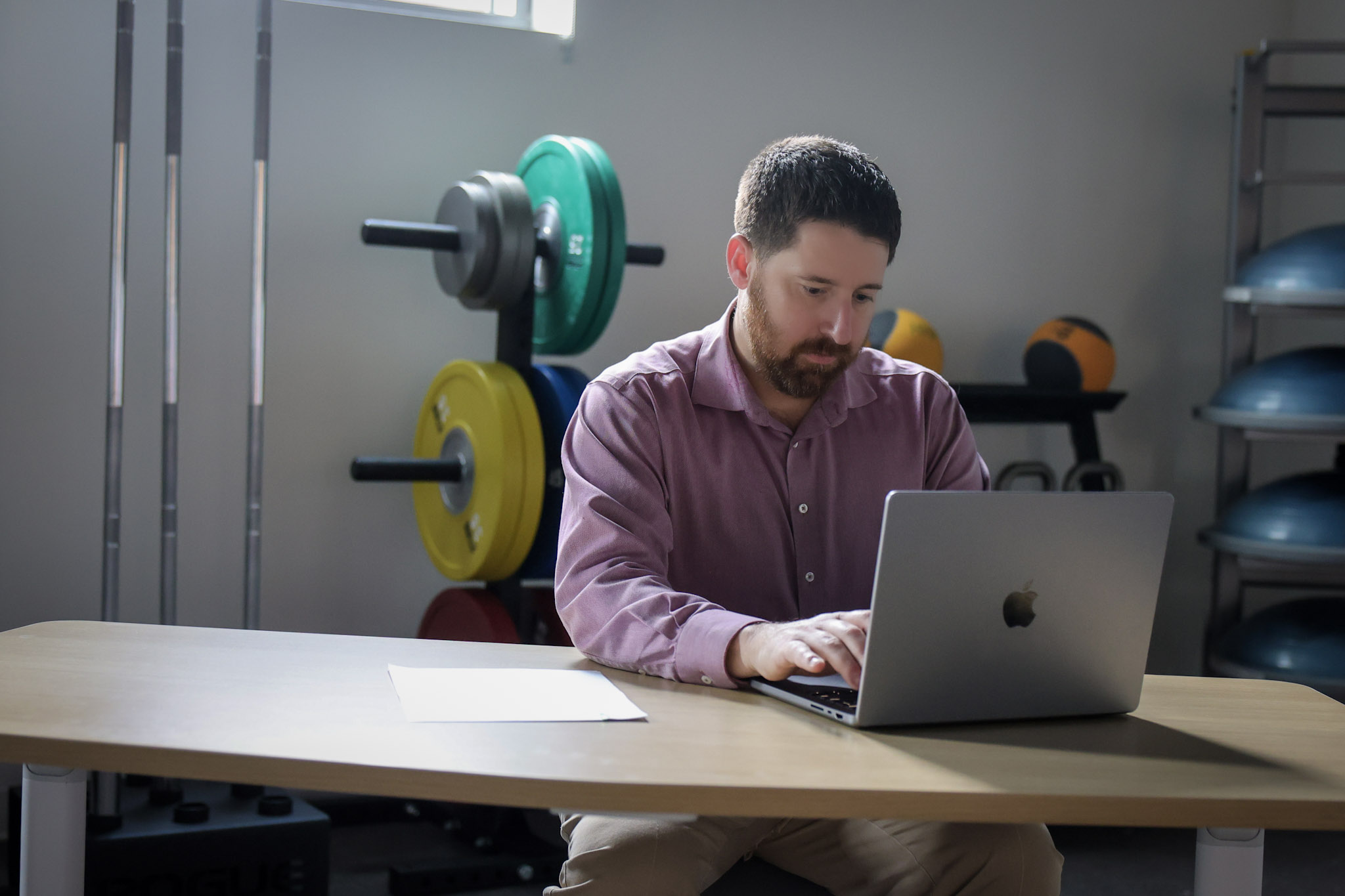
Dr. Alex Adams, an assistant professor in APSU’s Department of Health and Human Performance, has published the first comprehensive review on virtual K-12 physical education practices since 2018 and says more research is needed. | Photo by Seth Riker
CLARKSVILLE, Tenn. - Dr. Alex Adams, an assistant professor in Austin Peay State University’s Department of Health and Human Performance, has published one of the first comprehensive reviews of appropriate practices for K-12 online physical education—addressing a growing need as virtual enrollment remains above pre-pandemic levels nationwide.
The research comes at a critical moment. When COVID-19 forced schools online, physical education faced a major challenge. How do you teach movement through a screen? What began as emergency teaching has become part of the educational landscape, but knowledge of what actually works remains limited.
"There's a dearth of research in this field," Adams said. "We just don't have enough research that's truly on online P.E."
Distance learning itself is not new. In the 1980s, during overseas conflicts, schools mailed VHS tapes to students to keep education moving. It was emergency teaching, not designed to last. But today’s online P.E. programs are here to stay, and Adams is quick to clarify his position.
“I prefer us to be in person as much as possible,” Adams said. “I still think the best learning environment is the gym or the outdoor setting with a physical education teacher.”
Yet the question remains: Now that online P.E. is established, how do we improve it?
A Question Many Parents Are Asking
For generations, physical education has meant gym floors, team sports, and face-to-face instruction. When families hear “online P.E.,” skepticism is understandable.
“How do we do something that is physical in nature virtually?” Adams asked. “That’s the big concern.”
Before COVID, online P.E. was largely a high school credit recovery option or a solution for rural districts struggling to hire certified teachers. During the pandemic, it expanded across grade levels.
Today, many elementary programs use live instruction. Middle schools often blend formats. High schools tend to rely more on asynchronous models that allow students to work independently. Each model presents challenges and opportunities.
Rethinking the Gym
According to Adams, improving online P.E. begins with reimagining the space.
“You have to rethink your gym space,” he said. “They’re at home. So what do they have? Socks. Tie two socks together, and you’ve got an implement. Grocery bags can become scarves.”
Online instruction forces creativity, but allows greater family involvement. Assignments can include walking with a parent, interviewing a grandparent about physical activity, or reflecting on fitness goals together.
For some students, especially those uncomfortable changing in locker rooms or participating in competitive sports, virtual options may provide a different pathway to engagement.
Still, the biggest challenge remains teaching physical skills without real-time correction.
“Practice doesn’t make perfect,” Adams said. “Practice makes permanent.”
If a student repeatedly practices poor technique without feedback, that habit becomes ingrained. Strategies such as student-recorded videos, peer feedback, parent guidance, and emerging tools like artificial intelligence may help bridge that gap, but accessibility remains critical.
“If AI is part of the solution, we have to make sure it’s accessible to all students,” Adams said. “We can’t create solutions that only some families can use.”
What We Know and What We Need
Adams’ publication builds on national guidelines released in 2018, which were the first and only directives of their kind for K–12 online physical education. His work brings together research that has emerged in the years since the pandemic, offering clarity for educators. Still, he is clear that the overall evidence base remains limited.
Some evidence suggests cognitive learning can occur online. At the collegiate level, studies show fitness gains are possible in hybrid and asynchronous settings. What is missing is robust research at the K–12 level, particularly around physical skill development.
“We need more research with K–12 students who are choosing to be there,” Adams said. “We need to know what actually works at the elementary, middle, and high school levels.”
He also warned against using research to justify replacing in-person programs, noting that the goal is not to replace, but to improve.
“I don’t want it to be used as a mechanism to push more online P.E.,” he said. “I still believe in the in-person gym.”
Whether instruction happens in a gymnasium or through a Chromebook, the mission remains the same.
“To create a desire to be active for a lifetime,” Adams said. “That’s the real goal.”
About the Department of Health and Human Performance
The Austin Peay State University Department of Health and Human Performance educates students to promote lifelong health, advance human performance, and strengthen communities through evidence-based practice and applied learning. The department offers bachelor’s degrees in kinesiology and health and human performance, preparing graduates for careers in education, fitness, wellness, and allied health fields. At the graduate level, the department offers advanced programs in public health, speech-language pathology, healthcare administration, and performance enhancement and coaching, equipping professionals to lead, serve, and innovate across diverse healthcare and performance settings.