


Commencement Symbols and Traditions
Much of what you see at an Austin Peay commencement — the medallion, the mace, the banners, and the robes — carries centuries of academic tradition. These symbols mark the authority of the university and the achievement of its graduates.
The Presidential Medallion
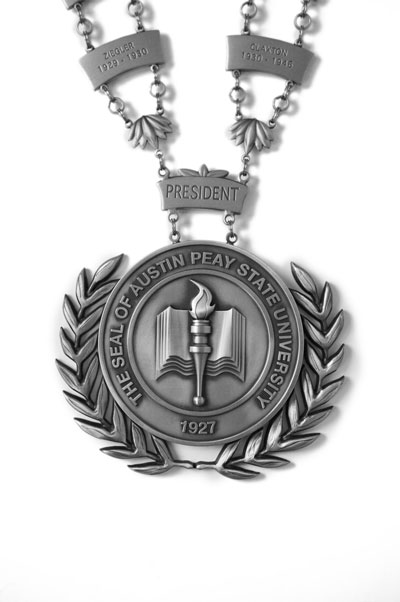
The Presidential Medallion signifies position, authority, and trust, and was designed to be worn by Austin Peay State University presidents at all ceremonial occasions. The bronze medallion, encircled by a laurel wreath, features the university seal. The words "The Seal of Austin Peay State University" are printed in relief around the border, and the founding date, 1927, sits at the lower edge. The seal's open book and burning torch stand in relief within a second, inner circle. The lighted torch symbolizes the flame of knowledge, and the book represents the accumulated knowledge of the world. The seal's location within the circle symbolizes the continuity of truth through learning. The medallion is suspended by an engraved succession chain honoring all presidents of the university.
The Ceremonial Mace
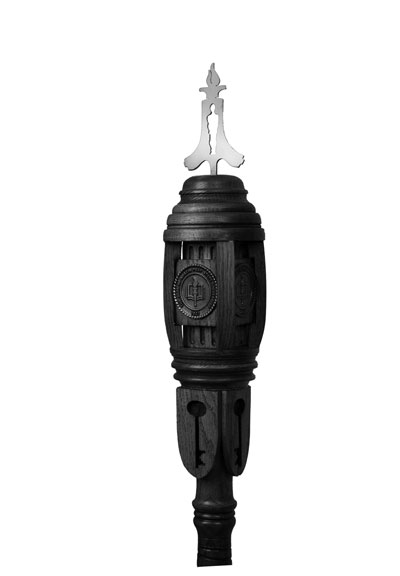
Originally, the mace was a weapon of offense carried into battle by medieval bishops. Today, it is a symbol of authority. Austin Peay State University's mace was designed and crafted by Dr. James Diehr for the 1988 inauguration of Dr. Oscar Page, APSU's sixth president. Then a professor of art, Diehr created the mace from oak — a material that, like education, is known for durability and ageless qualities. The design incorporates the seal of the university, keys symbolizing strength and knowledge, and a lantern shining forth the light of learning. The crest on top of the mace is a polished brass miniature of Diehr's sculpture Gateway, which stands in front of the Browning Administration Building.
Gonfalons

Faculty marshals from each college lead the graduates into the Dunn Center carrying gonfalons. Banners such as these have been used since medieval times in graduation ceremonies to symbolize the different academic areas within a university. The college seals on each gonfalon were designed by the Austin Peay State University Public Relations and Marketing staff with input from college faculty. The symbols within the seals represent the programs within each college, and the Browning Building, the administrative center of the university, serves as the backdrop for each gonfalon.
Academic Regalia

The academic gowns worn today are patterned after those worn during the Middle Ages in European universitas — informal gatherings of teachers and students who came together to study. During the 12th and 13th centuries, universities typically occupied unheated buildings, so students and teachers wore large, heavy robes that generally included a hood or cowl for covering the head in inclement weather. The distinctive gowns also set students and teachers apart from their fellow citizens.
The current academic attire originates from the University of Oxford and Cambridge University in England. Evolving over more than 600 years, Oxford's colorful regalia is composed of heavily embroidered silk. Until the mid-1800s, faculty and students at most United States universities wore gowns daily. Today, three basic types of gowns are worn:
-
Bachelor's gown — made of a red worsted material with a stiff yoke. Worn closed, it is distinguished by long, pointed sleeves.
-
Master's gown — designed to be worn open, with a stiff yoke. The long, rectangular sleeves have an arc cut from the bottom front; the sleeve is closed at the bottom, and the wearer's forearm protrudes through a slit near the elbow.
-
Doctoral gown — made of silk with full sleeves. Worn closed, it shows wide velvet facing down the front, and the sleeves are trimmed with velvet bars. The velvet trim may be red or the color distinctive to the wearer's discipline.
The hood is an outstanding feature of academic regalia. Its exterior is black, and the interior lining displays the colors of the institution that conferred the degree. A velvet border indicates the discipline:
-
Agriculture — Maize
-
Arts, Letters, Humanities — White
-
Commerce, Accountancy, Business — Drab
-
Dentistry — Lilac
-
Economics — Copper
-
Education — Light Blue
-
Engineering — Orange
-
Fine Arts — Brown
-
Forestry — Russet
-
Home Economics — Maroon
-
Journalism — Crimson
-
Law — Purple
-
Library Science — Lemon
-
Medicine — Green
-
Music — Pink
-
Nursing — Apricot
-
Oratory — Silver Gray
-
Pharmacy — Olive Green
-
Philosophy — Dark Blue
-
Physical Education — Sage Green
-
Public Administration — Peacock Blue
-
Public Health — Salmon Pink
-
Science — Golden Yellow
-
Social Work — Citron
-
Theology — Scarlet
-
Veterinary Medicine — Gray
The headpiece is red and generally consists of a tight-fitting cap attached to a stiff square called a mortarboard. The tassel is worn on the left front quarter of the cap. The style or color of the tassel has no assigned meaning.
Academic Honors
Undergraduate students who earn a grade-point average of 3.90 to 4.00 graduate summa cum laude. Those who earn a 3.70 to 3.89 graduate magna cum laude, and those who earn a 3.50 to 3.69 graduate cum laude. Graduate students who earn a grade-point average of 3.85 or greater graduate with honor. Listed honors reflect grades earned prior to the current semester.