


Austin Peay’s Dr. Stephen Kershner wins national award for classics education
By: Ethan Steinquest January 15, 2026
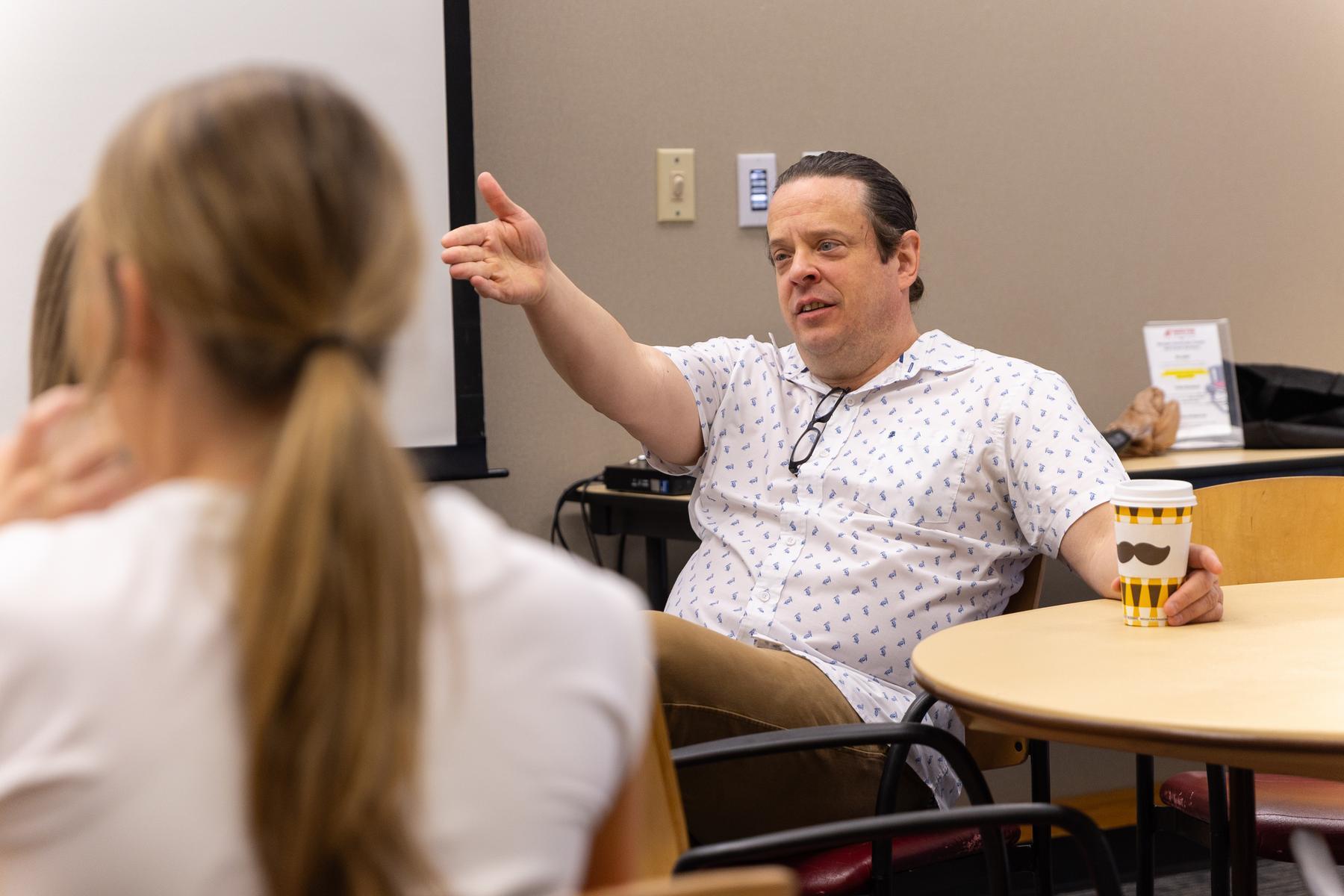
Dr. Stephen Kershner, an associate professor of classics at Austin Peay State University, speaks with students during a world languages event on campus in March 2025. | Photo by Sean McCully
CLARKSVILLE, Tenn. - Dr. Stephen Kershner, an associate professor in Austin Peay State University’s Department of Languages and Literature, recently earned the 2025 Award for Excellence in Teaching at the College Level from the Society for Classical Studies (SCS), North America’s leading organization for the study of ancient Greek and Roman civilizations.
Kershner was one of three educators nationwide to receive the award during the 2026 Archaeological Institute of America (AIA) and SCS Annual Meeting, hosted Jan. 7-10. He was recognized for his innovative teaching methods, supportive classroom environment, and dedication to mentoring students.
“We are incredibly proud to have Dr. Kershner on our faculty,” APSU President Mike Licari said. “His approach to teaching brings ancient civilizations to life and sets a standard for excellence that elevates our entire university. This award confirms what we’ve known for a long time: Austin Peay is home to truly outstanding educators.”
Kershner’s teaching centers on practical application, with students building critical thinking and problem-solving skills across disciplines. He also encourages “getting our wrong in every single day” to show how taking risks in class discussion promotes growth.
“Austin Peay is a regional institution, and our goal is to develop workforces and uplift the community,” Kershner said. “The Romans, Greeks, and all of the accoutrements that go with them are like a data set. They can teach us a lot about the world, politics, science, and art, and I’m focusing on using this material to make my students even more capable than they already are.”
Junior world languages major Richard Carney said Kershner provided essential guidance when he was unsure about his path forward. After graduation, he plans to pursue a master's degree in library and information science and become a librarian.
“It’s hard to put into words just how much Dr. Kershner has helped me throughout my academic career,” Carney said. “As a professor, he has always been kind and caring, and also extremely willing to help … he’s been an incredible inspiration in my journey, and I am so grateful that I was able to study under him.”
Kershner’s impact extends beyond the classroom. He frequently mentors students for conference presentations, serves as an editor for Philomathes: A Journal of Undergraduate Research in Classics, taught for five years through the APSU Prison Education Project, and organizes a recurring Classics Day that brings 150-200 local high school students to campus to learn about ancient civilizations.
“Some of these kids have never been told they belong in college, or have never thought they belong in college for one reason or another,” Kershner said. “Classics Day shows young people the possibilities and what can happen for them if they want it. It also lets APSU students plan the activities so they can learn how to run large-scale meetings.”
Outside campus, Kershner helped launch APSU’s Prison Education Project with Dr. Wes Atkinson and Dr. Dwonna Goldstone (now a professor at Texas State University). He currently serves on the university’s Prison Education Steering Committee as an advocate for incarcerated learners.
“It’s a stark world behind the walls, and this brings the humanities to them,” Kershner said. “Going in there and reading works like the Odyssey that I’ve taught in the classroom changes lives. I’ve seen men with seventh-grade educations discuss difficult concepts as well as anybody you’d find at a college.”
Kershner’s teaching has also inspired non-degree-seeking students like Dr. Nell Rayburn, a professor emeritus of mathematics who began enrolling in classics courses out of an interest in ancient languages.
“Reading epic and lyric poetry, history, rhetoric, and drama with Dr. Kershner and my classmates has opened for me a whole world of life viewed through a different cultural lens,” Rayburn said. “Always thought-provoking, always challenging, often joyful, sometimes infuriating, the Greeks of antiquity reach out to us across the millennia and call to us to think deeply about our own ingrained ways of viewing the world. They live again, in Dr. Kershner’s classroom.”
Dr. William “Buzz” Hoon, dean of the College of Arts and Letters, praised Kershner’s approach to making classical studies engaging and relevant.
“Dr. Kershner’s SCS recognition reflects the caliber of teaching we strive for in the College of Arts and Letters,” Hoon said. “Whether he’s working with an undergraduate presenting their work at a national conference or a high school student discovering classics for the first time, he’s cultivated a program that serves the entire community.”
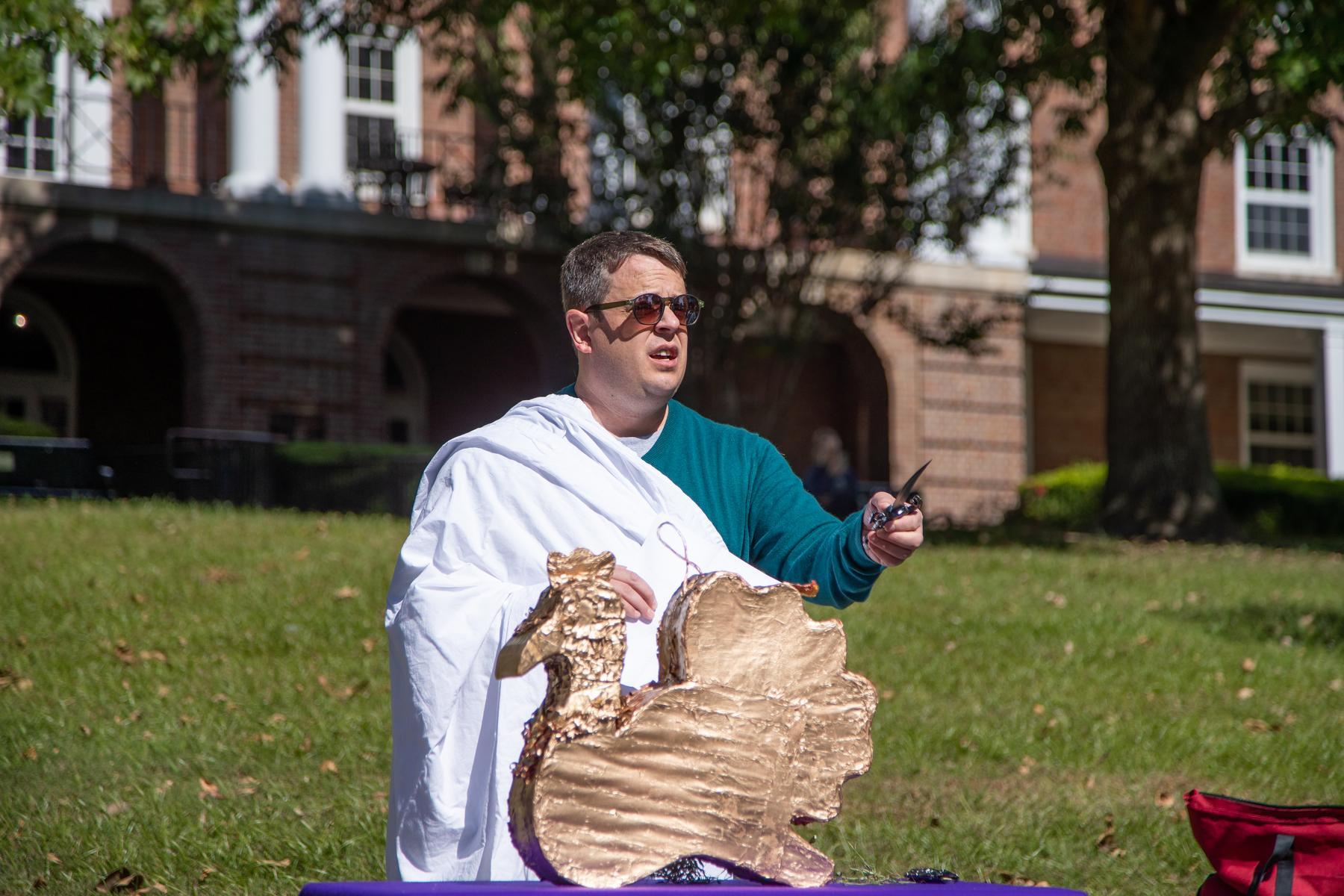
Dr. Stephen Kershner leads a mock sacrifice of the Golden Eagle mascot before APSU’s 2018 Homecoming game against Tennessee Tech, giving students an interactive way to learn about ancient Roman sacrifices and religious traditions. | Photo by Taylor Slifko
Transfer students are among those who have benefited from Kershner’s support while settling into a new academic environment.
“One aspect that really helped me stay on track with my education is definitely how dedicated Dr. Kershner was [in] getting my transfer credits to count, which allowed me to graduate on time and have more space to take some really interesting Ancient Mediterranean courses,” said Annalycia Padilla Ruby, a graduate English major with a bachelor’s degree in classics. “He is dedicated to making sure his students not only meet their individual goals, but exceed them by preparing us with [our] class workload, individual meetings, and professional development.”
To provide individualized attention, Kershner has adapted the tutorial system developed at Oxford and Cambridge in the 1800s. This brings students together in small groups to share essays, critique each other’s work, and build confidence through discussion.
“Teaching excellence is the cornerstone of APSU’s academic mission, and Dr. Kershner’s commitment to student success exemplifies what we value most,” said Dr. Mitchell L. Cordova, provost and vice president for Academic Affairs. “He is constantly innovating new teaching methods to bring out the best in his students, and we’re proud to see him recognized at such a high level.”
Despite the national recognition, Kershner remains focused on making a meaningful impact at the individual level.
“We as humans want our world to be a better place, and many people think ‘I’ve got to hit a home run doing this,’” Kershner said. “I decided for myself that I was going to hit singles … reaching out to one person and improving their life or day is moving in the right direction, and I hope everyone learns to hit their singles to put some love and hope into the world.”