


APSU honors students create clay tablets for history of the book class
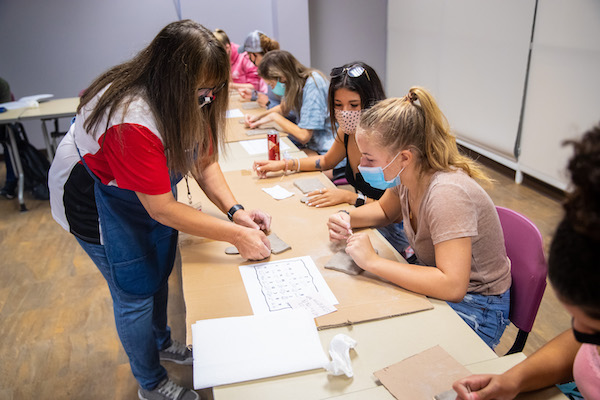
CLARKSVILLE, Tenn. – To give students in her honors course a memorable hands-on experience related to the content students study in class, Austin Peay State University’s Gina Garber, professor of library administration, recently led a cuneiform clay tablet active-learning exercise. The event took place Sept. 9 in the Honors Commons.
This fall, Garber is guiding students through the almost 5,000-year history of the book, from clay and stone tablets to the invention of paper to the recent invention of the e-book.
“Once students learn about the history of the book and how writing has changed the world, it will give them an opportunity to think critically about the current challenges that come with new technologies, such as issues of the digital divide and readily available self-published works,” Garber said.
The class provides materials to immerse students in the bookmaking processes from the past, including papyrus, rice paper, calligraphy pens, gold leaf, linotype tools and blocks, Sumi ink and clay.
That morning in September, Garber instructed students to write using the Sumerian pictographic script on soft clay with wooden tools similar to the reeds the people of ancient Mesopotamia used in 3000 BCE. Garber intends for this event to be a memorable experience students can recall when they see Sumerian writing on tablets later in life. She teaches her class the importance of kinesthetic or hands-on learning.
“I think kinesthetic learning is effective for this class because students can actually put their hands on the materials,” Garber said. “It’s one thing to read about the clay tablets, but I think to write on the tablets using the tools people of ancient Mesopotamia used is an important learning experience for students.”

Students began the process by using an outstretched wire to slice their tablet from a clay slab. Students try to keep their slabs only a half-inch thick or slightly thinner to fit them in the special oven they must be baked in. Next, using a sheet of the Sumerian pictographs, students write their name and a phrase on the clay in cuneiform script.
“I am making impressions upon this clay,” student Gabriel Rodriguez said. “I have two tools here. One’s cut off at an angle to make these triangle shapes. Then I have a really pointy stylus to draw the lines. That’s all the cuneiform script is, just triangles and lines.”
Garber led her exercise with clay from River City Clay, a downtown art studio. Garber returned the tablets to River City to fire in the kiln so students could take their work home.
This is just one exercise of many to come this semester. In the future, Garber will host more exercises relating to the literature and book-making content she covers in class. She sets each week up to end with an active learning exercise, hoping the activity gives students a therapeutic break from more ordinary aspects of learning and student life.
“Fundamentals of Interdisciplinary Thinking: History of the Book and the Evolution of Information” is an interactive course focusing on historical developments in written communication from clay tablets to today’s digital media.
For more information, visit https://www.apsu.edu/honors/.
News Feed
View All News
Austin Peay State University's Department of Art + Design, with support from the Center of Excellence for the Creative Arts, will host composer, filmmaker, and visual artist David Stout for a free public lecture, "At Home in the Uncanny Valley: The Play and Promise of a Latent Space," at 6 p.m. on Oct. 28 in the Sara & Mike Gotcher Theatre.
Read More
Dr. John W. Steinberg, an Austin Peay State University professor of history and one of the world's leading authorities on Russian military history, is spending the 2026-27 academic year teaching cadets at the United States Military Academy at West Point as the Charles Boal Ewing Chair in Military History.
Read More
Austin Peay State University has received a gift from Sharon A. Dunn ('73), a College of Business graduate, to establish the KY Tri-County College of Business Scholarship Endowment, giving first preference to students from Todd, Christian, and Trigg counties in Kentucky.
Read More