


Austin Peay-led research team names new crayfish species for 101st Airborne
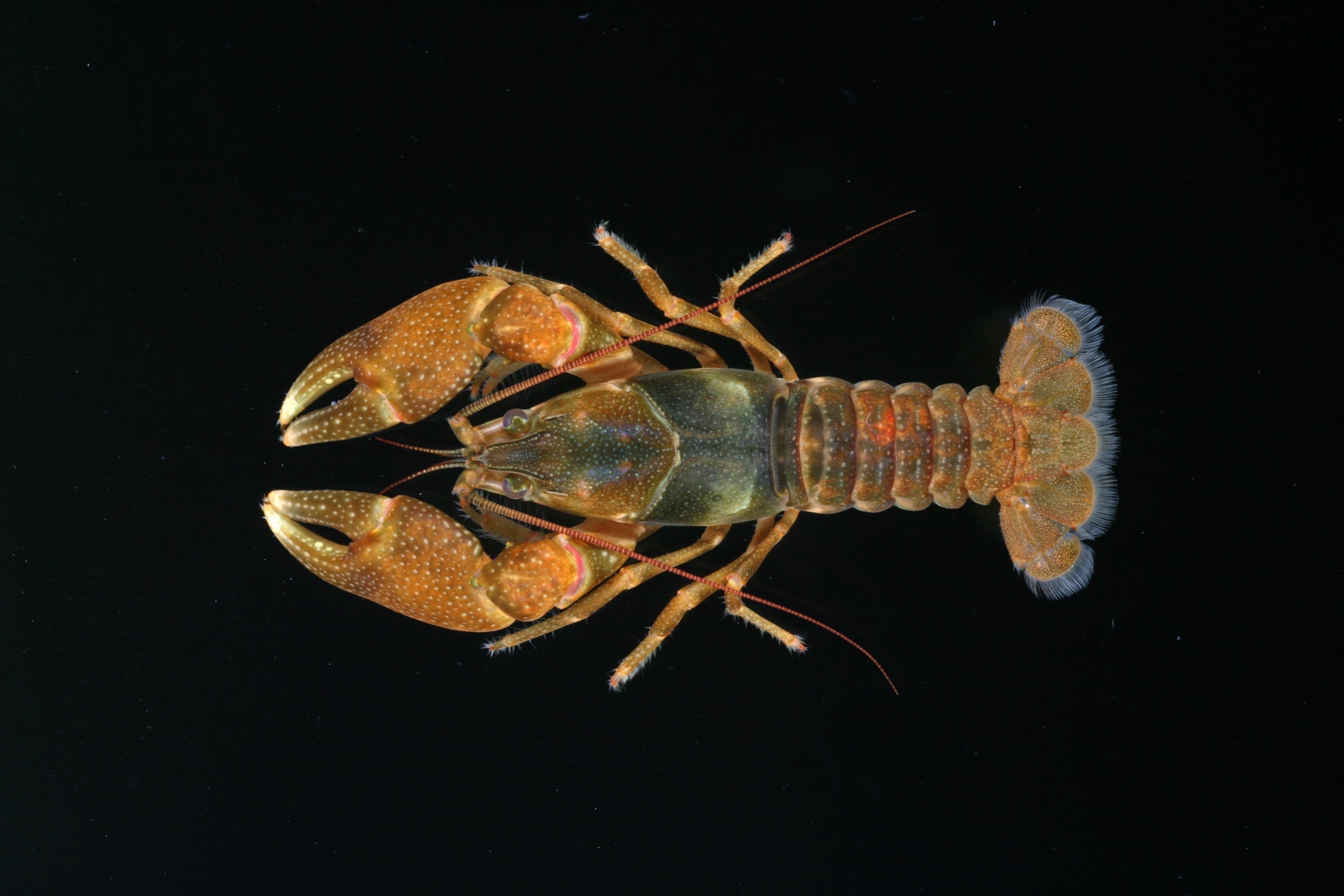
(Posted March 6, 2019; updated Aug. 12, 2019, with new photos; crayfish photo courtesy of Carl Williams)
The stream beds on the Tennessee side of Fort Campbell harbor a rare treasure, a rusty-brown crayfish with white-tipped claws that exists nowhere else in the world.
Former Austin Peay State University graduate student Erin Bloom led the research that identified the crayfish as a new species. She and her teammates named the new species the Screaming Eagle Crayfish in honor of the troops of the 101st Airborne Division.
“That was probably one of the most overwhelming parts of this for me was trying to come up with a name,” Bloom, now a biology professor at Volunteer State Community College in Gallatin, said. “We knew we wanted to pay tribute to where the crayfish is found. Because the majority of them are found on Fort Campbell, we thought it would be perfect.”
Even the Screaming Eagle Crayfish’s scientific name salutes the 101st Airborne. Faxonius bellator loosely translates to “crayfish warrior.”
DISCOVERING THE SCREAMING EAGLE CRAYFISH

Though the Screaming Eagle Crayfish has had its new name for only a couple of months, it has had a home at Fort Campbell for years. Nobody until now knew the crayfish lived only in Montgomery County and almost entirely on the Army post.
Bloom’s research determined the crayfish lives in only three streams on post and one stream at Billy Dunlop Park in Clarksville, where it’s seemingly rare. She and her teammates – APSU biology graduate Brittany McCall, APSU biology professor and Center of Excellence for Field Biology Principle Investigator Dr. Rebecca Blanton Johansen and retired Eastern Kentucky University biology professor Guenter Schuster – published their work Jan. 7 in the Journal of Crustacean Biology. The APSU Center of Excellence for Field Biology supported the research.
Johansen credits the 2008 survey work of BHE Environmental (now a part of Power Engineers), particularly that of her colleague Bruce Bauer, for the crayfish’s initial discovery. The surveyors were studying crayfish, stoneflies, dragonflies and damselflies, specifically.
“They noticed this crayfish on Fort Campbell as something weird, and they couldn’t quite figure out what it was,” Johansen said. “Erin came in, and we took this project on, to look at this weird crayfish to see what species it was or if it was something new.”
Added Bloom: “For me, it was really a puzzle I wanted to solve.”
‘WASN’T SUPPOSED TO BE HERE’

The research started in 2013 as Bloom pursued her master’s degree at Austin Peay. McCall, an APSU undergraduate at the time, and Schuster, a renowned crayfish expert, soon joined the project, which lasted about three years.
They determined the Fort Campbell crayfish had similarities to the Barren River Crayfish endemic to the Green River system in Kentucky and Tennessee and to the Wonderful Crayfish endemic to the Tennessee River system in Alabama and Tennessee.
The BHE Environmental surveyors initially thought the Fort Campbell crayfish were Barren River Crayfish but couldn’t figure out how they had crossed into the Red River system.
“The surveyors and crayfish experts like Bruce Bauer thought it was odd because that crayfish wasn’t supposed to be here,” Johansen said.
Bloom and her team discovered the Fort Campbell crayfish had features different from the Barren River Crayfish from the Barren River and the Wonderful Crayfish of the Tennessee River. McCall’s and Bloom’s extensive lab work and DNA tests helped prove the Fort Campbell crayfish was, in fact, a distinct species.
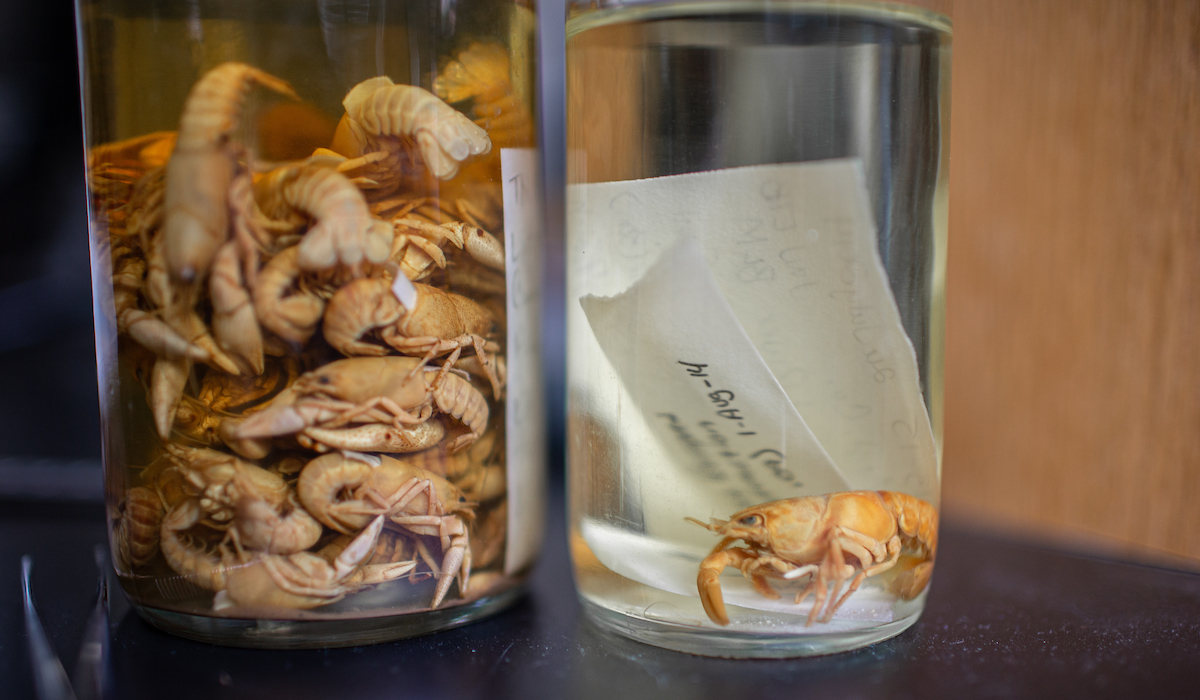
While Bloom led efforts for DNA sequencing, McCall spent nearly an entire summer in the lab measuring 243 crayfish from Fort Campbell and the Barren River and Tennessee River systems, taking about two dozen sets of measurements for each crayfish, much of the work under a dissecting microscope.
“It’s not something you’d think you can do as an undergraduate, participating in research like this,” she said.
DEFINING SCREAMING EAGLE’S VULNERABILITY
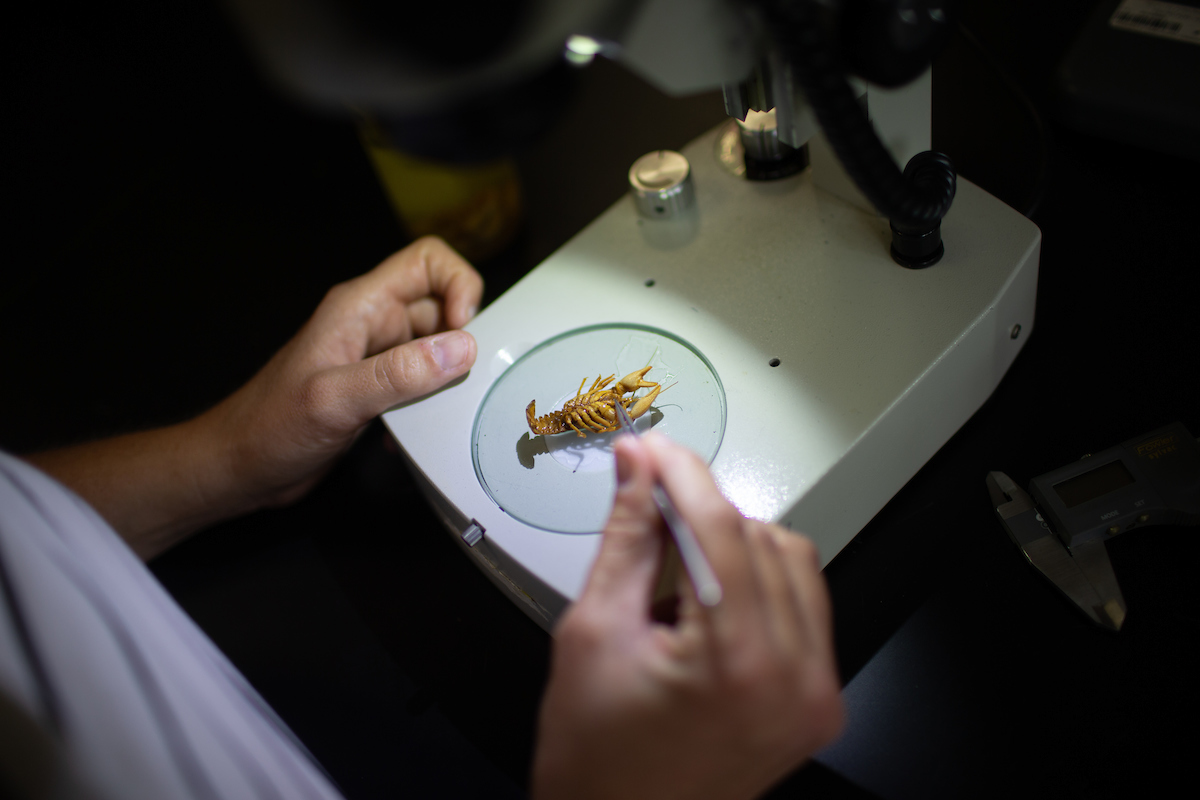
The Screaming Eagle crayfish looks like the Barren River Crayfish and Wonderful Crayfish, but “with a little practice, you can tell them apart,” Johansen said. “And compared with other species of crayfish that you will encounter where it is found, they’re easy to recognize, the tips of their claws are pale, almost white, and their shape is different.”
The newly named crayfish is rare, and it’s vulnerable.
“It’s in a very small area,” Bloom said. “We sampled other areas surrounding Fort Campbell, other streams in the Red River system, just to see if there were any other localities where we could find this crayfish, and we just haven’t been able to find them elsewhere.”
Even at Billy Dunlop Park, the crayfish is hard to find. The team found only eight specimens during four trips to the park, Bloom said.
“Given its small range, there is a conservation concern,” Johansen said. “It seems to be declining in occurrence at Billy Dunlop, and it’s concerning that the West Fork of the Red River has really been hit hard by development.”
PUBLICATION AND MORE WORK TO COME
After the team’s research ended in 2015, Bloom and Johansen worked for a couple of years on the manuscript, which they submitted to the Journal of Crustacean Biology last fall. McCall earned her master’s at Arkansas State University, where she’s now pursuing her doctorate in environmental sciences.
“We all worked on it so long that when we finally got the email to say it was ready for publication, it was just kind of like, ‘Wait, what? It’s really done?” Bloom said. “But we aren’t done.”
“We want to focus on the life history of these guys,” she added. “We know when reproductively active males and females are present, but as far as food habits, etc., we just haven’t had the chance. We are hoping to start that soon.”
Bloom and Johansen might be back at Fort Campbell this summer tracking the lives of the tiny creatures now known as the Screaming Eagle Crayfish, a name especially important to McCall.
“To pay homage to my hometown, and to my Fort Campbell family, is important to me,” the Northeast High School graduate said. “It feels good to give back in any way I can.”
TO LEARN MORE
- To read Bloom, McCall, Schuster and Johansen’s study, click here.
- For more about the APSU Department of Biology, visit www.apsu.edu/biology.
- For more about the Center of Excellence for Field Biology, go to https://www.apsu.edu/field-biology.
News Feed
View All News
The Austin Peay State University National Alumni Association has named 12 new members to its board of directors, strengthening its mission to expand alumni chapter engagement as the university looks ahead to its centennial.
Read More
Austin Peay State University's Department of Art + Design, with support from the Center of Excellence for the Creative Arts, will host composer, filmmaker, and visual artist David Stout for a free public lecture, "At Home in the Uncanny Valley: The Play and Promise of a Latent Space," at 6 p.m. on Oct. 28 in the Sara & Mike Gotcher Theatre.
Read More
Dr. John W. Steinberg, an Austin Peay State University professor of history and one of the world's leading authorities on Russian military history, is spending the 2026-27 academic year teaching cadets at the United States Military Academy at West Point as the Charles Boal Ewing Chair in Military History.
Read More