


APSU engineering physics student tackles plastic pollution at University of Pittsburgh
By: Megan Simpson October 16, 2026
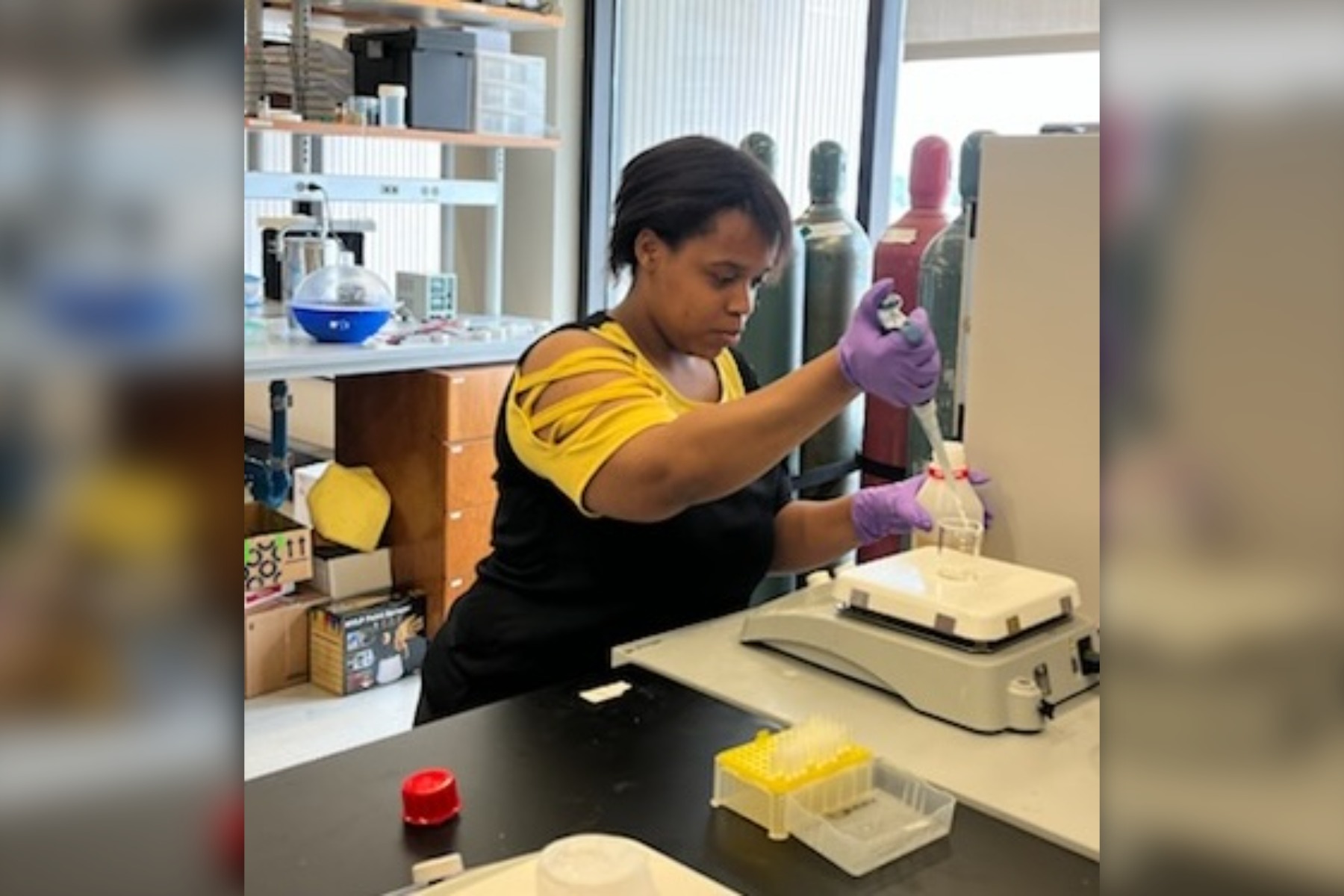
Keira Scott, an APSU engineering physics major, completed a National Science Foundation (NSF) Research Experiences for Undergraduates (REU) program this summer at the University of Pittsburgh. | Contributed photo
CLARKSVILLE, Tenn. — Keira Scott, an Austin Peay State University engineering physics major with a minor in mathematics, spent her summer at the University of Pittsburgh developing coatings to help address plastic pollution, one of the world's most serious environmental problems.
Scott, who grew up in a military family, was one of nine students selected nationwide for the National Science Foundation's Research Experiences for Undergraduates (REU) program, where she researched biodegradable alternatives to petroleum-based plastics.
The problem with plastics
Scott helped tackle a simple challenge: conventional plastics can take hundreds of years to break down in the ocean, releasing harmful chemicals that work their way up the food chain. Even some plastic alternatives, like PLA (a common "compostable" plastic), can prove just as harmful when they end up in landfills or oceans instead of industrial composting facilities.
One alternative is sodium alginate, a material derived from seaweed. Because it comes from the ocean, it breaks down naturally in water within days rather than centuries. However, it breaks down a little too well.
"As soon as it's exposed to water, it just degrades into something goopy," Scott said. "The issue is that it's really hydrophilic. It absorbs water from the air."
During the REU, Scott and her mentor worked to find a protective coating that would keep moisture out long enough for the material to be useful as packaging while still allowing it to biodegrade quickly once discarded. They experimented with beeswax and zein, a protein extracted from corn, to test how well different coatings repelled water by measuring the contact angle of water droplets on treated surfaces.
"If it has a high water contact angle, it shows that it's really hydrophobic, meaning moisture won't penetrate the barrier easily," Scott said.
The research involved constant trade-offs: too much beeswax improves water resistance but makes the material cloudy and less appealing for food packaging. The team also had to consider how long the coatings would take to break down in the ocean.
Keira Scott at the APSU College of STEM’s Academic Rush event. Scott has completed two REUs and is heavily involved on campus. | Photo by Megan Simpson
Building research experience
This opportunity was Scott’s second REU. In 2025, she studied hydrophobic thin film coatings for space telescopes at Brigham Young University.
Scott credits Austin Peay faculty, particularly Dr. Emmabeth Vaughn and Dr. Eugene Donev, for encouraging her throughout the process and opening doors to campus involvement. She has worked with both Vaughn and Donev on research as an undergraduate.
“Austin Peay is a hidden gem because the research opportunities we have here are so vast,” she said.
Beyond the lab work at the University of Pittsburgh, Scott gained insight into what graduate school actually looks like, including an overview of research proposals, qualifying exams and fellowship applications. She also gained more experience writing abstracts and practicing oral presentations.
"I didn't realize I didn't get summers off [as a graduate student]," she said, noting that her mentor worked diligently into the evenings five days a week.
Advice for aspiring researchers
Scott, who serves as the inaugural STEMbassador for the Department of Physics, Engineering and Astronomy, plans to share what she learned with other APSU students interested in research opportunities and encourage them to see REUs as a path to graduate school.
"A lot of people hear about internships and not so much about REUs," she said. "REUs are designed to help students figure out whether they want to go to graduate school or not."
In addition to the discipline-specific training, Scott built on her interpersonal skills in the workplace. She encourages students to build relationships with faculty early and get involved in research before their senior year.
"You don't want to be coming to professors in your senior year asking for a letter of recommendation, and they don't know you," Scott said.
For more information about research opportunities in the APSU Department of Physics, Engineering and Astronomy, visit www.apsu.edu/physics.
About the Austin Peay College of STEM
The College of Science, Technology, Engineering & Mathematics (STEM) provides studies for students in the areas of agriculture, astronomy, aviation sciences, biology, chemistry, computer science, earth and environmental sciences, engineering physics, engineering technology, information technology, mathematics, medical laboratory sciences, radiologic sciences and physics. Its outstanding, discipline-based programs are student-centered and designed to prepare students for responsible positions at all levels of research, industry, education, medicine and government. Follow the College of STEM on Facebook, Instagram and LinkedIn.