


Crushed barrels and shattered watermelons: APSU’s professional mad scientist bringing Gov School demos to Zoom
(Posted June 26, 2020)
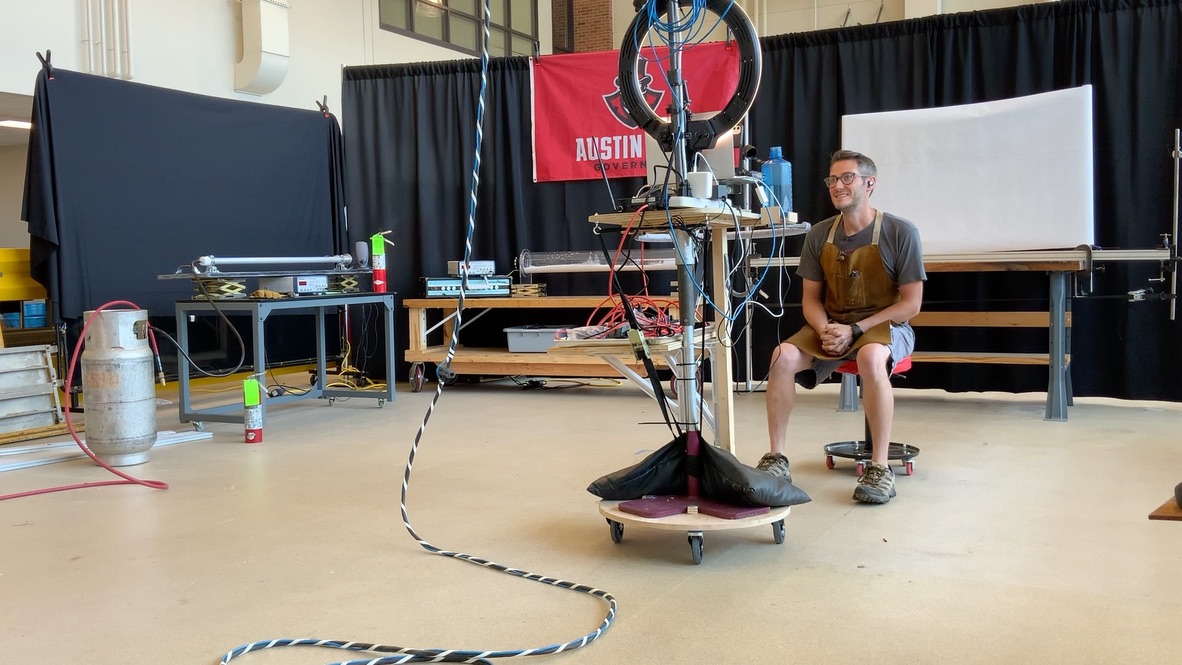
Austin Peay State University’s professional mad scientist is at it again.
Each summer, Bryan Gaither orchestrates several science demonstrations during the Governor’s School for Computational Physics.
Every year until this year, he’s fired off those demos in person, giving the state’s brightest students who attend the three-week residential college experience a breather from the classroom.
This year is different. Governor’s School is entirely online, mostly conducted on Zoom, but that hasn’t slowed Gaither, who’s also the Department of Physics, Engineering and Astronomy’s lab manager.
Gaither is determined to deliver his demos, which offer important physics lessons. Some are parts of the labs offered during Governor’s School.
Here’s a sampling of this year’s demos, one of which earned Gaither a new nickname – The Barrel Slayer.
Meet the Barrel Slayer
The demo that most impressed the Gov School students happened on Tuesday, June 23, when Gaither crushed a 55-gallon steel barrel using nothing but atmospheric pressure.
The demo goes like this:
- Gaither boils a bunch of water inside the barrel, the water turns to steam, and Gaither caps the barrel, trapping the steam inside.
- Gaither usually cools the steam inside the barrel by placing the drum in a pool filled with ice. This time, however, he improved the demo by hanging the barrel from a gantry crane and spraying super-chilled water on the barrel.
- Within a minute or two, the steam condenses into water, which shrinks the atmospheric pressure inside the barrel. The atmospheric pressure outside the barrel overwhelms the steel barrel, crushing it instantly.
- In other words, the barrel implodes. The air crushes the barrel. In person, you can feel the concussion of the implosion reverberate through your body. The crush is very loud and fast.
During the Governor’s School demo, the students, watching via Zoom, were anxious but ho-hum. Until the barrel imploded.
When Gaither logged back into the class later in the week, one of the students greeted him with, “Barrel Slayer!”
Can thermite melt through an airplane fuselage?
On Friday, June 19, Gaither tried out a new demo: using thermite to melt through an iron plate. Here’s how it goes:
- Thermite – a mix of iron oxide rust and aluminum powder – burns at 4,000 degrees Fahrenheit. The reaction is intense and quick and can cause iron to turn molten.
- Gaither tried to burn through a hunk of cast iron by using 1.3 pounds of thermite, but the reaction was so intense on Friday, it ended before burning through clay pots (needed to contain the reaction) and reaching the iron below.
- “That just means we have to go to a much bigger scale,” Gaither told his Zoom audience. He plans to use 12 pounds of thermite to try to melt through an airplane fuselage on Friday, June 26, during the Governor’s School last day activities.
Watermelons take flight
Austin Peay has a siege machine, and Gaither built it.
He built the 12-foot-tall trebuchet last year to use as an outreach tool to help students model projectile motion in a real-world engineering setting.
He set up the trebuchet at APSU’s beach volleyball courts on Wednesday, June 24, and launched 12-pound watermelons up to 275 feet. The melons, of course, shattered upon impact.
The Governor’s School students offered up a suggestion for a future trebuchet demo: Launching watermelons at 55-gallon steel barrels set up like bowling pins.
Austin Peay provides the Governor’s School for Computational Physics, which is an introduction to computational problems in physics and engineering. The students earn four credit hours – for Physics 2500 and Physics 2501 – by completing the school.
The school runs through June 26 and includes coding, lab work, class lectures and homework. The school normally is a residential, face-to-face experience, but the coronavirus crisis forced this year’s lessons online.

To learn more
- For more about the APSU Department of Physics, Engineering and Astronomy, go to https://www.apsu.edu/physics/.
- For more about the APSU Department of Mathematics and Statistics, go to https://www.apsu.edu/mathematics/.
- For more about Governor’s Schools across the state, visit https://www.tn.gov/education/instruction/tdoe-governors-schools.html.
News Feed
View All News
Austin Peay State University has announced six inductees into the APSU Governors Military Hall of Fame Class of 2026, to be honored during a reception and induction dinner on Friday, Nov. 6, in the Morgan University Center Ballroom.
Read More
Austin Peay State University has received a generous gift from The Ivy Endowment Circle to establish the Glistine Green Jones Scholarship Endowment. The endowment honors Glistine Green Jones' legacy of mentorship, service, and leadership within Alpha Kappa Alpha Sorority, Incorporated® Kappa Rho Chapter.
Read More
Austin Peay State University's Zone 3 Press, with support from the Center of Excellence for the Creative Arts, will host Newbery Honor-winning Lipan Apache author Darcie Little Badger for a free public reading and book signing at 7 p.m. on Nov. 5 in Art + Design Room 120.
Read More