


APSU professor earns NSF grant to study identity development in engineering student veterans
By: Colby Wilson July 15, 2026
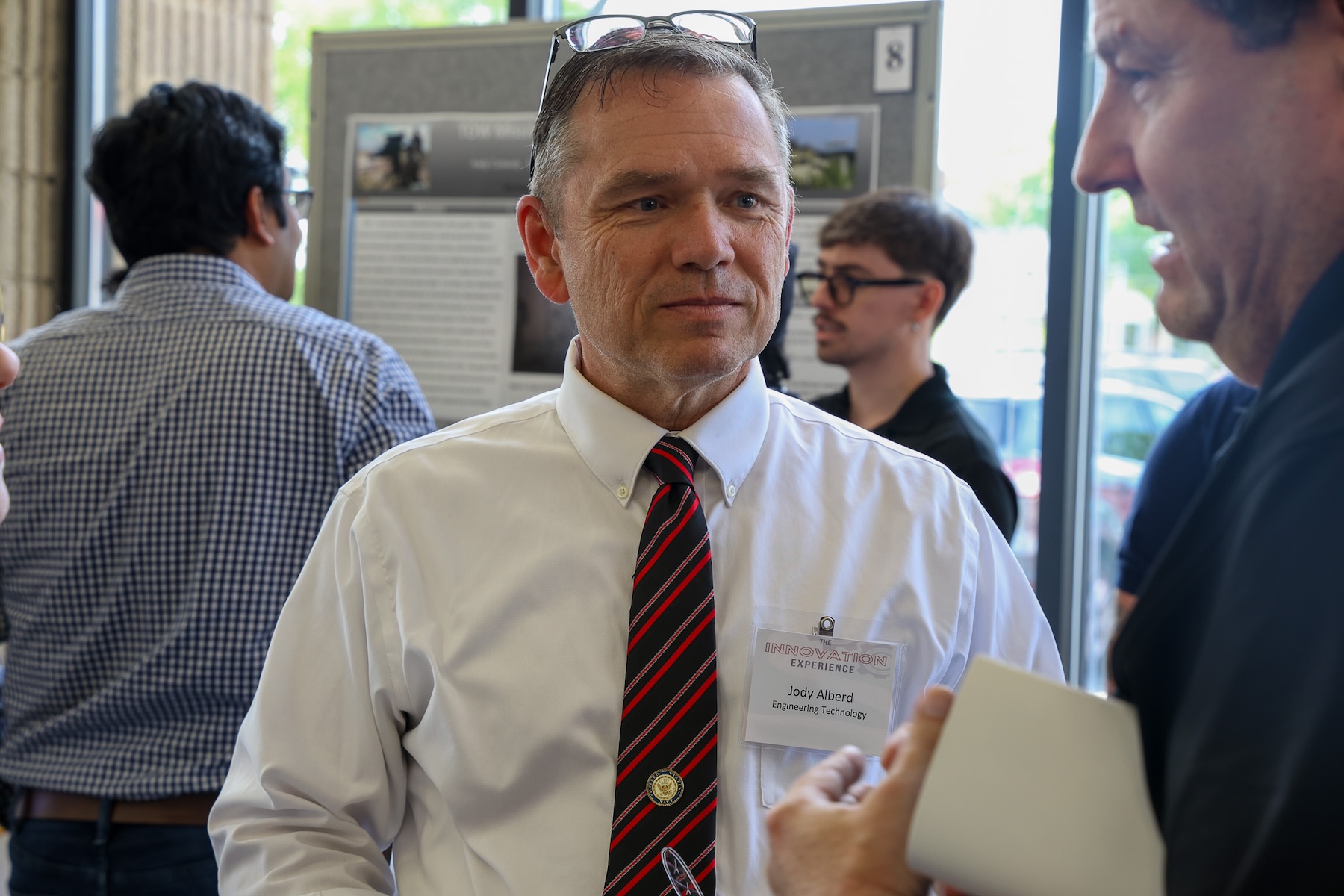
Jody Alberd, an assistant professor in Austin Peay State University’s Department of Engineering Technology, attends the College of STEM’s annual Innovation Experience. | Photo by Colby Wilson
CLARKSVILLE, Tenn. — Jody Alberd knows the challenge of transitioning from military service to engineering studies. After 20 years in the Navy, he found himself at Austin Peay State University navigating the same academic halls he now teaches in as an assistant professor in the Department of Engineering Technology.
That personal experience has now evolved into groundbreaking research. Alberd recently received his first National Science Foundation (NSF) grant as principal investigator—a Research Initiation in Engineering Formation (RIEF) award to study how student veterans develop their engineering identity throughout their senior capstone design projects.
"Veterans come in with a very strong and very powerful military identity that's already well established," Alberd said. "So we want to look at, how does that transition into an engineering identity formation?"
The two-year study will focus on student veterans in engineering physics and engineering technology programs, examining a critical juncture in their academic careers when theoretical knowledge meets practical application.
From Personal Experience to Research Questions
Alberd's research path began with his journey from naval service member to engineering educator. After retiring from the Navy, he completed his engineering technology degree at Austin Peay, experiencing firsthand the identity challenges he now seeks to understand academically.
"One of the things I think that student veterans struggle with is understanding that that military identity doesn't have to be completely exclusive to the engineering identity," he said. "You can integrate those together, and they just don't necessarily know how to do it before they get into these projects."
The research addresses what Alberd describes as a unique form of imposter syndrome for veterans.
"You come in and you see yourself as a soldier or a sailor or a Marine, and then now you have to see yourself as an engineer," he said. "That's a challenge for everybody, but more so when you have already established a strong identity through your military career."
How the Study Works
The study will follow student veterans throughout their senior capstones, interviewing each participant at the beginning, middle, and end to track their evolving sense of identity.
Alberd said the research seeks to answer three questions:
-
How do student veterans experience and describe their engineering identity development during the capstone design projects?
-
What aspects of that capstone environment—whether it be teamwork, mentorship, or the technical challenges—support or even possibly inhibit their identity formation?
-
How do student veterans reconcile their prior military identity with their new emerging identity as engineers?
Nothing about the capstone experience will change for participating students. The goal is to observe the current process and understand how identity takes shape within Austin Peay's engineering programs.
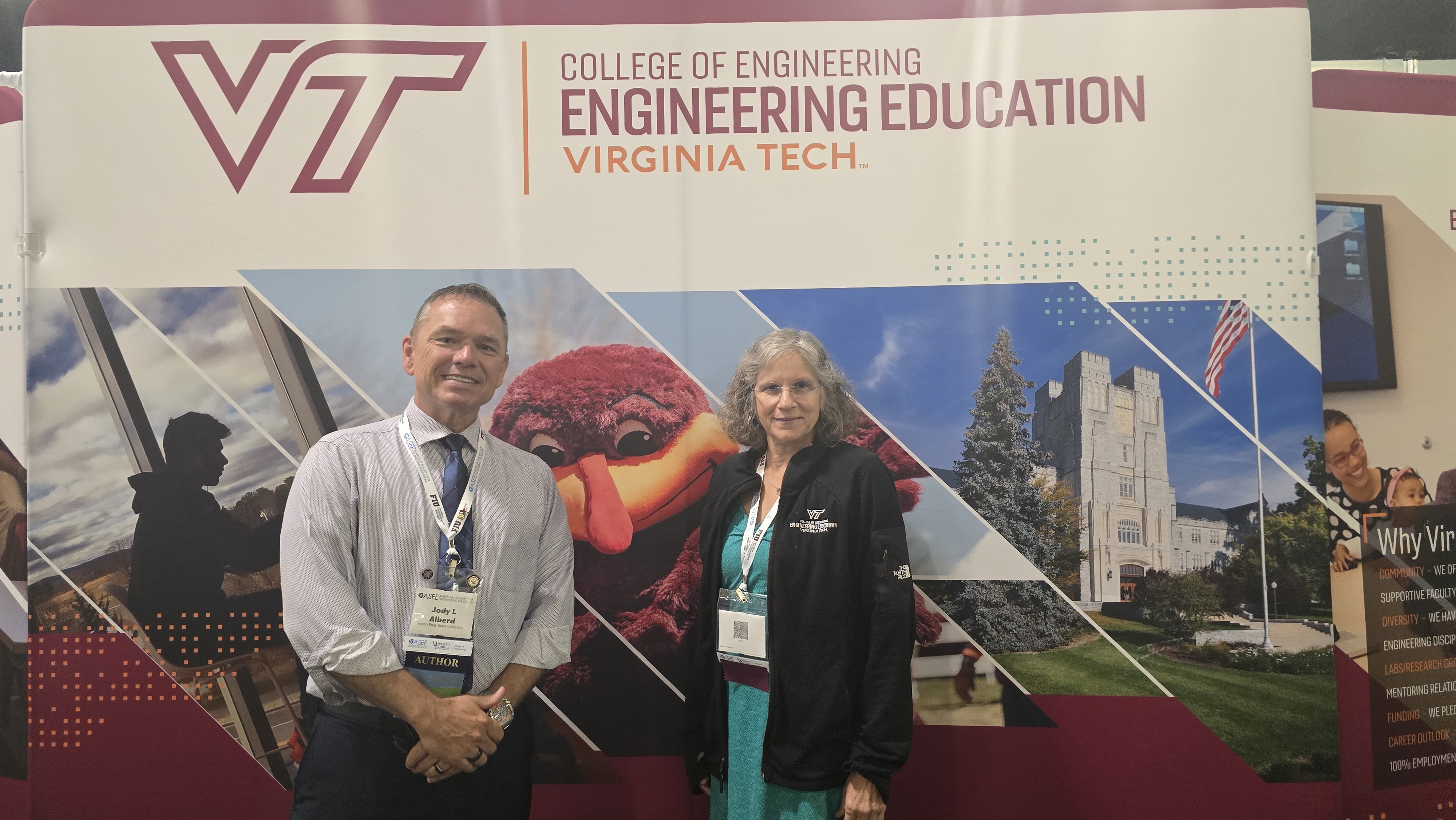
Jody Alberd with Dr. Marie Paretti, a professor of engineering at Virginia Tech and the co-principal investigator for Alberd’s research project. | Contributed photo
Collaborative Academic Partnership
Although this is Alberd's first NSF grant as principal investigator, he has assembled an experienced support team. His co-principal investigator is Dr. Marie Paretti from Virginia Polytechnic Institute and State University, who has an extensive background in engineering education research and capstone project development.
Paretti will serve as Alberd’s mentor for the project, offering strategic guidance and support in its design, implementation, and evaluation.
That partnership grew out of a challenging but educational three-month grant writing process.
“At one point, I think I was halfway through—a month and a half into writing this—and I realized I was approaching it like a project and not research,” Alberd said. “So I scrapped everything I had, and I restarted.”
Feedback from an NSF program officer also proved formative in the study’s development and ultimately connected Alberd with his mentor.
"Initially, when I approached one of the NSF program officers, he did not like my proposal," Alberd said. "He said it was too basic and it wasn't specific enough. That's when I decided to focus on capstone projects specifically, and he recommended that I reach out to Dr. Paretti, who really helped me focus the project and develop the research methods we are going to use."
The project's advisory board brings together several experts: Dr. Allison Godwin from Cornell University, who created the engineering identity formation framework the study is based upon; Dr. Brian J. Novoselich, a retired colonel and current CEO of the American Society for Engineering Education; Dr. Emmabeth Vaughn from Austin Peay, who has previously worked with Alberd on another NSF grant and is a prior recipient of a RIEF grant; and Dr. Eva Gibson from Austin Peay's psychology department, who has prior experience serving on the advisory board for a RIEF project.
Beyond Individual Programs
Austin Peay's proximity to Fort Campbell makes it an ideal location for this research, providing access to a significant population of student veterans. However, Alberd envisions the work expanding to other universities and disciplines.
"The difficulty of identity formation for veterans isn't just exclusive to engineering," he said. "It's also to see yourself as an accountant or a business major or an artist or a musician. Seeing yourself as anything other than a military service member."
Looking Ahead
The research officially begins this academic year, with Alberd conducting interviews and working closely with Paretti to analyze them. The advisory board will meet twice a year to review the study’s methods and findings.
Alberd sees the project as part of addressing the broader challenge veterans face when leaving the military: "I can't eat the whole elephant, but I can help with this bite."
About the Austin Peay College of STEM
The College of Science, Technology, Engineering & Mathematics (STEM) provides studies for students in the areas of agriculture, astronomy, aviation sciences, biology, chemistry, computer science, earth and environmental sciences, engineering physics, engineering technology, information technology, mathematics, medical laboratory sciences, radiologic sciences, and physics. Its outstanding, discipline-based programs are student-centered and designed to prepare students for responsible positions at all levels of research, industry, education, medicine, and government.