


Austin Peay’s Science on Tap to explore the science of ‘Jurassic Park’

(Posted on Wednesday, Feb. 23, 2022)
When Austin Peay State University’s Science on Tap returns to Strawberry Alley Ale Works on March 1, Dr. Catherine Haase, Dr. Kallina Dunkle and Phil Roberson will explore the science portrayed in the 1993 movie “Jurassic Park.”
They’ll discuss inaccuracies in the movie and the common misconceptions that the movie spawned about dinosaurs. They’ll also talk about the creative liberties that filmmakers take to not always get the science right.
The three will speak at “Science in the Movies: Jurassic Park Edition” at 5:30 p.m. Tuesday, March 1, at Upstairs at Strawberry Alley on the second floor of Strawberry Alley Ale Works.
Last fall, Haase – professor in Austin Peay’s Department of Biology – taught an honors-level class that investigated the science portrayed in blockbuster Hollywood movies. In the class, students used critical thinking to analyze how the science in the movies stacked up to real science.
Tuesday’s Science on Tap will give attendees the same opportunity with “Jurassic Park,” the movie (based on Michael Crichton’s 1990 novel) that launched a franchise – and a generation of misinformed amateur paleontologists.
“I mean, I am a paleontologist, mostly because of ‘Jurassic Park’ at a young age,” said Roberson, lab manager for Austin Peay’s Department of Geosciences. “Even though it’s very inaccurate, that doesn’t mean that I don’t watch it periodically. Once every year or couple of years, I’ll pop in the DVD to revisit what inspired me to be who I am.”
Unraveling the movie’s (degrading) DNA
Haase will start the presentation by talking about the impetus for the class, “being critical about what we see on the big screen.” After that, Dunkle – associate dean of the College of STEM and a geology professor – and Roberson will focus on “Jurassic Park.”
“We want to talk about the common misconceptions, what they got wrong,” Roberson said. “Some of it was good at the time. Some of it wasn’t.”
Their discussion will expand beyond the movie and dinosaurs into geophysics and genetics. They’ll answer the question, “Could we actually make dinosaurs from million-year-old DNA?”
“We’ll talk about what’s wrong with that and what the reality would be,” Dunkle said. “We know that DNA degrades – even if a mosquito did bite a dinosaur and got immediately encapsulated in amber, which is astronomical odds to begin with, the degradation still happens.”
If you’re planning to attend Science on Tap, Dunkle encourages you to watch the original “Jurassic Park” first, especially if you haven’t seen the movie in a while.
Don’t be afraid – a real-life velociraptor can’t open the door.
Science on Tap meets at 5:30 p.m. on the first Tuesday of every month, bringing together two great things: science and local brews. Science on Tap is hosted by Austin Peay’s College of Science, Technology, Engineering and Mathematics.
News Feed
View All News
Austin Peay State University's Zone 3 Press, with support from the Center of Excellence for the Creative Arts, will host Newbery Honor-winning Lipan Apache author Darcie Little Badger for a free public reading and book signing at 7 p.m. on Nov. 5 in Art + Design Room 120.
Read More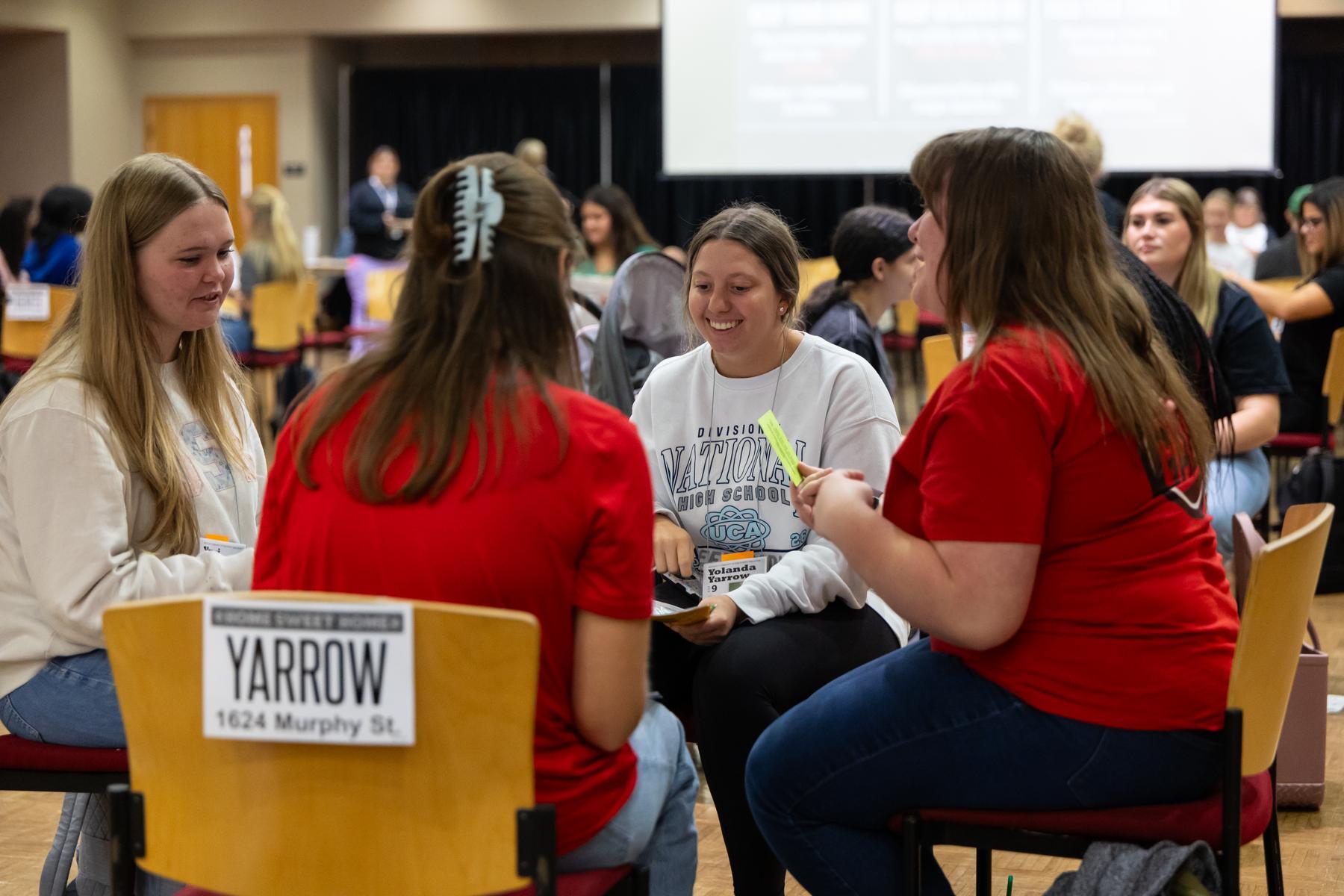
Nearly 150 Austin Peay State University students took on the roles of families experiencing financial hardship during an immersive poverty simulation on Oct. 5, exploring how limited resources can affect access to housing, transportation, healthcare, and more.
Read More
The exhibition will run from Oct. 30 to Jan. 7 at the Customs House, along with a Nov. 7 reception. It features the work of exemplary APSU students alongside faculty, showcasing the range, development, and skill within the Department of Art + Design.
Read More