


Austin Peay State University launches Tennessee's first Principal Registered Apprenticeship Program
By: Megan Simpson January 14, 2026
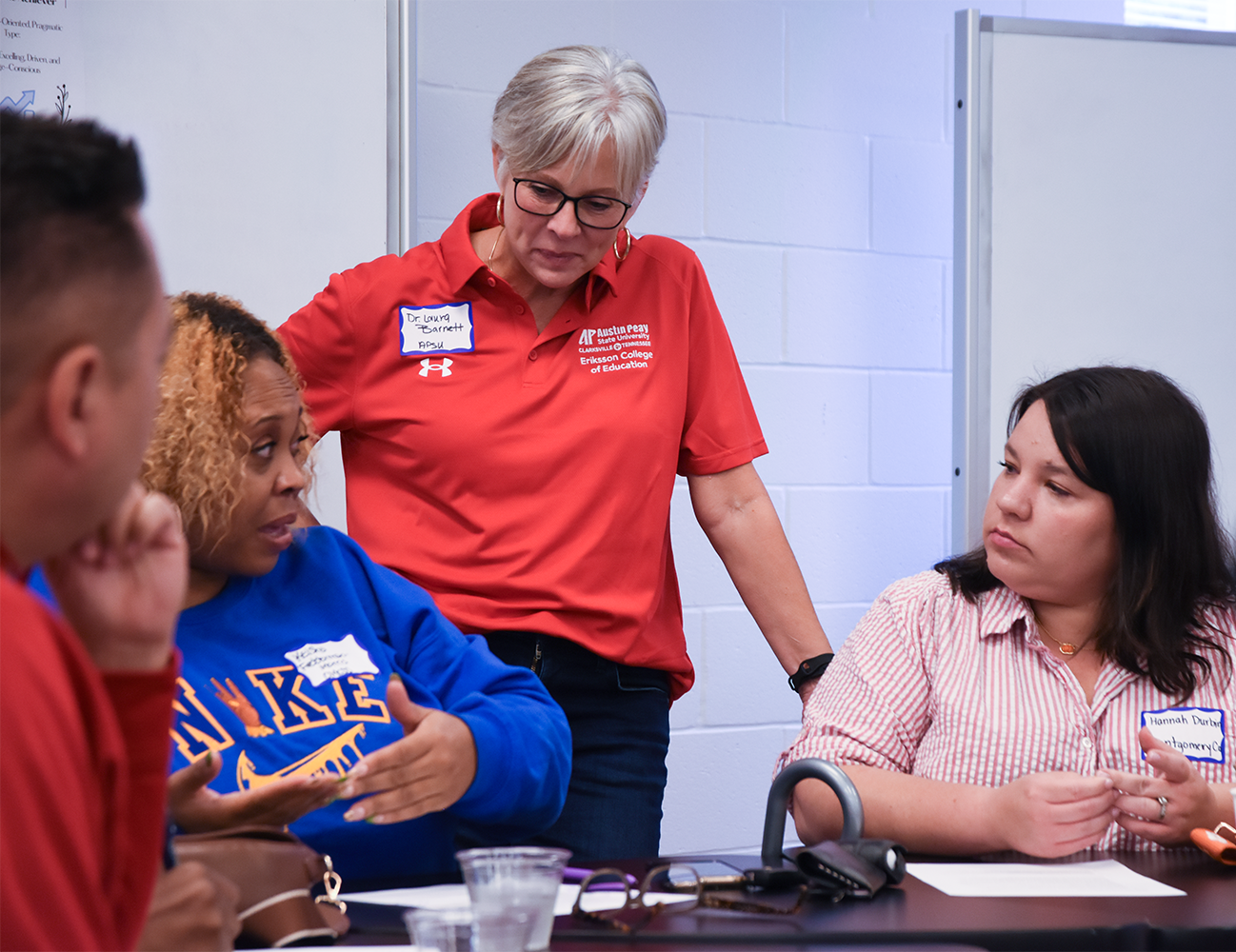
Dr. Laura Barnett (center) discusses a leadership case study with Master of Arts in Education in educational leadership studies students at Austin Peay State University. This master’s program — now the first federally-registered principal apprenticeship in Tennessee — prepares students to serve as instructional leaders. | Photo by Megan Simpson
CLARKSVILLE, Tenn. — Austin Peay State University’s Eriksson College of Education recently launched Tennessee’s first Principal Registered Apprenticeship Program (PRAP), a groundbreaking initiative to train the next generation of school leaders through a federally approved “earn while you learn” model.
The program has already secured partnerships with 54 Tennessee school districts, with 120 aspiring principals enrolled in the accelerated master's degree program this fall through the apprenticeship pathway.
“Partnering with APSU on this groundbreaking apprenticeship program is an exciting step forward,” said Tennessee’s Commissioner of Education Lizzette Reynolds. “Together, we’re breaking down barriers for Tennessee’s future principals and strengthening the leaders our schools need to thrive.”
The PRAP marks a historic milestone for Tennessee education, applying the successful registered apprenticeship model — traditionally used in skilled trades — to school leadership preparation. Participants will work as paid apprentices in their school districts while completing a Master of Arts in Education in educational leadership studies through APSU, receiving full-tuition scholarships and mentorship from experienced principals.
“This ‘earn while you learn’ model removes the biggest barriers — tuition, time away from work, and distance from quality programs — so talented educators across urban, suburban, and rural communities can advance into leadership,” said Dr. John McConnell, interim dean of the Eriksson College of Education. “It’s a practical, affordable, and scalable approach that keeps rising leaders rooted in the schools and communities they already serve. It also aligns what districts need with how we prepare leaders.”
The program has secured $800,000 in federal funding through the Tennessee Department of Education, which serves as the official sponsor of the registered apprenticeship program. The grant provides up to $6,425 per apprentice to cover tuition and program costs in the 2025-26 academic year.
This initiative also addresses a critical need. According to national research, principal turnover rates remain higher than before the COVID-19 pandemic, with many districts struggling to
find qualified candidates. Traditional principal preparation programs often require
educators to reduce their work hours or take on significant debt — barriers that discourage
talented teachers from pursuing leadership roles.
How the Program Works
APSU’s PRAP eliminates these obstacles. Participants complete a fully online master’s degree in an accelerated one-year format — 10 courses delivered in 7.5-week terms from August 2025 through July 2026.
School districts nominate candidates and enter PRAP partnership agreements with APSU. Districts provide a mentor principal from the candidate's building and coordinate release time for job-embedded leadership work. These mentors guide apprentices through real-world challenges, while APSU faculty deliver evidence-based instruction aligned with Tennessee Instructional Leadership Standards.
“The whole program is intended to be driven by the needs of the district,” said Dr. Christi Maldonado, Eriksson College of Education associate dean and assistant program coordinator. “This is a way for them to take people who are in their schools already and in their communities and have multiple layers of support to get them ready to fulfill needed leadership roles.”
While enrolled, participants receive an aspiring instructional leader license, enabling them to serve in administrative roles before graduation.
A New Model for School Leadership Development
The apprenticeship structure represents a fundamental shift in how Tennessee prepares school leaders. PRAP creates formal partnerships between universities, school districts, and the state.
"The biggest difference in this route is that there is a contract with the student's district," said Dr. Laura Barnett, Eriksson College of Education associate dean and program coordinator. "They've been nominated by their district. They are being given support by their district, and they have the state that is overseeing it to make sure that there's quality and fidelity."
This three-way commitment ensures candidates receive coordinated support throughout their training and follows in the steps of states like North Dakota, which launched principal apprenticeships in the U.S. in 2023.
"Everything that they're learning on the theory side, they're getting to view through the lens of what's happening in their particular school and their districts and their communities," Maldonado said. "I anticipate that people who graduate from the program are not going to have as much of a gap and a learning curve to step into leadership."

Hundreds of students have graduated from Austin Peay State University’s Master of Arts in Education program in Educational Leadership Studies in recent years, and program leaders are excited to experience continued growth as they implement the new apprenticeship model for this school leadership degree.
Building on a Foundation of Innovation
This principal apprenticeship model builds on APSU's pioneering work in teacher preparation. In January 2022, the university’s partnership with the Clarksville-Montgomery County School System became the first federally registered teaching apprenticeship program in the U.S. — a model that has since been replicated nationwide.
The Grow Your Own Teacher Residency emerged from a collaboration between APSU's Eriksson College of Education and CMCSS to address the national teacher shortage. The innovative approach provided recent high school graduates and teacher's aides with an accelerated, tuition-free path to become licensed educators in three years while working as paid residents in local schools.
The success was immediate and dramatic. By August 2022, APSU graduated its first cohort of 40 teacher apprentices — students like Malachi Johnson, who earned his bachelor's degree just three years after high school and immediately began teaching at Byrns Darden Elementary School. The program's impact caught national attention, with the White House citing APSU's model in its 2022 plan to address nationwide teacher shortages.
Tennessee became the first state to receive U.S. Department of Labor approval for a permanent Teacher Occupation Apprenticeship framework, enabling multiple Grow Your Own partnerships statewide. The initiative garnered praise from U.S. Secretary of Education Miguel Cardona and U.S. Secretary of Labor Marty Walsh, who called it "a bold solution to cultivate teaching talent."
About the Eriksson College of Education
The Eriksson College of Education prepares dynamic teachers and educational leaders to positively impact communities and schools in the 21st century. The college offers initial and advanced licensure and non-licensure programs. The college’s programs, including the nationally known Grow Your Own Teacher Residency, are accredited by the Council for the Accreditation of Educator Preparation (CAEP). For more information, visit apsu.edu/education.