


APSU student develops eco-friendly plastics at Oak Ridge National Laboratory
By: Colby Wilson September 11, 2025
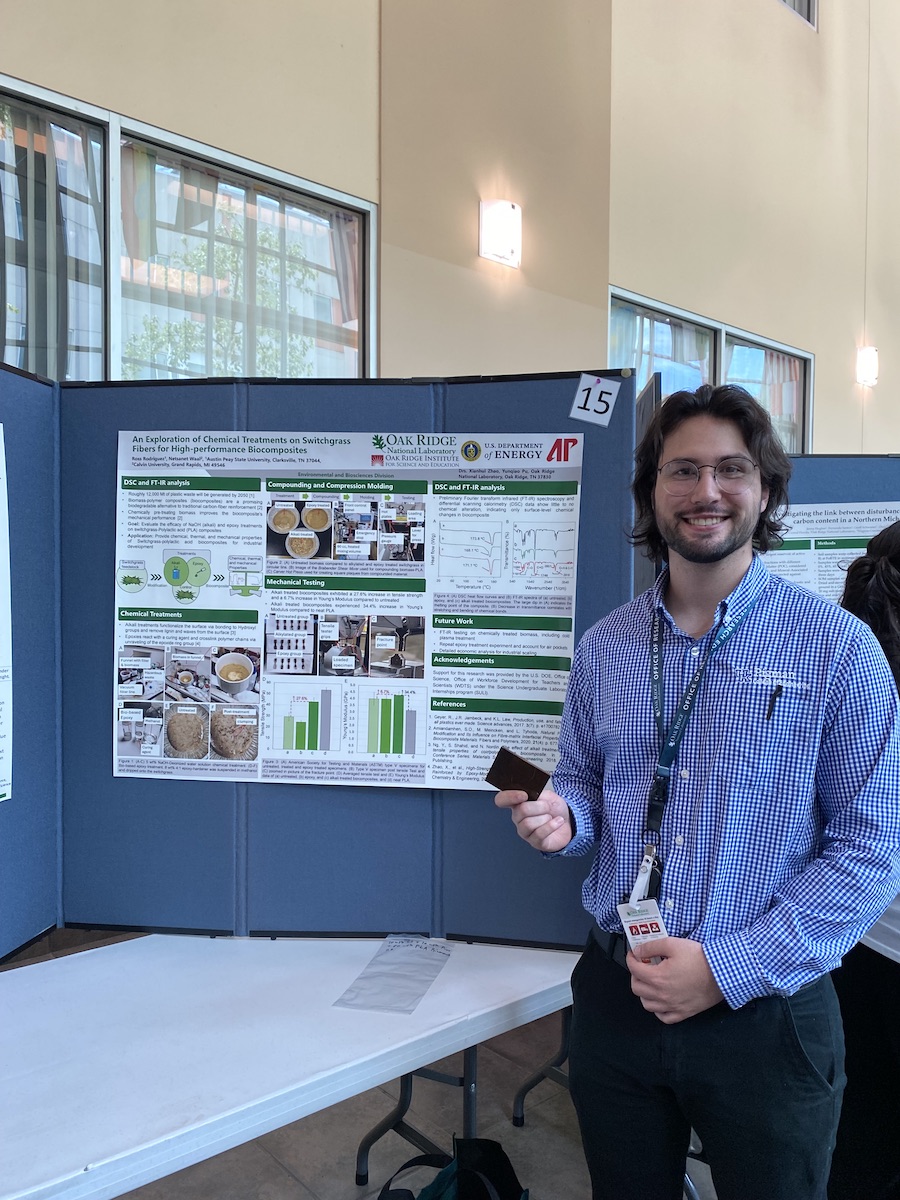 CLARKSVILLE, Tenn. — Ross Rodriguez knew the statistics were daunting: by 2050, the
world is projected to produce about 12,000 megatons of plastic pollution, much of
it from manufacturing used in everything from aerospace parts to automobiles.
CLARKSVILLE, Tenn. — Ross Rodriguez knew the statistics were daunting: by 2050, the
world is projected to produce about 12,000 megatons of plastic pollution, much of
it from manufacturing used in everything from aerospace parts to automobiles.
But armed with natural plant fibers, chemical treatments, and 10 weeks at Oak Ridge National Laboratory, the Austin Peay State University engineering physics student set out to tackle this environmental challenge head-on.
Rodriguez was one of the first students from Austin Peay's engineering physics program to earn a coveted Science Undergraduate Laboratory Internship (SULI) through the Department of Energy — a highly competitive program that required three essays, multiple letters of recommendation, and what Rodriguez describes as "a billion questions" on the application.
"I didn't know that Steven and I were the first ones to get it," Rodriguez said, referring to fellow Austin Peay student Steven Warth, who also earned a SULI position. "It's a competitive program, and the whole application process took me probably a week to fill everything out."
From Theory to Practice
Rodriguez's project focused on developing biodegradable composite materials that could replace traditional carbon fiber reinforcements. The challenge: polymers like PLA (polylactic acid) are flexible but not strong, while carbon fiber reinforcements provide strength but aren't biodegradable.
"We're utilizing the fiber aspect, the reinforcing aspect from plant fibers and incorporating them into polymer matrices as a substitute for carbon fiber," Rodriguez said. "You get that increase in rigidity that you need for high-performance composites, but you also get that sustainability aspect because it makes it biodegradable."
His research used biomass fibers from sources like tree bark and various grasses, whose components provide natural strength. The resulting composites are not only biodegradable but also cheaper, lighter, and better suited for aerospace applications than traditional alternatives.
The trade-off, however, is brittleness. While the bio-composites are stronger and more rigid, they lose some flexibility and break sooner than traditional polymers.
Solving the Adhesion Problem
Much of Rodriguez's work focused on chemical treatments to improve how plant fibers bond with polymer matrices. The problem: natural fibers have waxy coatings that cause them to slip out of the polymer matrix during stress, leading to premature failure.
"Most of that is due to the fact that the fibers dislodge themselves when they're being pulled apart before the polymer or the fiber itself breaks," Rodriguez said. "So it's bad adhesion."
His solution involved surface treatments using sodium hydroxide to wash and abrade fiber surfaces, removing waxes and impurities. The process is then neutralized with acetic acid to bring pH levels back to safe, environmentally-friendly levels.
Rodriguez also experimented with bio-based epoxy treatments that act as a biodegradable glue between fibers and polymers, helping prevent slippage while maintaining environmental sustainability. With all deliverables due at the end of the eighth week of the program, Rodriguez was on a strict timeline to reach his conclusions.
The Oak Ridge Experience
Working primarily at Oak Ridge's main campus and the Manufacturing Demonstration Facility in Hardin Valley, Rodriguez's days were split between literature research, experimental design, and hands-on laboratory work.
The work was largely independent, with weekly mentor meetings and collaboration with other researchers on adjacent projects. Rodriguez worked under two mentors due to space constraints, using lab facilities in one building while reporting to his original mentor in another.
"I was very independent; it was very hands-off with my mentors," Rodriguez said. "A lot of it is on the student, which I actually really appreciated because a lot of times, especially in industry work, it's all down to you to get your work done."
The program required substantial writing — Rodriguez produced both a research paper and poster presentation, with all deliverables requiring security clearance and export control review before public release.

Ross Rodriguez’s research poster outlines his work at Oak Ridge National Laboratory.
Historical Perspective and Future Vision
The experience at Oak Ridge, with its history dating back to uranium enrichment for the Manhattan Project, provided Rodriguez with both inspiration and career clarity.
"I got to see a lot of the rich history at Oak Ridge - we actually got to see the original graphite reactor where they enriched uranium," he said. "Because of the history, there's a lot of high expectations even for the interns. But also, the mentors do a great job working and trying to grow you as a student and person."
The exposure helped Rodriguez determine his career path: pursuing a master's degree and working in Oak Ridge's manufacturing sector, which offers a balance between the freedom of research and the fast pace of industry applications.
Austin Peay Advantage
Rodriguez credits his preparation at Austin Peay, particularly his work with Dr. Emmabeth Vaughn on 3D printing research, for his success at Oak Ridge.
"I think the faculty in the engineering physics department have helped me so much with preparing for internships and specifically research-based internships like this," he said.
He noted that Austin Peay's status as a primarily undergraduate institution provides advantages that larger research universities cannot match.
"Because it's smaller, there's a lot more interaction and a lot more time that you can have to spend with your mentors," Rodriguez said. "There's a lot more one-on-one experience and hands-on experience as an undergraduate in research specifically that you wouldn't get at an R1 institution."
At larger universities, he said undergraduates often find themselves "at the bottom of the totem pole," primarily interacting with graduate students rather than faculty researchers.
"Here, you can try [research]," Rodriguez said. "They're very willing to work with you and try it, especially if you're interested, no matter how your experience has been in undergrad."
Rodriguez's achievement opens doors for future Austin Peay students seeking opportunities at national laboratories, while his research is contributing to addressing one of the world's most pressing environmental challenges.
About the Austin Peay College of STEM
The College of Science, Technology, Engineering & Mathematics (STEM) provides studies for students in the areas of agriculture, astronomy, aviation sciences, biology, chemistry, computer science, earth and environmental sciences, engineering physics, engineering technology, information technology, mathematics, medical laboratory sciences, radiologic sciences and physics. Our outstanding, discipline-based programs are student-centered and designed to prepare students for responsible positions at all levels of research, industry, education, medicine and government.