


APSU speech pathologists sound off on language milestones for the new school year
By: Seth Riker July 16, 2025
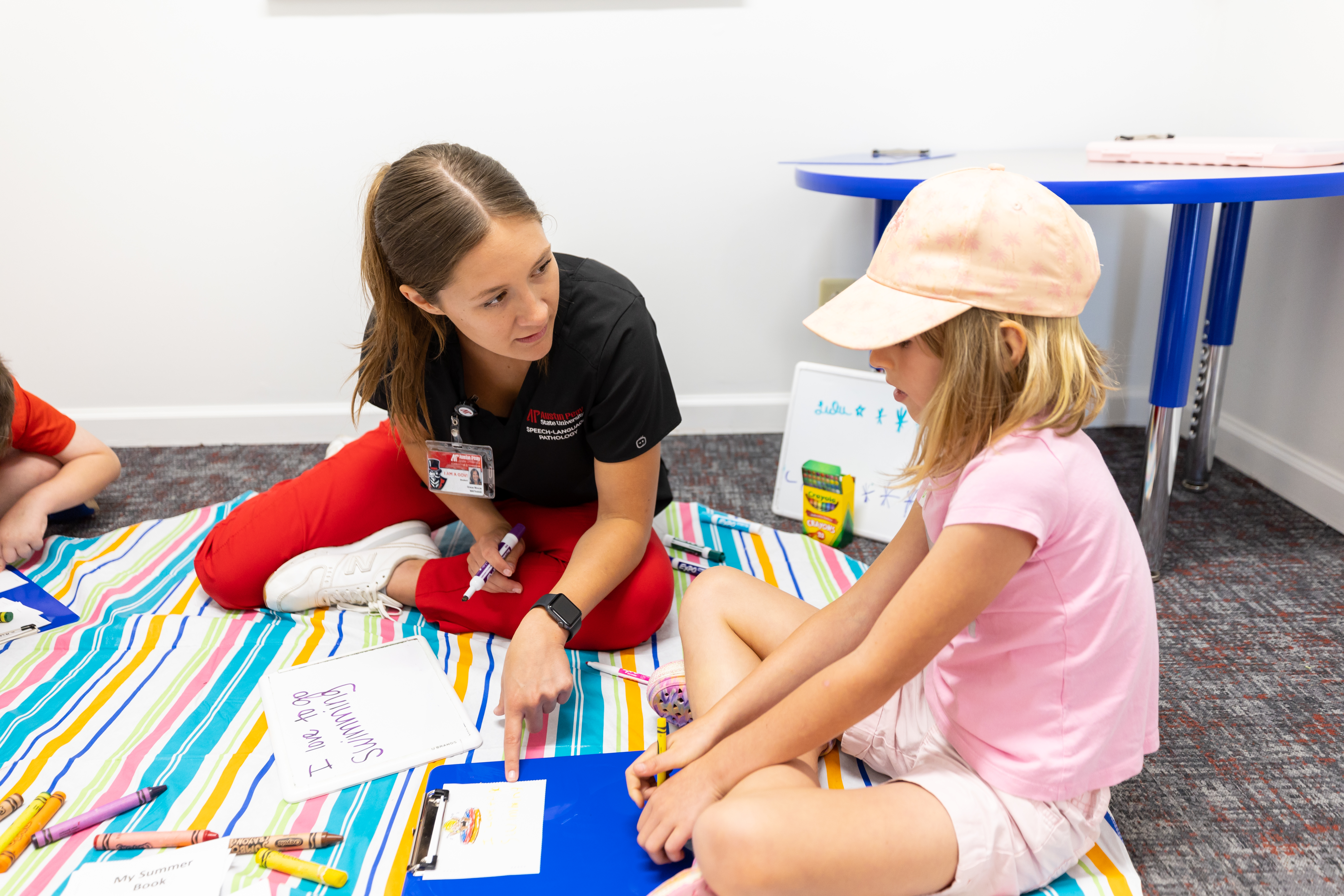
A student clinician from APSU’s Master of Speech-Language Pathology program mentors a young learner during a summer camp promoting speech, language, and literacy skills. | Photo by Sean McCully
CLARKSVILLE, Tenn. - The start of a new school year brings a wave of excitement and anticipation. New teachers, sharpened pencils, fresh routines. But for many parents, it may also bring worry: Is my child where they need to be? Are they communicating clearly? Will they be able to keep up?
For parents of young children, especially those in preschool through elementary, concerns about speech and language development are common. Dr. Kelly Kleinhans, director of Austin Peay’s Master of Speech-Language Pathology program, regularly works with families navigating these exact questions.
"Everyone wants their child to be happy, successful, and socially connected," Kleinhans says. "When communication becomes a challenge … when a child doesn't respond to their name, isn't easily understood by others, or struggles to express themselves, parents notice. They worry, and rightfully so. Communication is at the core of both academic learning and social development."
One of the first steps Kleinhans’ team offers is a screening, a simple way to determine if a child's abilities fall within a typical range or if further assessment is needed.
"Sometimes we find everything is on track, and we offer home strategies,” she said. “Other times, we move into a more detailed evaluation to better understand how to support the child."
This individualized approach becomes especially important as children enter the classroom.
"School is a language-based environment," Kleinhans said. "From circle time in preschool to book reports in third grade, students are constantly being asked to express themselves, listen, describe, and explain. If they struggle with language, they might also struggle to engage, participate, or keep up."
Early intervention can help children build the confidence and skills they need before those struggles become setbacks. But Kleinhans is quick to point out that every child is different.
"Some kids are incredibly resourceful and find ways to communicate no matter what,” she said. “Others may withdraw if they feel misunderstood. That’s why we take the time to really understand each child’s needs."
Kleinhans also notes that developmental context matters. Factors like cultural norms, individual temperament, and bilingual environments can influence how and when a child expresses themselves. Even for those with typical development, parents can help nurture speech and language skills at home.
"Reading is huge," Kleinhans said. "It builds vocabulary, sequencing, and prediction skills … so much of what supports classroom learning. You can even talk about a video they love, ask what happened, and what might happen next. Follow their interests. That's where learning sticks."
What to Watch For
Speech and language milestones can vary, but the APSU Speech-Language Pathology team offers these general guidelines:
By Age 2:
-
Using simple words like “mama,” “ball,” or “up.”
-
Producing early sounds like p, b, m, h, and w.
By Age 3:
-
Using sounds like k, g, f, t, d, and n.
-
Speech is mostly understood by familiar adults.
By Age 4:
-
Engaging in simple conversations.
-
Understanding basic concepts like colors, shapes, and directions.
By Age 5-6:
-
Telling short stories and retelling events.
-
Using complete sentences with proper grammar.
Concerns may arise if a child frequently struggles to follow directions, is difficult to understand, or seems frustrated when trying to express themselves.
Free Support for Families
The APSU Speech-Language & Swallowing Community Clinic offers free screenings and therapy services, led by graduate student clinicians under the supervision of licensed, certified faculty. To schedule an appointment for Fall 2025, contact the clinic at 931-221-1622 or at slpclinic@apsu.edu.