


Strong nations start at home: APSU’s sociology department shares limited-edition print celebrating civic responsibility
By: Seth Riker June 23, 2026
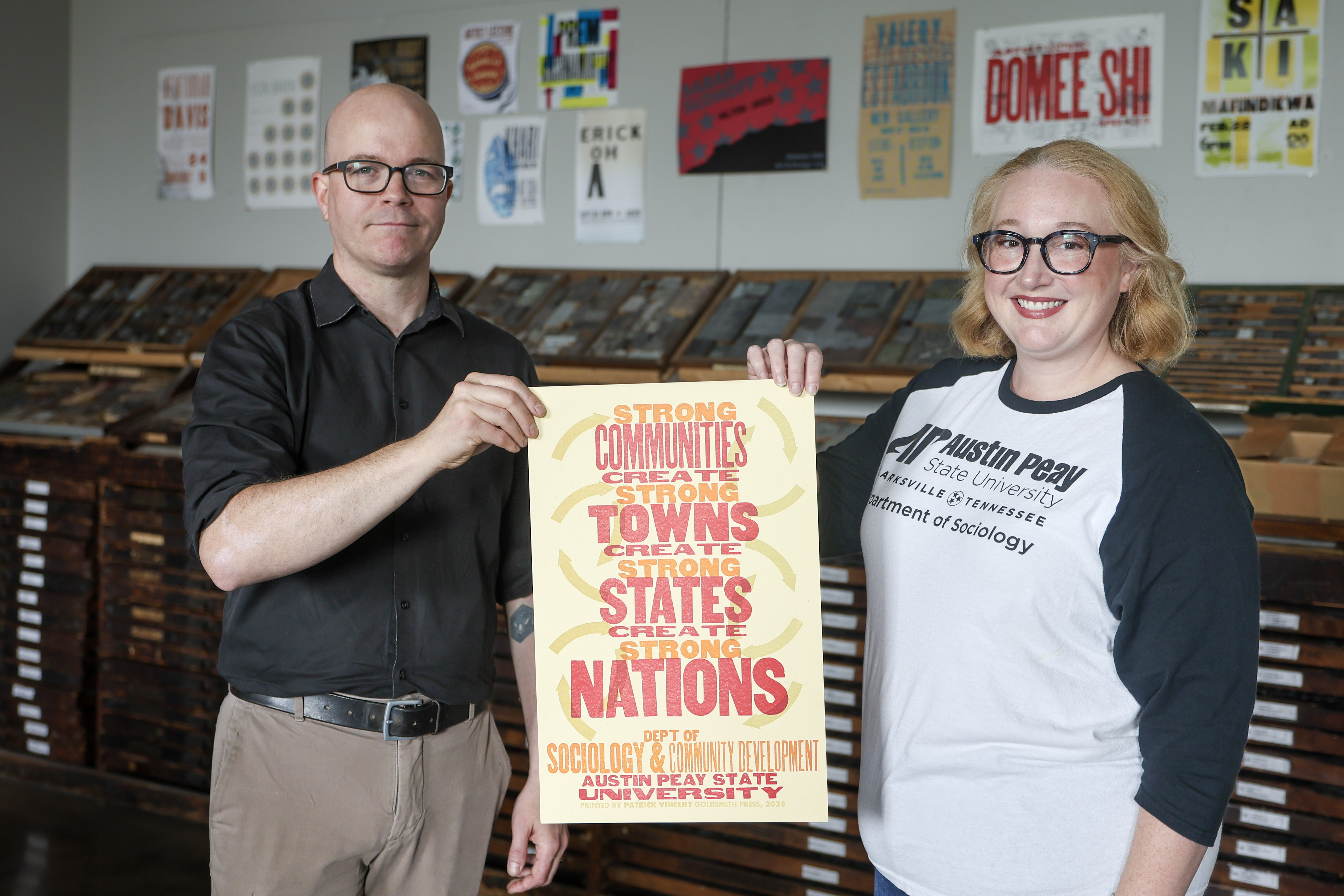
APSU faculty Dr. Misty Ring-Ramirez and Patrick Vincent hold one of 200 limited-edition letterpress prints created for community members, educators, and local leaders. | Photo by Seth Riker
As the U.S. approaches its 250th anniversary, discussions about citizenship, community, and civic responsibility are taking place across the country.
At Austin Peay State University, two departments are contributing to that conversation through an unlikely medium: a hand-printed letterpress broadside inspired by the idea that meaningful change begins close to home.
The Department of Sociology and Community Development recently partnered with the Department of Art + Design to create a limited-edition print bearing a simple message:
Strong communities create strong towns create strong states create strong nations.
Only 200 prints were produced, and those interested can request one here. The sociology department plans to distribute them to community partners, educators, local leaders, and residents throughout the region as a reflection of the department's mission and a reminder that strong societies are built from the ground up.
Dr. Misty Ring-Ramirez, chair of the Department of Sociology and Community Development, said the project was inspired by a belief that people often underestimate the power of local action.
"I think a lot of times when people think about social change, they think about a law changing or a major court ruling that changes how we think about and act around a social issue," she said. "But we know as sociologists, especially from studying social movements and collective behavior, that's a pretty rare outcome and also tends to lag pretty far behind where people actually feel about things."
Instead, Ring-Ramirez said, meaningful change often begins in neighborhoods, schools, workplaces, and community organizations.
"We don't have control day to day over what laws are or what policies are, but we do have control over how we raise our kids, how we treat our neighbors, and how we show up for our communities," she said. "Those changes, when a lot of people make them, have the power to affect larger social change in aggregate."
The project also highlights the university's relationship with community organizations that help prepare APSU students for careers in service, leadership, and public engagement.
"We depend a lot on our community partners to help train our students through internships and service-learning opportunities," Ring-Ramirez said. "It's nice to have something tangible that we can give our partners as a reminder and token of gratitude for working with us and partnering with us."
For Patrick Vincent, professor of printmaking in the Department of Art + Design and the director of Goldsmith Press, the medium itself carries an important message.
"Printmaking, not just letterpress, is a very community-oriented practice," he said. "Different than if you're a painter or drawer, which is a very solitary practice, printmaking exists in this collaborative space. A lot of the history of print has been about social messaging."
The project also carries an unexpected connection to the nation's founding. Vincent noted that the Declaration of Independence was originally distributed as a letterpress broadside, the same printing tradition used to create the APSU edition.
"They would set type, print it, and put it in a square somewhere for people to read," he said. "A lot of people talk about the printing press as being a way of developing our national identity because we had our own way of communicating."
That historical connection felt especially fitting as the nation prepares to commemorate its semiquincentennial in 2026.
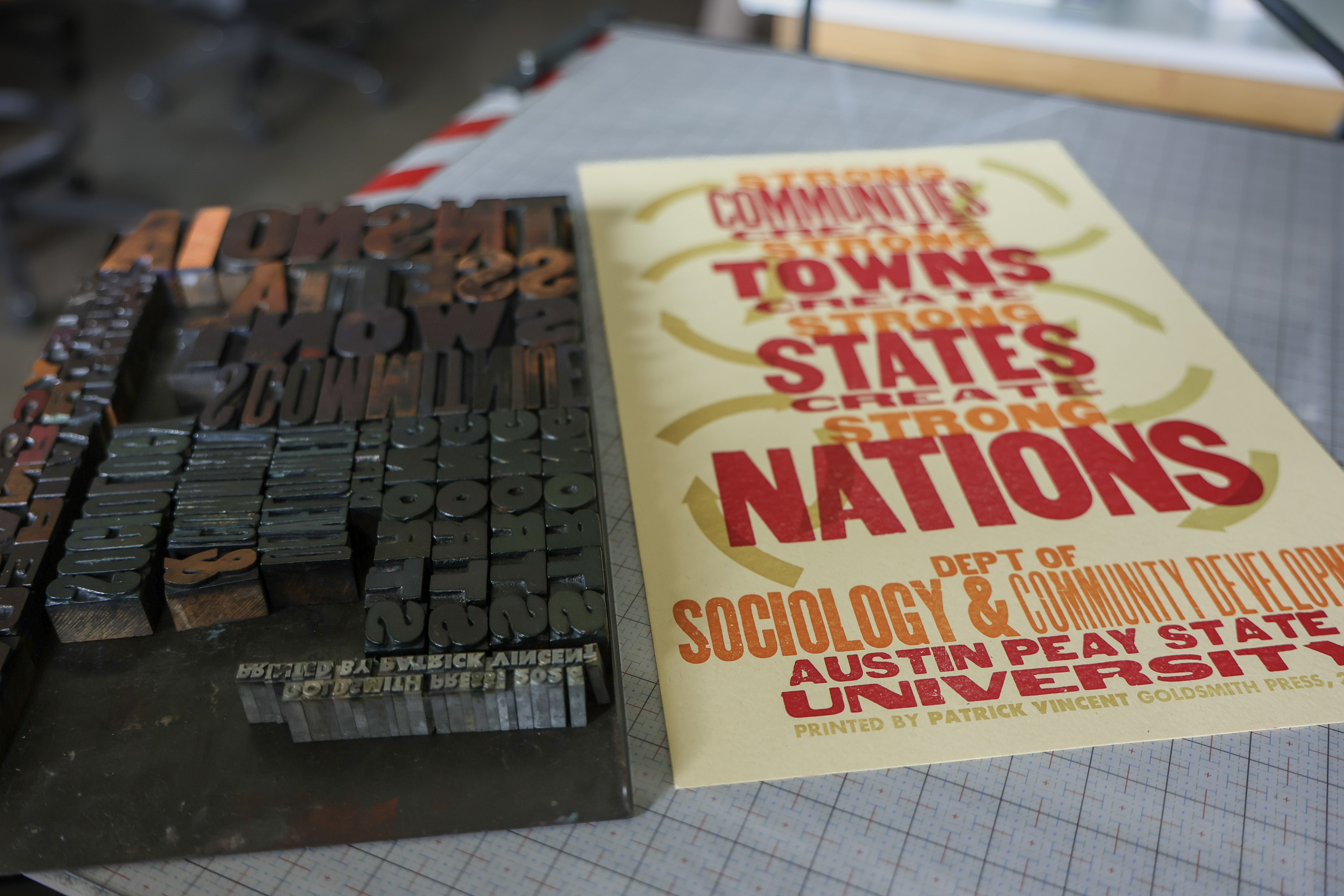
Movable type used to create the limited-edition letterpress print rests beside the finished piece at the Goldsmith Press. | Photo by Seth Riker.
Visually, the design reinforces the message. The typography grows larger as the statement progresses from communities to towns, states, and nations, illustrating how individual actions can accumulate into broader societal impact.
"I wanted it to get bigger and bigger with each step," Vincent said. "The background has arrows moving around because these things are interconnected. A nation is comprised of communities, but community action is what leads to the bigger changes."
For both faculty members, the project is ultimately intended as an encouragement rather than a critique.
"If people are working toward social change, none of that effort is meaningless, no matter how small it seems," Ring-Ramirez said. "If they're doing something and it feels like, 'Well, I'm just affecting my local community,' that's okay, because these things trickle up."
Vincent hopes the piece communicates a similar sense of optimism.
"I was trying to make it feel fun," he said. "Loud, bright, warm colors that are urgent, but not punishingly urgent. Motivating in a less stressful way."
For Ring-Ramirez, the project ultimately reflects both the mission of her department and the broader purpose of public higher education.
"This felt like a good time to share, through something visual and through words, a reminder that we're all here to help build stronger communities. Because that is what makes a stronger Tennessee and a stronger country."