


APSU research looks “beyond labels” to rethink childhood adversity
By: Seth Riker January 21, 2026

APSU research shows that children’s developmental outcomes are shaped less by single experiences, such as parental incarceration, and more by the broader environments and supports surrounding them in early childhood. | Adobe Stock
CLARKSVILLE, Tenn. - New research from Austin Peay State University is challenging common assumptions about how early adversity shapes children’s development and where society may be oversimplifying the causes of long-term outcomes.
Dr. Rong Huang, assistant professor in APSU’s Department of Psychological Science and Counseling, recently published two complementary studies on early childhood risk. Together, they ask a central question: What actually drives developmental challenges for children growing up in high-risk environments? What does not?
One of the studies, published in Early Child Development and Care, examines young children in Head Start programs to better understand whether father incarceration independently shapes early academic and social development. Huang and her co-authors used a rigorous case–control matching approach and found that father incarceration alone did not predict worse outcomes once poverty-related factors were carefully considered.
“We matched children with and without father incarceration very strictly on family income, parental education, and other background factors,” Huang said. “When we did that, father incarceration was no longer related to children’s academic or social outcomes in early childhood.”
For Huang, the finding is important not because incarceration is inconsequential, but because it highlights how often single experiences are blamed for outcomes rooted in broader structural conditions.
“The message to the public is that we need to look deeper,” she said. “We shouldn’t just look at simple relationships between two things and assume one causes the other.”
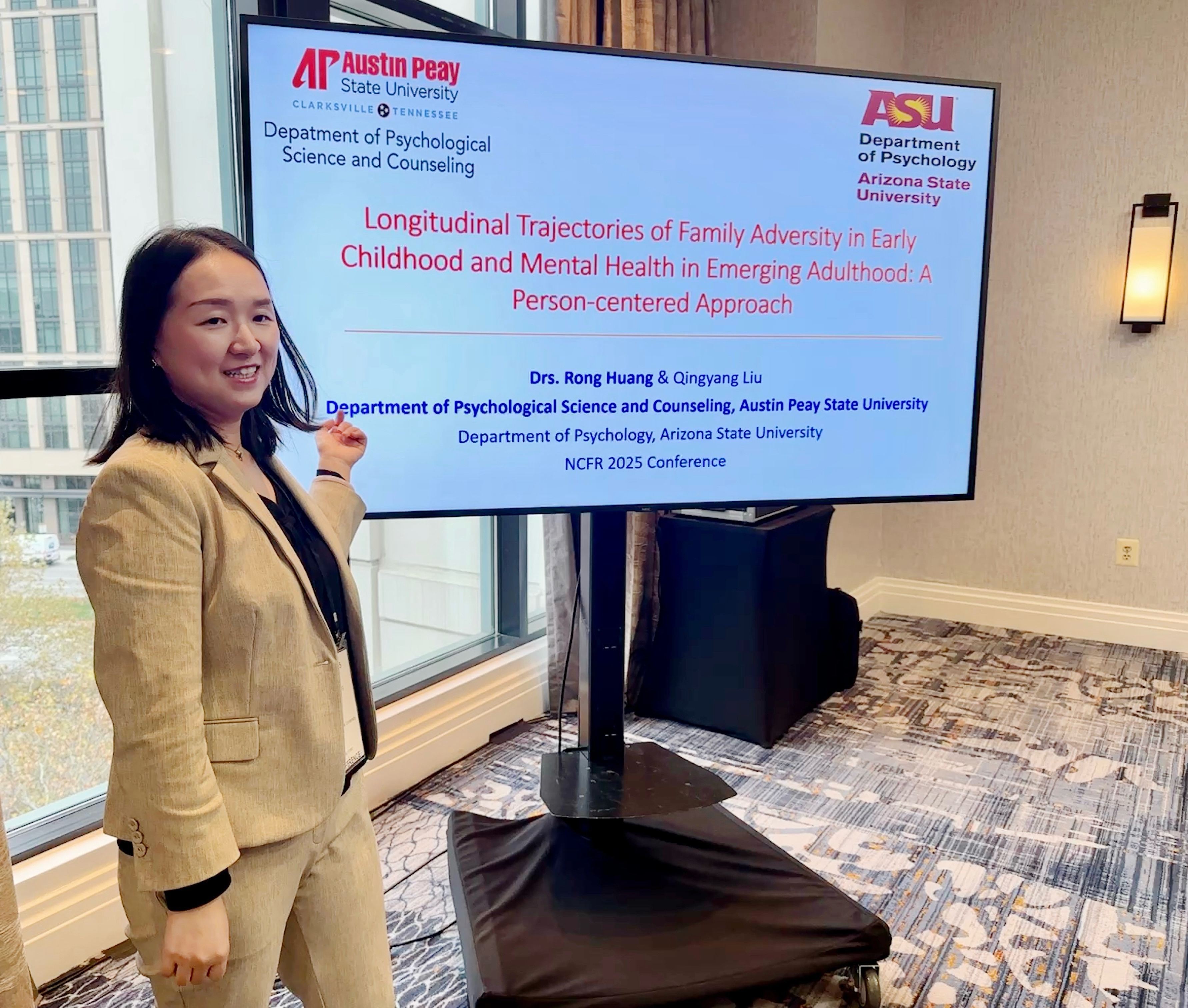
Dr. Rong Huang presents her research at the National Council on Family Relations Conference in November 2025. | Contributed photo
A second study, published in Development and Psychopathology, takes a longitudinal view, tracking family adversity from infancy through preschool and linking those experiences to mental health outcomes in emerging adulthood. Rather than examining one risk at a time, Huang’s research maps how patterns and persistence of adversity — such as material hardship, parenting stress, or exposure to conflict — shape development over time.
“My whole research goal is to understand how structural risks in family contexts shape children’s developmental pathways,” Huang said. “Different risks often happen together, and they interact with each other.”
The two studies highlight a key takeaway for families, educators, and policymakers: children’s long-term well-being reflects the environments that surround them over time, not just single events—making early, sustained family support central to healthy development.
Huang emphasized that early childhood remains a particularly sensitive period for intervention and care.
“Early childhood is the foundation for human development,” she said. “This is when children start to build trust … trust in their caregivers and trust in the world they live in.”
She hopes the research encourages more thoughtful, evidence-based conversations about risk, resilience, and responsibility.
“To support children in adversity,” Huang said, “we have to move beyond labels and focus on the conditions that families are navigating every day.”
About the Department of Psychological Science and Counseling
Austin Peay State University’s Department of Psychological Science and Counseling prepares students to serve others through evidence-based practice, research, and advocacy. Part of the College of Behavioral and Health Sciences, the department offers a bachelor’s degree in psychological science, graduate degrees in counseling and industrial-organizational psychology, and one doctoral degree — Tennessee’s first and only accredited PsyD program. Learn more at apsu.edu/psychology.