


Transforming business forecasting with AI: APSU professor shares practical solutions
By: Elaina Russell July 10, 2025

Dr. Asit Bandyopadhayay is an assistant professor of business analytics at Austin Peay State University. | Photo by Sean McCully
CLARKSVILLE, Tenn. - Advancing technology like generative artificial intelligence (AI) is changing the way we do business. In his latest white paper, Dr. Asit Bandyopadhayay, assistant professor of business analytics at Austin Peay State University, examines how generative AI is transforming forecasting solutions commonly used for projecting sales, inventory and customer demand.
To demonstrate a practical process for implementing an AI forecasting solution, Bandyopadhayay constructs a case study outlining steps for a mid-size restaurant to integrate an AI model in an effort to improve weekly sales forecasting and staffing needs based on its demand patterns.
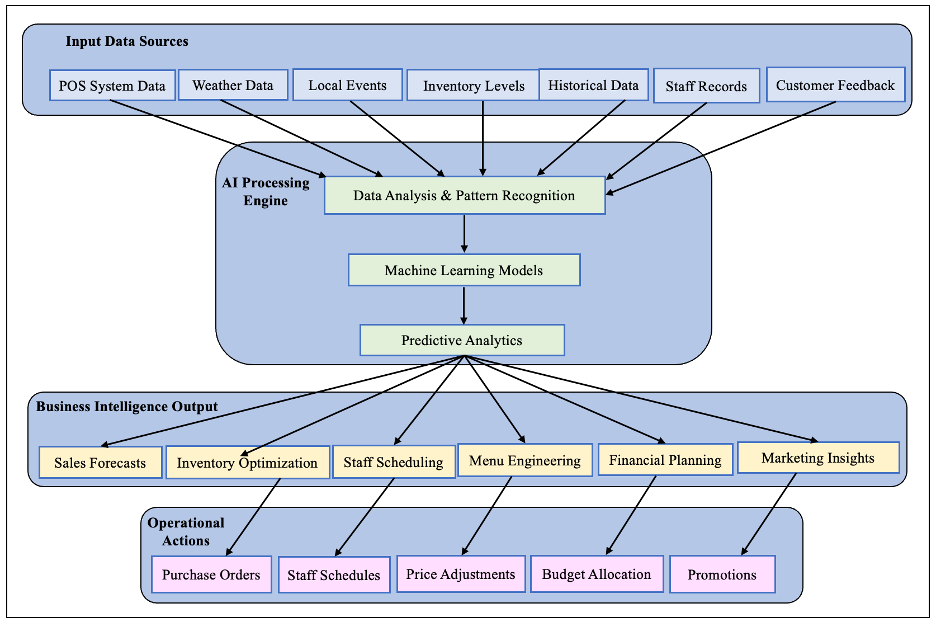
Flowchart for applying generative AI in restaurant forecasting.
The study highlights potential benefits like improved accuracy, real-time adaptability, optimized resource allocation and strategic decision support.
Bandyopadhayay’s work compares traditional and AI-based approaches to help business owners understand their application, benefits and limitations as they make decisions based on their individual organizations.
“By understanding the nuances of both approaches, business owners can make informed decisions to enhance their forecasting practices and achieve sustained growth,” he said.
Real-world application comparison examples include:
Demand Forecasting
- Traditional Models: Use historical sales data to predict future demand. Effective for businesses with stable, repetitive patterns.
- Generative AI: Incorporates external factors like weather, social media trends, and local events, providing more nuanced predictions.
Inventory Management
- Traditional Models: Employ reorder point and safety stock calculations to manage inventory.
- Generative AI: Offers dynamic inventory optimization by simulating demand fluctuations and supplier disruptions.
Customer Behavior Analysis
- Traditional Models: Segment customers based on demographic data and purchase history.
- Generative AI: Creates personalized insights by analyzing customer interactions, preferences, and sentiment.
Bandyopadhayay says the reward of implementation far exceeds the risk, but acknowledges that business owners may face challenges with quality data, budget and change management. For many businesses, he says a balanced approach may be optimal as AI models progress.
“The choice between these approaches depends on factors such as business size, industry, budget, and technological readiness,” he said. “As AI continues to evolve, its role in predictive analytics will move beyond forecasting to include prescriptive insights, providing businesses with actionable recommendations to optimize operations and drive innovation.”
Dr. Bandyopadhayay is an assistant professor of business analytics and a current research faculty fellow for the Center for Applied Business Research at Austin Peay State University. To read his complete white paper, visit https://bit.ly/4nE9GiP.
About the Center for Applied Business Research
The Center for Applied Business Research (CABR) coordinates applied research-related activities in the College of Business at Austin Peay State University. It circulates research updates, creates research opportunities and promotes the academic research community.
The CABR strives to become a business research network linking scholars, industry leaders, business owners and students to positively impact business and society. For more information, visit https://www.apsu.edu/business/applied-research/.