


Governor’s School welcomes Tennessee students to APSU for high-level STEM education
By: Colby Wilson July 14, 2026
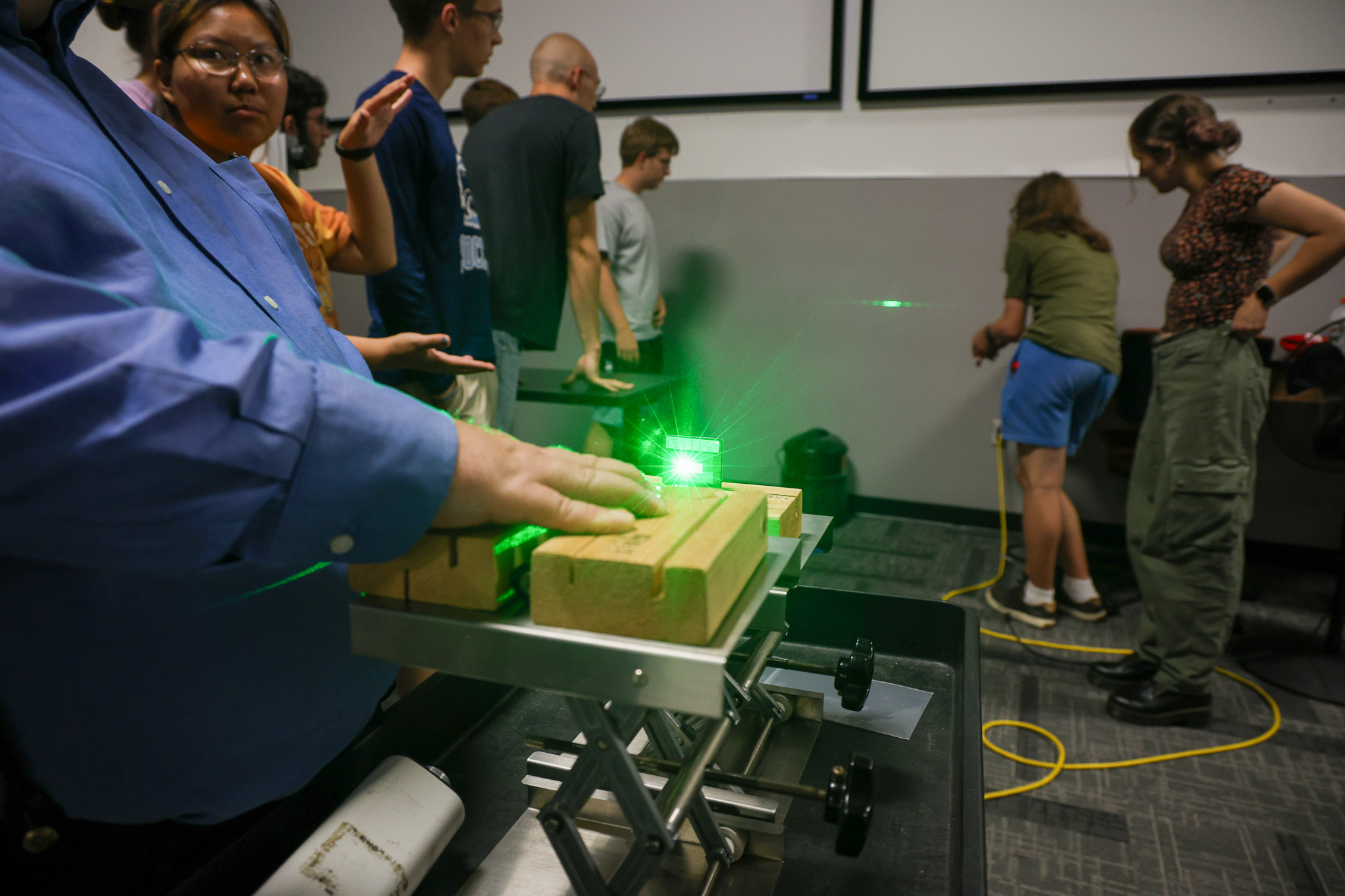
Students observe a laser-based variation of Thomas Young’s double slit experiment, which proves that light behaves as a wave, during the Governor’s School for Computational Physics. | Photo by Colby Wilson
CLARKSVILLE, Tenn. — For four weeks this summer, Austin Peay State University's campus hosted some of Tennessee's brightest high school students as they challenged themselves in the Governor's School for Computational Physics—a program that connects theoretical physics and practical computing.
Hang on … what IS the Governor’s School for Computational Physics, anyway?
I’m glad you asked. See, every summer for the last 18 years, Austin Peay has been home to this program, taking some of the highest-achieving students in Tennessee and immersing them in an academic cocoon—designed to nurture, yes, but also challenge every thought they’ve ever had about physics, computing and mathematics. In 2026, APSU offered a new Governors School curriculum under Dr. Justin Oelgoetz, who took over the program this year with a fresh perspective.
Among this year's cohort were Dream Kang from West High School in Knoxville, Karina Boyd from Westview High School, and Mina Malty from Smyrna High School. All rising seniors, they came with different backgrounds but shared curiosities about physics, mathematics, and computational problem-solving.
For Kang, the program represented a second chance.
"This was my second year applying," she said. "I went through all the lists of the Governor's Schools because it was really promoted at our school to apply for any of them. This one was the most interesting one that caught my eye. Computational physics—it sounded hard and fun at the same time."
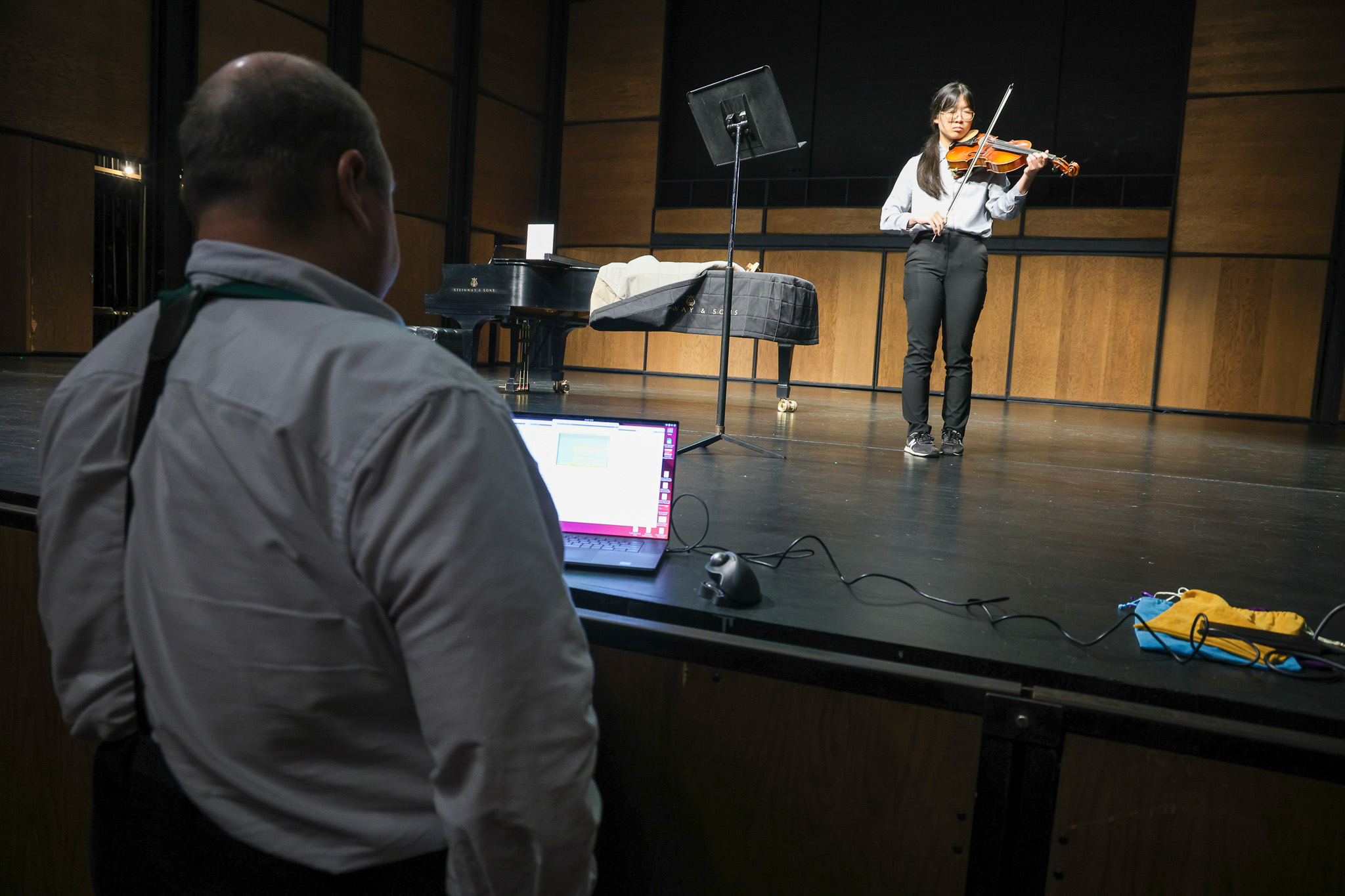
The Governor’s School for Computational Physics provides several interdisciplinary experiences, such as this experiment involving charting music tones. | Photo by Colby Wilson
Beyond the Classroom Walls
The program's intensity surprised even students with strong academic backgrounds. Without a traditional syllabus, participants discovered each day's lessons as they unfolded, tackling everything from quantum mechanics to machine learning.
"Dr. [Daniel] Mayo's lectures are always on point," Kang said, referring to one of APSU's most popular professors of mathematics and statistics. "He actually went into all the math behind quantum mechanics and how everything works together. I had only learned about it conceptually before, so that was actually entertaining."
Boyd, who had never participated in a summer program before, found herself drawn to unexpected areas.
"I really enjoyed the machine learning aspects and getting to learn how it worked mechanically, but also mathematically," she said. "I never really thought about things that way before."
For Malty, who entered with AP Physics experience, the computational focus opened new possibilities.
"I thought, what if I take physics and put it into computational physics?" he said. "I got catapulted through calculus and learned the basics of quantum computing with superpositions and Monte Carlo methods for the Ising model."
In addition to classwork, the students toured Oak Ridge National Laboratory for a day and conducted a host of experiments designed to put their studies into practice, including charting music tones with Austin Peay Professor of Music Dr. Korre Foster.
Building Community Through Challenge
The community the students built during their month on campus was perhaps as important as the academic content. Living in residence halls and working together daily, they formed bonds that helped them tackle difficult material.
"I think it's been really nice to build my own community from the ground up," Boyd said. "I came here not having connections, and being here for even a month showed me that I have the ability to build what I consider quite a strong community."
Malty emphasized how the group dynamic evolved quickly.
“In the first four days, we all kind of pushed each other to be ourselves,” he said. “There was no shame in being yourself.”
Boyd said the program’s social aspect was essential for the students’ academic success.
"I don't think anybody in this program could have completed a day without asking for help," she said. "That's probably one of the biggest skills this program teaches you."
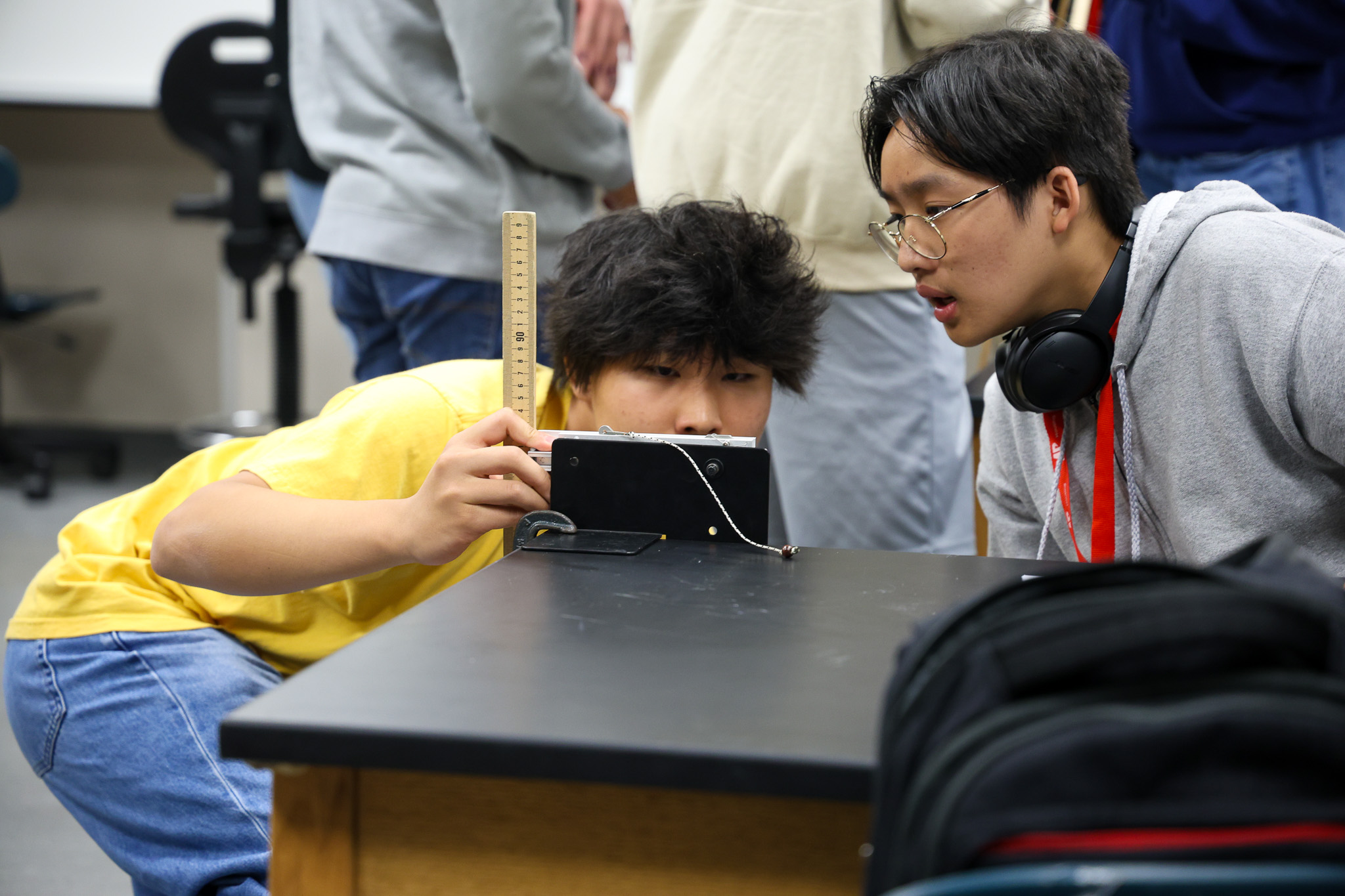
Students take measurements during a classroom activity conducted as part of the Governor’s School for Computational Physics. | Photo by Colby Wilson
Practical Lessons and Future Applications
The students gained skills they expect to carry forward, regardless of their career paths. Malty plans to study electrical engineering and computer science and found immediate applications.
“The coding in Fortran was extra practice,” he said. “When we did the electrical side with RK4 and the Euler methods, it was like electrical engineering and computer science merged with physics.”
Kang, who is undecided on a future major, emphasized the program’s wider benefits.
"Even if you're not specifically planning to go into physics, you learn good skills here—coding, graphing, how to think critically, and how to interact with your peers when the content is hard and fast-paced," she said.
Encouraging Future Participants
Despite the challenges, participating students recommend the Governor’s School to future applicants.
"This opportunity showed me there's tons more out there," Boyd said. "I just need to give myself the shot—apply, and I'll never know where it takes me."
Malty said it’s important for incoming students to reach out to each other, build connections during the program, and take plenty of photos.
“Push each other to be extroverted from day one,” he said. “When I first came here, I thought everybody was going to be an introverted nerd. But we started seeing each other as real humans.”
As these students return to their high schools for senior year, they carry not just computational skills and physics knowledge, but confidence in their ability to tackle complex challenges and build meaningful connections. Those lessons will serve them well beyond any classroom.
About the Austin Peay College of STEM
The College of Science, Technology, Engineering & Mathematics (STEM) provides studies for students in the areas of agriculture, astronomy, aviation sciences, biology, chemistry, computer science, earth and environmental sciences, engineering physics, engineering technology, information technology, mathematics, medical laboratory sciences, radiologic sciences, and physics. Its outstanding, discipline-based programs are student-centered and designed to prepare students for responsible positions at all levels of research, industry, education, medicine, and government.
