


APSU students develop low-cost solution to protect regional water supply
By: Colby Wilson May 7, 2026
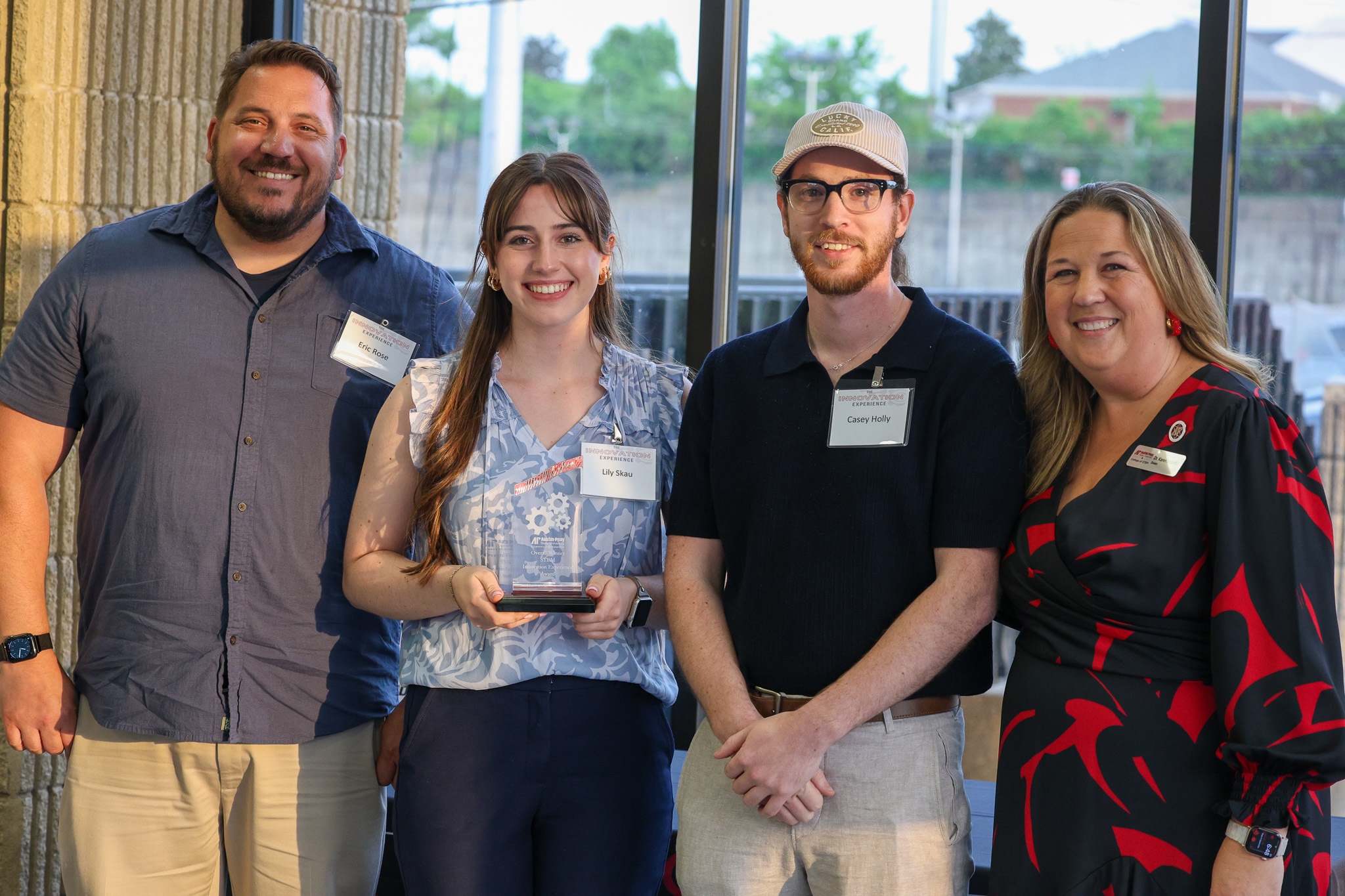
APSU engineering physics students Eric Rose, Lily Skau, and Casey Holly with Dr. Karen Meisch, dean of the College of STEM. | Photo by Colby Wilson
CLARKSVILLE, Tenn. — A team of Austin Peay State University engineering physics students has developed a promising, low-cost solution that could be used to inspect a critical water pipeline serving 13 Tennessee and Kentucky communities without shutting off the water supply.
The students’ project, sponsored by the Logan Todd Regional Water Commission, aims to prevent service disruptions that would leave thousands of residents without clean water. Their work earned them the top prize at the College of STEM’s annual Innovation Experience and could benefit several communities, including Springfield, Tennessee; Guthrie, Kentucky; and Russellville, Kentucky.
Students Casey Holly, Lily Skau, and Eric Rose, working under the guidance of Dr. Russ Longhurst, developed an acoustic monitoring system using accelerometers to detect sediment buildup in a 36-inch-diameter pipeline. The system costs roughly $6,000—a fraction of the price for traditional robotic inspection devices.
"We were presented with the problem of this 15-mile pipeline that runs from the Cumberland River to Guthrie, Kentucky, to a water treatment plant that has no access points from point A to point B," Rose said. "So there's no good way to tell if there's obstructions in the pipe without cutting it open."
Longhurst compared the team’s approach to non-invasive medical diagnostics.
"It's analogous to a human going into the hospital to see if they have blockage around their heart and arteries," he said. "Obviously, a blockage can be a very serious health issue that could result in death. So what we do today in medicine is we use methods like X-rays or sonar rather than performing open heart surgery to see if we've got a blockage."
The water commission suspects sediment has accumulated where the pipeline crosses the Red River — the system's lowest point, where slow-moving water lets particles settle. Workers have already confirmed significant buildup at both ends of the line during routine maintenance, suggesting the middle stretch is likely affected.
Acoustic Solution Beats Costly Alternatives
Traditional pipeline inspection methods like "pigging"—sending robotic devices through pipes—work well for oil and gas companies with large budgets, but are too expensive for most city water utilities.
The students’ solution works by listening to the pipe’s acoustic “signature” through an accelerometer attached to its exterior. A controlled impact device strikes the pipe at the same location with consistent force, while the accelerometer records the acoustic response. Software converts the raw data using Fast Fourier Transform (FFT) analysis to identify the pipe’s resonant frequency.
"We strike the pipe, and the accelerometer records the acceleration on the pipe due to the impact," Skau said. "Then we compute an FFT to get it from the time domain into the frequency domain, and from there we can detect a shift in resonant frequency."
As sediment accumulates, it changes the pipe's acoustic properties, creating measurable frequency shifts that indicate the presence and extent of blockages.
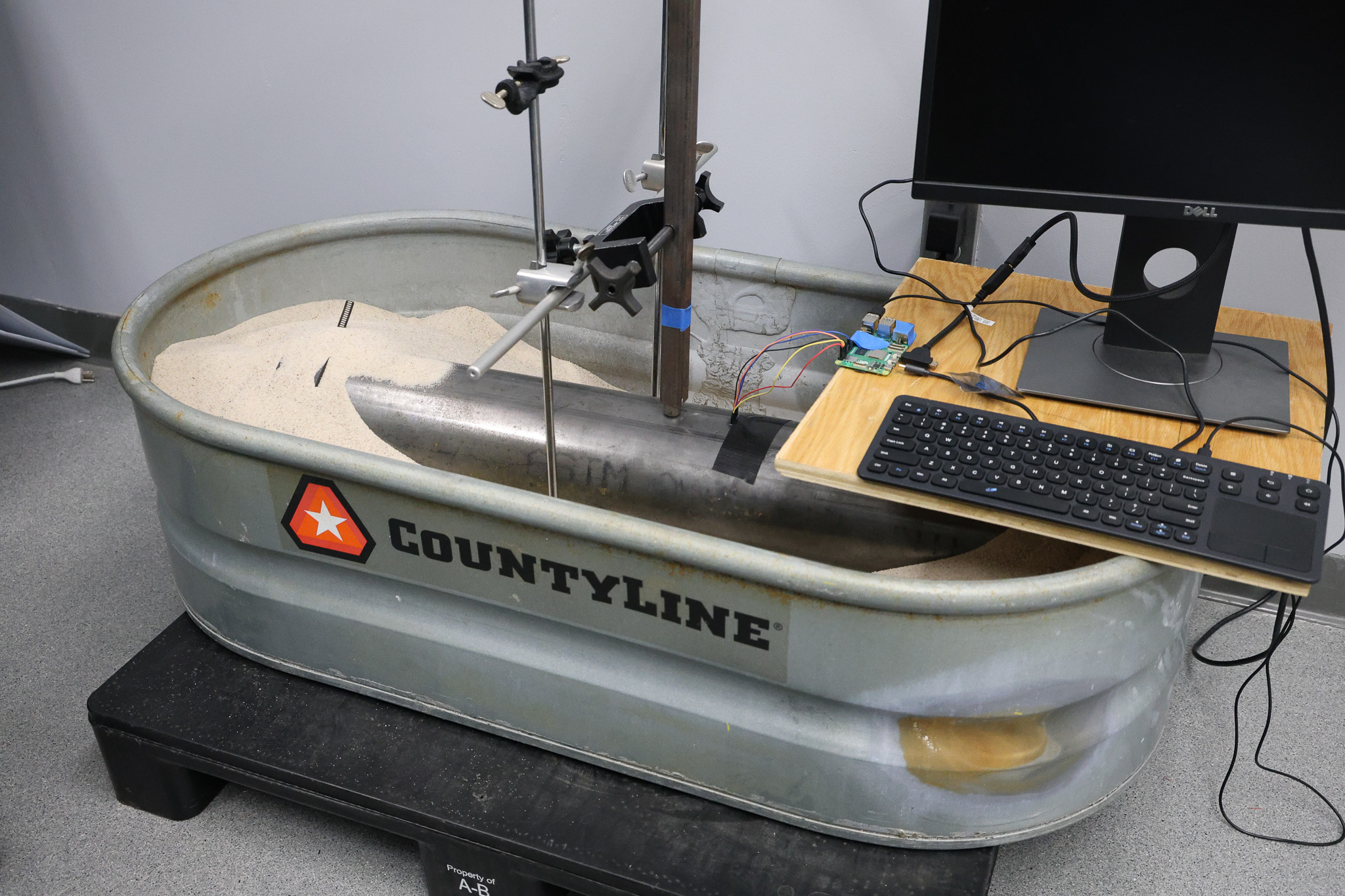
A prototype version of the pipeline inspection tool, which uses sand to simulate sediment buildup. | Photo by Colby Wilson
Prototype Testing Phase
The team built a scaled prototype using a pipe section that can be filled with varying amounts of sand to simulate different sediment buildup levels. Initial tests with water-filled pipes showed consistent, measurable results.
"We got good results last week on the water-filled pipe," Rose said. "So we're getting consistent results. Let's add sand and compare that difference."
One of the students’ major challenges in developing this proof-of-concept was retooling existing accelerometer technology for application in a municipal setting.
"This isn't a common industry problem, so there wasn't much existing research to build on," Holly said. "We had to adapt vibration monitoring concepts typically used in industrial settings and completely adapt them to pipeline sediment detection."
What’s at Stake
The non-invasive approach eliminates the risks associated with traditional pipeline inspection methods, beyond cost savings.
"If you were to cut open the pipe, access it, and something went wrong or delays were encountered, you're risking shutting off water to numerous communities," Longhurst said. "The compounding effect of not having clean, fresh water delivered to a community could set off a health crisis."
The pipeline serves 13 municipalities, with only a three-to-four-day backup water supply available during maintenance shutdowns.
"What if the flow said the pipe's choked up and you can't deliver water anymore?" Rose asked. "A significant number of people would go without water."
The team plans to present their findings and publish their methodology to help other institutions facing similar pipeline inspection challenges. If successful, the technology could be permanently installed for continuous monitoring of critical water infrastructure.
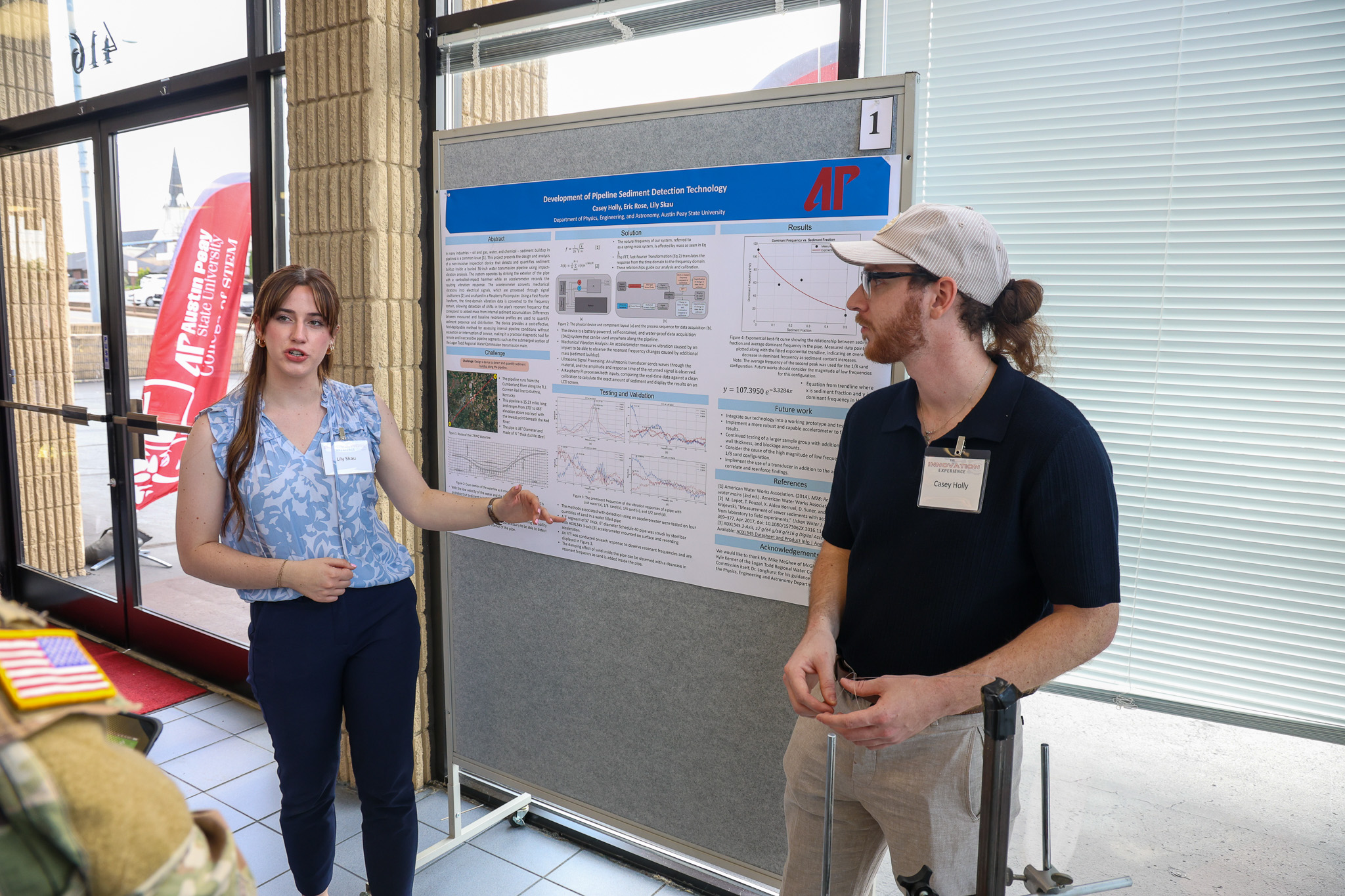
APSU students Lily Skau and Casey Holly present their work at the College of STEM’s annual Innovation Experience. | Photo by Colby Wilson
Why the Innovation Experience Matters
The project exemplifies Austin Peay's commitment to connecting academic learning with community needs through the Innovation Experience program, where students tackle real problems facing regional partners. Through this model, sponsors receive free support while students gain practical experience—with some capstone participants being hired directly by their sponsoring companies.
Holly, Skau, and Rose’s STEM Innovation Experience Award recognition highlights the broader potential of their work. If widely adopted, it could influence how municipalities across the region inspect their water systems.
About the Austin Peay College of STEM
The College of Science, Technology, Engineering & Mathematics (STEM) provides studies for students in the areas of agriculture, astronomy, aviation sciences, biology, chemistry, computer science, earth and environmental sciences, engineering physics, engineering technology, information technology, mathematics, medical laboratory sciences, radiologic sciences, and physics. Its outstanding, discipline-based programs are student-centered and designed to prepare students for responsible positions at all levels of research, industry, education, medicine, and government.