Austin Peay students turn research into real-world career gains
By: Elaina Russell March 31, 2026
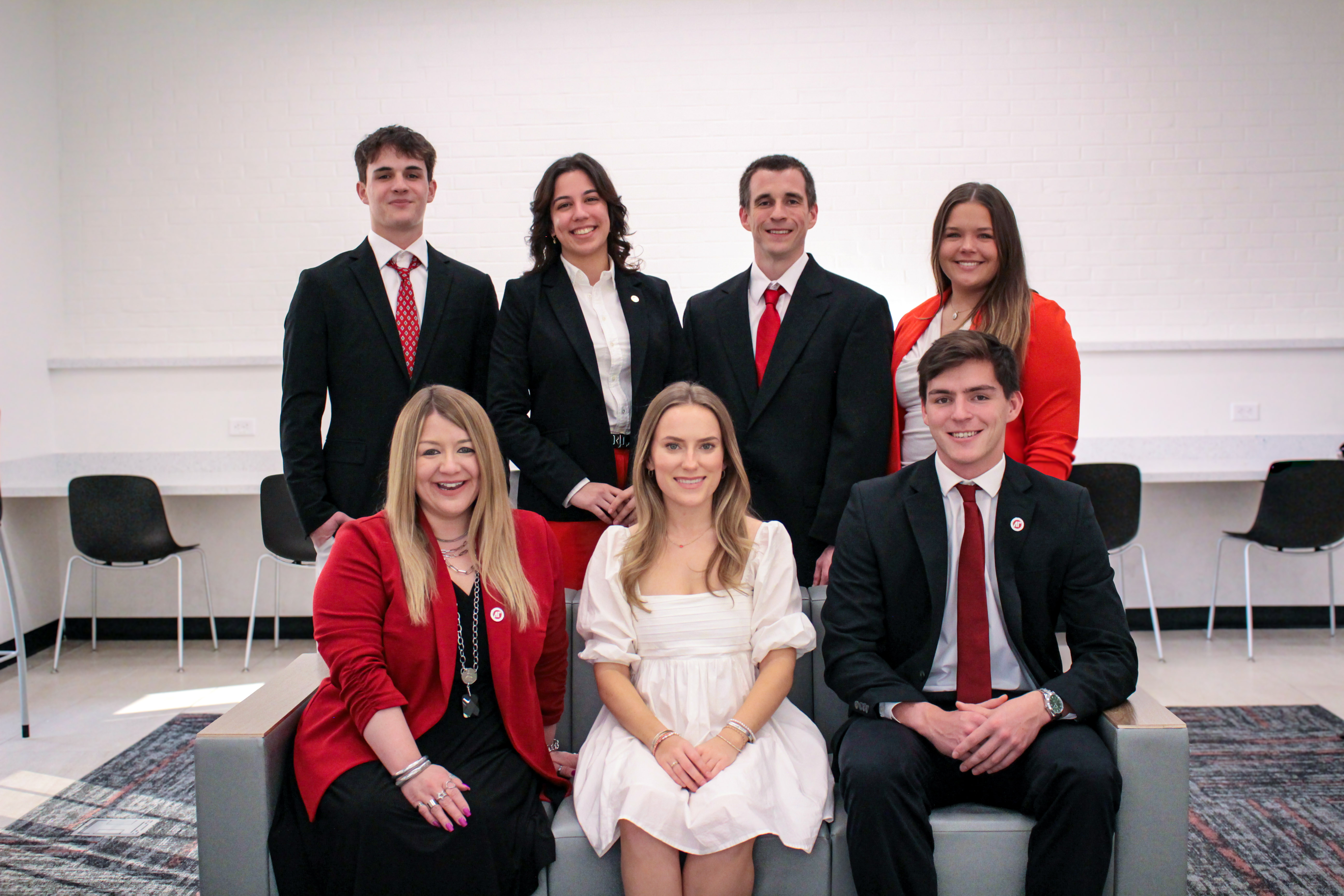
Back row, left to right: Carter Black, Daniela Diaz Campos, Dr. Matt Hampton, Sarah Ahlheit. Front row, left to right: Dr. Stephanie Bilderback, Katie Thrash, Kade Tjaarda.| Photo by Elaina Russell
CLARKSVILLE, Tenn. — Five business students at Austin Peay State University set a goal last year to understand how college majors and demographics influence long-term earnings. While studying data on 1,058,246 students, they unintentionally began documenting the blueprint for their own success.
The study, recently published in the Journal of International Education in Business and co-authored by Daniela Diaz Campos, Sarah Ahlheit, Katherine Thrash, Kade Tjaarda, and Carter Black, analyzes data from the U.S. Census Bureau's American Community Survey (ACS) to examine wage trajectories for over a million college graduates between 2009 and 2022.
Under the guidance of faculty mentors Dr. Stephanie Bilderback and Dr. Matt Hampton, the team examined how factors such as workforce experience, age, gender, race, marital status, immigrant status, family size, and industry affect wage growth over time.
Their work ultimately identified how institutional mechanisms that support students, such as academic advising, internships, research opportunities, and experiential learning, drive wage growth over time—a notable 12.5% increase for business students during the observation period.
The team represented the College of Business last year, presenting an early version of their work at the Society of Business, Industry and Economics (SOBIE) conference in Destin, Florida. There, they collected valuable peer feedback and added another integrated experience to their resumes.
"This project was a great way to see how research actually works," Tjaarda said. "It was interesting to see how wages varied and how much economic value a degree can hold. The best part was getting to attend SOBIE to present our research and learning about other projects students were working on."
The collaboration among mixed majors gave Ahlheit a fresh perspective, helping her conceptualize coursework beyond a typical classroom assignment and strengthening the team’s results.
"Having the opportunity to contribute to a peer-reviewed publication as an undergraduate was an incredible experience," she said. "It was especially rewarding to see our work develop from an initial idea to presenting at SOBIE and ultimately becoming a published article."
What the students didn’t realize is that they were confirming their own results. They experienced what they were measuring, proving their research by living it.
Bilderback acknowledged the irony of the team’s progress from an initial idea to a peer-reviewed publication while studying how those experiences create lasting value.
"Working with students on research is one of the most rewarding parts of teaching," she said. "It allows us to connect classroom theory with real-world economic outcomes while giving students the opportunity to contribute to meaningful scholarship."
The research became part of a broader career-building blueprint for the student team as they continued their work, presented at conferences, completed internships and utilized faculty mentorship to demonstrate skills to employers.
Those experiences helped seniors like Diaz Campos, Ahlheit and Tjaarda secure job offers before their spring graduation. Thrash will continue her education in the Master of Business Administration program, and Black, a sophomore, will soon become president of the Larry W. Carroll Govs Fund, the college’s student-managed investment fund.
"This publication is the result of countless moments of learning shared with remarkable mentors and peers," Diaz Campos said. "It taught me that even the hardest challenges become possible when you are surrounded by the right support system and people who share your ideas and aspirations."
The data show that experience is not a supplement to coursework but a necessity for turning credentials into careers that pay off for students nationwide.
Diaz Campos, Ahlheit, and Tjaarda are entering the labor market with job offers not because their majors guarantee success, but because they have accumulated demonstrable capabilities in and out of the classroom. They studied how integrated support drives success while experiencing it firsthand.