


APSU biology lab finds dignity for forgotten skeleton “friends”
By: Colby Wilson April 7, 2026
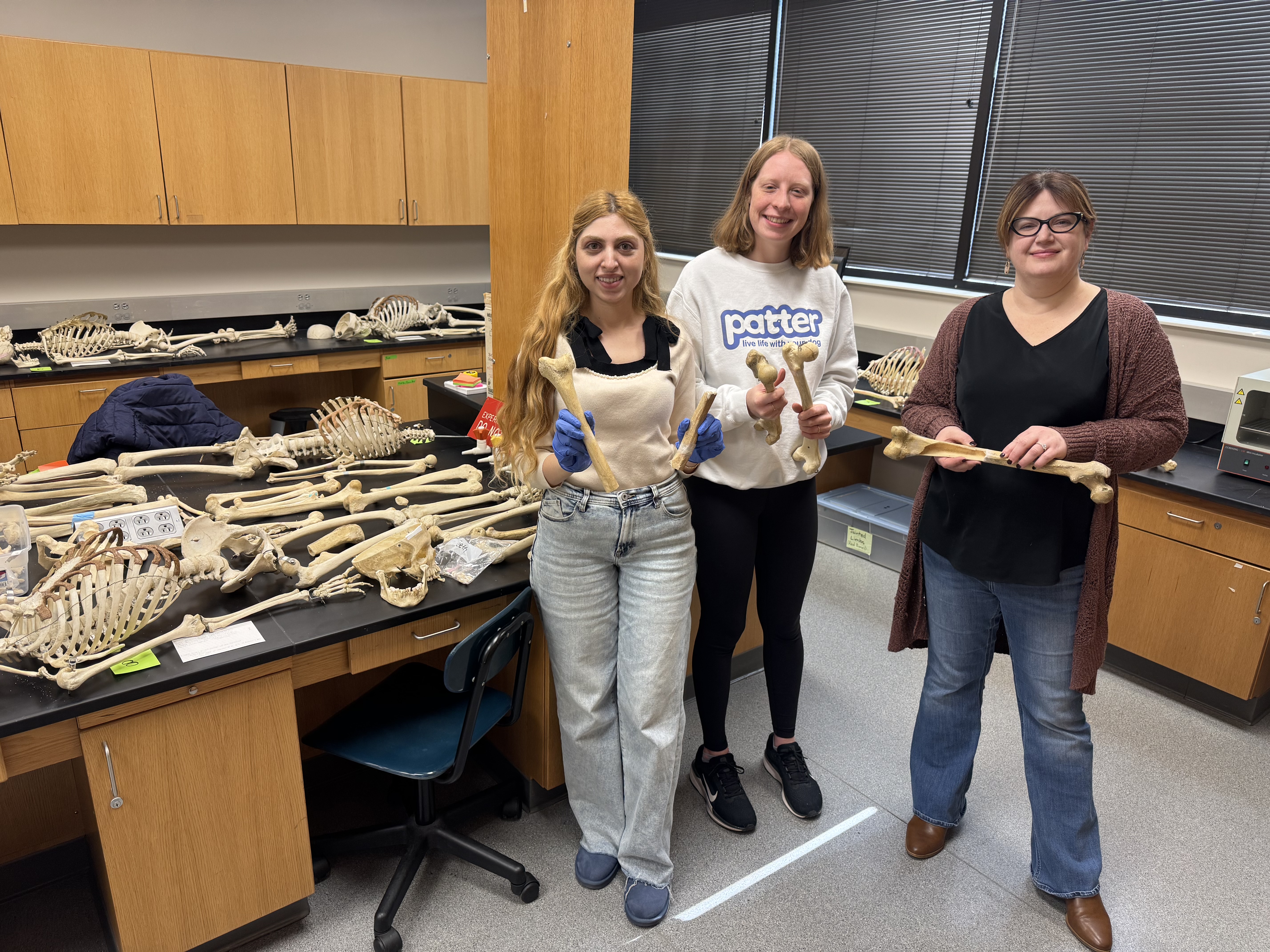
From left: biology major Kani Almousa, graduate student Lydia Gann, and Dr. Amy Thompson, chair of the Austin Peay State University Department of Biology. | Photo contributed by Dr. Amy Thompson
CLARKSVILLE, Tenn. — What began as student concern about an aging skeleton in an Austin Peay State University physiology lab has evolved into a thoughtful response to medical education's complex history—and a model for addressing inherited teaching materials with questionable origins.
Dr. Amy Thompson, chair of the Austin Peay Department of Biology, is overseeing the analysis of nine nearly complete human skeletons and dozens of loose bones. Her research team believes these were part of the illegal body trade that flourished from the late 1800s to the 1980s, primarily involving bodies taken from India and shipped to medical schools across the United States and United Kingdom.
"The most important thing for us is to think about how they were collected unethically," Thompson said. "There was likely not consent given by anyone. I think there's more to be learned by understanding what happened and acknowledging them as humans and giving them a proper burial than to keep using them when we have other tools to learn."
Student Discovery Launches Investigation
The project began when biology major Brandon Gulley, who served in Austin Peay’s Student Government Association, and other students noticed the real skeleton in their physiology class and began researching its origins. Their investigation revealed that their specimens were likely connected to the historical global trade in human remains.
"India was getting these bodies, preparing the skeletons, doing treatments to get the skeletons to be bleached and pristine bones—like you would think of seeing in a lab setting," Thompson said. "Then they would ship those out, and the biggest places they were sending them to were the United Kingdom and the U.S."
The bodies often came from vulnerable populations: unclaimed corpses, those whose families couldn't afford proper cremation, or bodies stolen by what Thompson calls "body snatchers."
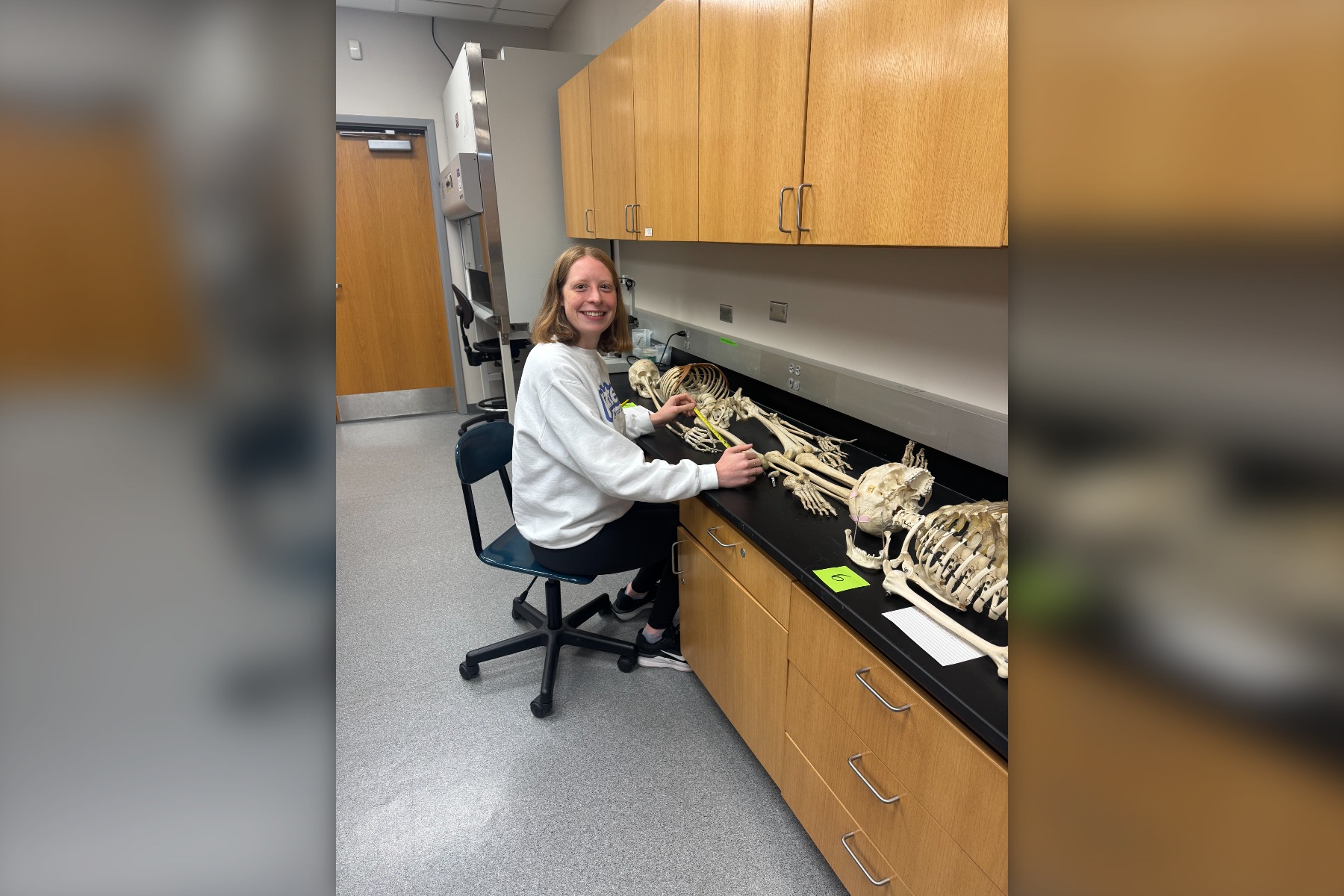
Lydia Gann, a graduate student with training from the University of Tennessee’s renowned Forensic Anthropology Center. | Photo contributed by Dr. Amy Thompson
Forensic Detective Work
From there, Thompson and biology students Sai Nesanuru and Neel Patel systematically searched campus facilities for other skeletons and remains. They discovered bones throughout the biology department that had been collected over decades.
Lydia Gann, a graduate student with forensic anthropology training from the University of Tennessee's renowned Forensic Anthropology Center (colloquially known as the Body Farm), joined the project to help match scattered bones and assess the remains.
"When I came on, they had all the skeletons assembled from the classrooms," said Gann, who is completing her master's degree in forensic science online through the University of Florida. "I found that there were a few that were inaccurately matched by looking at characteristics such as the lengths of them and coloration."
The research team, including Thompson, Gann and biology student Kani Almousa, uses forensic techniques to measure skull and pelvic features, calculating probabilities to determine sex and approximate age of the remains. Their research suggests the skeletons span several decades of the trade.
"If you look at these teeth, you can see there are fillings that are not that old," Thompson noted in her lab, pointing to silver dental work in one skeleton's mouth. "Those old silver fillings are probably [from the] middle 1950s. That one over there looks newer than that to me. My thought is that those were some of the later traded bodies, because this got outlawed in the 80s."
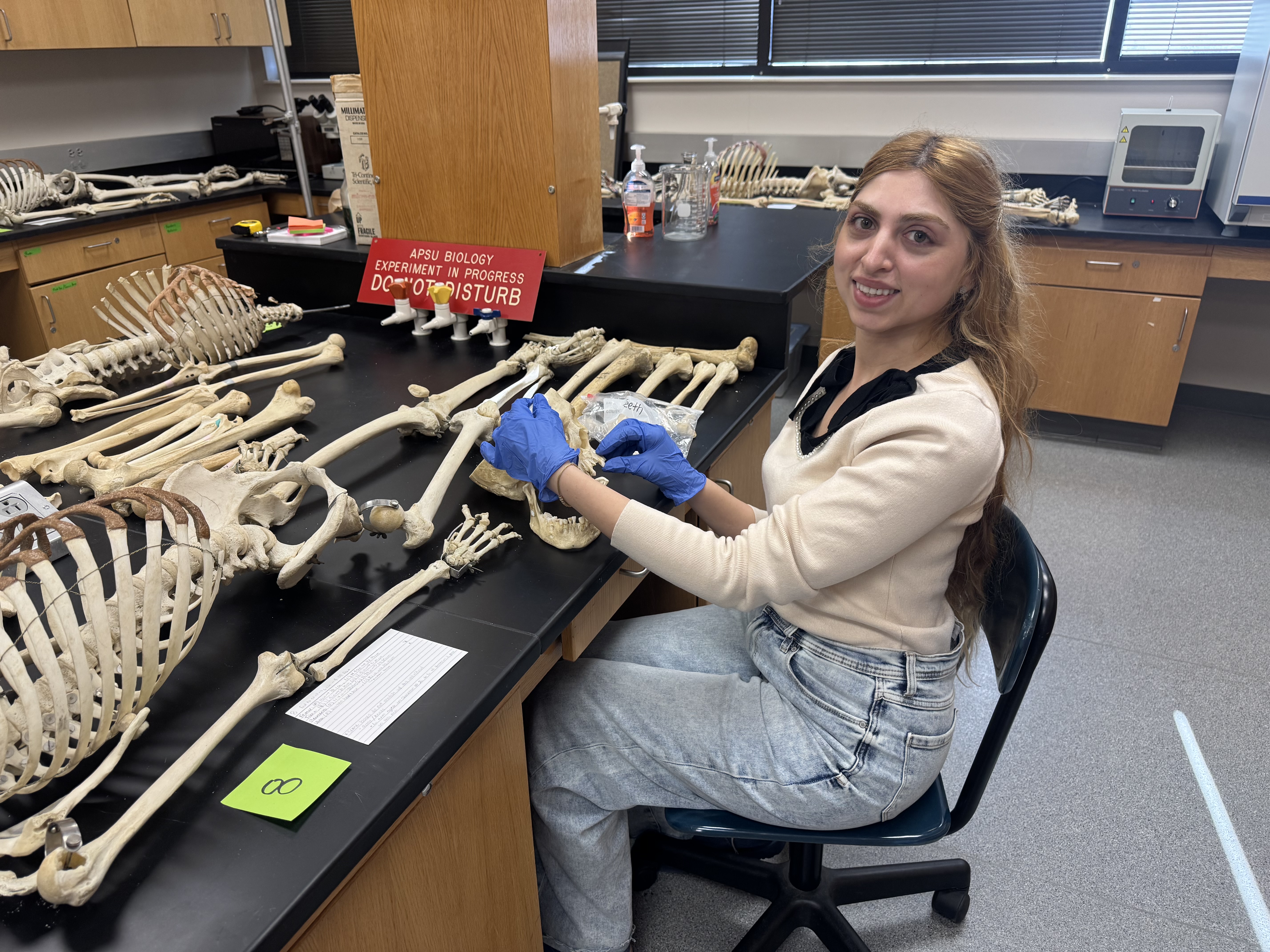
APSU biology major Kani Almousa uses forensic anthropology techniques to estimate the age of a skeleton previously used as a teaching tool for the department. | Photo contributed by Dr. Amy Thompson
No Easy Return
Unlike artifacts that can be sent back to their country of origin, these human remains present complex challenges. India, aware of the historical trade, isn’t keen to accept returned skeletons.
Thompson's team plans to cremate the remains and bury them at the university farm, where other historical burials exist. The site includes graves of infants who likely died during an influenza outbreak, creating what Thompson sees as an appropriate resting place for other vulnerable populations.
Ethical Alternatives Available
Modern technology has made the ethical dilemma less necessary for current students. High-quality plastic skeletons and 3D-printed models provide anatomical education without human remains.
"As technology has advanced, you can actually create pretty accurate medical examination skeletons out of plastics or 3D printing," Gann said. "That is a really good alternative that I know a lot of schools are moving toward using."
Thompson acknowledges the educational value these skeletons have brought to campus, but prioritizes ethics over convenience.
"Yes, we can still learn from these remains," Thompson said. "But I think there's more to be learned by understanding what happened and acknowledging them as humans and giving them a proper burial than to keep using them when we have other tools to learn. Even if it was the only tool, I'm of the mindset that you have to do the right thing."
Model for Other Institutions
Thompson's team plans to publish their research and methodology to guide other institutions facing similar ethical problems in their collections.
"I think it would be good to show that we are doing something ethical, something other schools should look into if they don't know where their skeletons come from," Gann said.
The project represents institutional responsibility in addressing historical practices, whether inherited or initiated by current faculty or administrators.
"You have to make the right decision," Thompson said. "Put yourself in someone else's shoes: would you want to find out that this happened to your family member? You thought you sent your family member to be cremated, and you find out your loved one's in another country being used for education instead."
The research team continues detailed measurements and analysis before the final cremation and burial, treating the remains with dignity while gathering information for their planned academic publication and memorial markers.
"We call them our friends," Thompson said. "We're trying to do the right thing, but we want to learn as much as we can because when we do cremate them and ultimately bury them, we want to be able to get markers and give a little bit of information about what we can know about them."
About the Austin Peay College of STEM
The College of Science, Technology, Engineering & Mathematics (STEM) provides studies for students in the areas of agriculture, astronomy, aviation sciences, biology, chemistry, computer science, earth and environmental sciences, engineering physics, engineering technology, information technology, mathematics, medical laboratory sciences, radiologic sciences, and physics. Its outstanding, discipline-based programs are student-centered and designed to prepare students for responsible positions at all levels of research, industry, education, medicine, and government.