


APSU’s Berlin study abroad program offering $15K in scholarships for 2027
By: Ethan Steinquest September 16, 2026
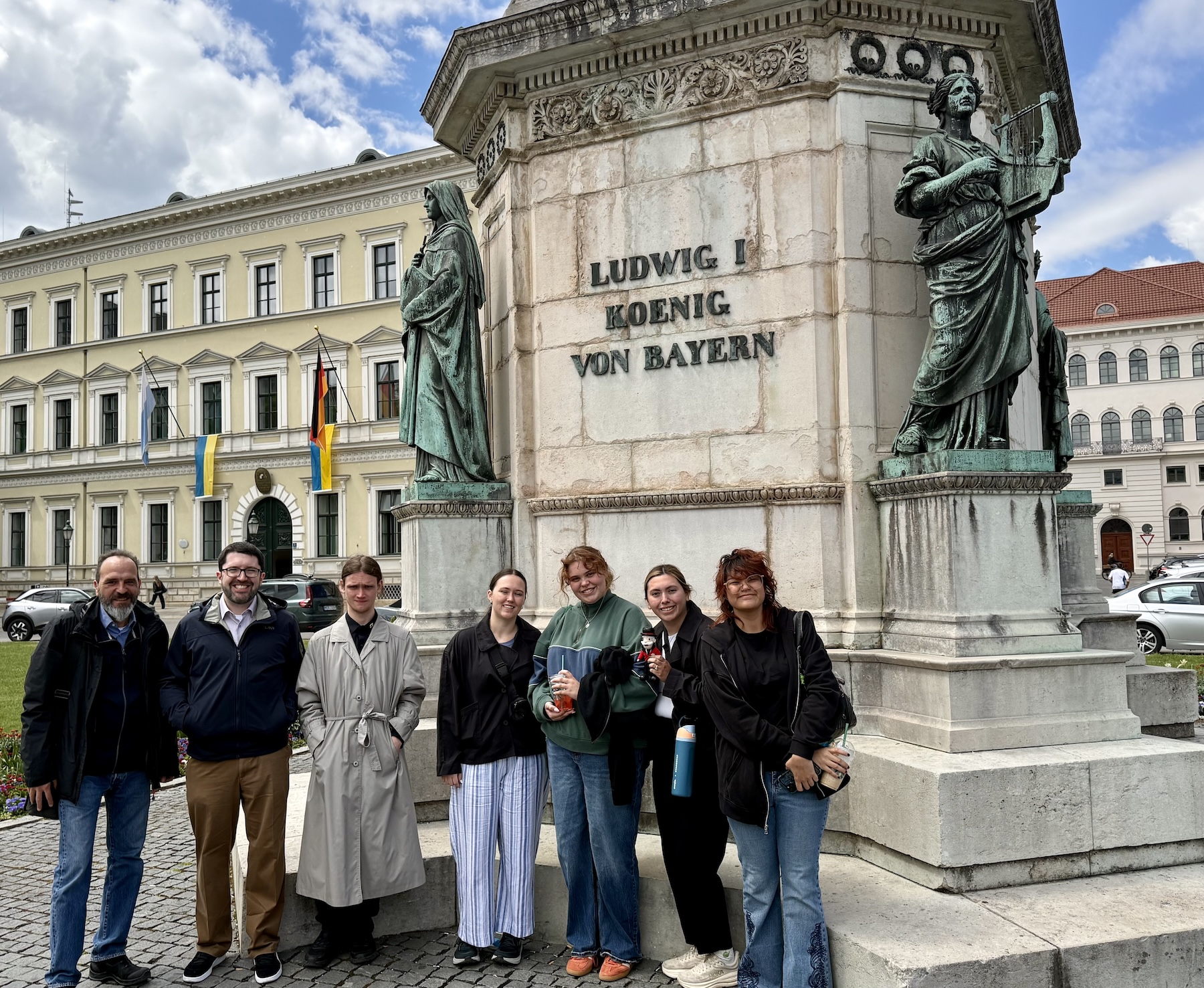
APSU students outside the Bavarian Ministry of the Interior in Munich. The visit allowed them to learn more about the state police during a study abroad trip to Germany. | Contributed photo
CLARKSVILLE, Tenn. — When five Austin Peay State University students traveled to Germany over the summer, they presented research to graduate students in Ingolstadt, fielded questions from Bavarian lawmakers, and walked the Berlin Wall with a woman who once believed it was there to protect her.
Now, thanks to a $15,000 grant from the Maynard Family Fund of Excellence, another group will strengthen those connections. Dr. Simon Rotzer, an assistant professor with the Institute for National Security and Military Studies and the Department of Criminal Justice, is organizing a return trip to Berlin next summer, and the grant will provide $1,500 scholarships for 10 students.
The most recent program took students to Munich and Berlin to see how their Austin Peay coursework plays out abroad.
“You can do a lot of good when you collaborate and bring people together,” Rotzer said. “My goal was never to conclude that the U.S. or the Europeans are clearly better. It was to start conversations: this works well in Germany, this works better in the U.S. — what could we learn from each other?”
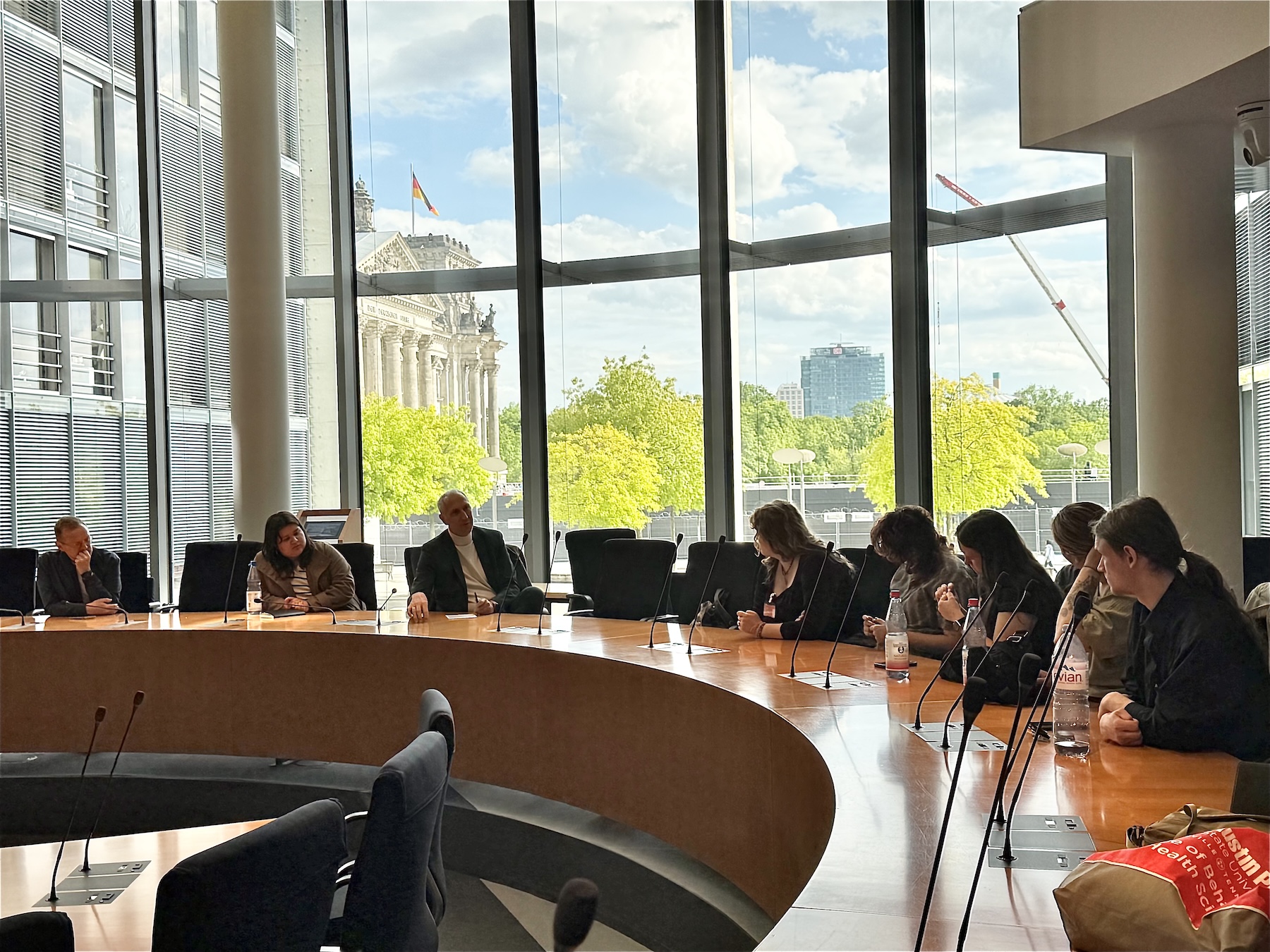
APSU students meet with a member of the German parliament in the Paul Löbe Haus to discuss topics ranging from the war in Ukraine to how the U.S. and Europe work together on defense. | Contributed photo
A Seat at the Table
Those conversations happened at every stop. A high-ranking Bavarian Police officer set aside an afternoon to walk students through German policing in Munich, while members of the Green Party hosted the group at the Bavarian State Parliament—asking them about the U.S. for several hours.
“Having people in such high positions genuinely consider your position as a student and an American was really nice,” sophomore criminal justice major Ruth Matthews said. “You could see they were taking notes and using this information in their jobs. One of the women from Parliament said, ‘I want to know what you all think on this topic so that I can go talk to other people about it.’”
Each student also researched a stop and led the group’s discussion on site. Matthews presented on Dachau, the first Nazi concentration camp.
“You can study it all you want, but to actually go there and see the conditions these people were in is an entirely different experience,” she said. “It really connected everything in my brain and made it feel real.”
Matthews, who plans to pursue a career in investigative work, said the trip sharpened that goal and left her with lasting connections overseas.
For Alison Osborne, an Air Force veteran who recently earned her master's in criminal justice, the trip offered a professional lens on everything from German immigration policy to criminal justice reform.
"The entire trip, top to bottom, was informative, productive, and provided critical insights," she said. "Shortly after graduating, I was able to land a job as a bilingual legal assistant in Nashville, and seeing and interacting with German officials helped me get a better understanding of the professionalism one must carry."
Osborne plans to attend law school and eventually work for the Department of Defense, and said her experience will follow her there.
"[Studying abroad] helps you learn to navigate on your own and get a better understanding of the world around you,” she said. “Having background knowledge of Germany would benefit me significantly — especially if I worked at a U.S. base in Germany or a U.S. embassy."
Sophomore national security studies major Grey Russell said talking with a German Democratic Republic (GDR) survivor stood out the most.
“Listening to her firsthand experience about a worldwide national security event was amazing,” Russell said. “Without the study abroad program, I would not have gotten that experience, and I am extremely thankful for it.”
Visiting Dachau also drove home the weight of the Holocaust and Germany’s commitment to remembering it.
“Being in the room, listening to the experiences endured while being next to the instruments, and listening to how Germany has tried to make amends, and in doing so, has become a powerful ally to Europe and the United States was incredibly powerful,” Russell said.

An APSU student with a mockup plane ticket commemorating the Department of Criminal Justice’s study abroad trip to Germany. | Contributed photo
Next Stop: Berlin
The Summer 2027 program will expand this year’s itinerary, with students spending 10 days in the German capital for behind-the-scenes visits to agencies like the Federal Intelligence Service — Germany’s equivalent of the CIA.
Students will also join a seminar alongside University of Potsdam students, sit down again with a GDR survivor, and visit Teufelsberg, a former U.S. National Security Agency listening station.
The trip is part of Rotzer’s Special Regional Topics course available to all students as an elective. Applications are due by Feb. 1, 2027, and can be completed here. Students can also connect with the Global Education Office, part of the new Honors College, for advising and additional travel scholarships.
“One thing I love about Austin Peay is that there’s so much effort and emphasis being put on study abroad programs,” Rotzer said. “These experiences change lives, and if we allow our students to do something of value and have genuine conversations in other countries, a lot of good comes from that.”
Invest in the future at Austin Peay
To support fundraising initiatives or establish a corporate partnership, contact the APSU Division of Alumni, Engagement and Philanthropy at 931-221-7127 or give@apsu.edu.