


Exploring Majors & Careers
Uncertain about choosing a major or career path? You're not alone!
Did you know that more than one-third of students change their majors at least once? Plus, less than 10% feel confident about their future careers! If this resonates with you, don’t fret! The Career Success Center is here to guide you every step of the way. Our passionate team is excited to embark on this career journey with you, helping you uncover your true interests and limitless potential. Let’s dive into your options and discover the perfect path for you together!
Career Assessment
Career assessments can help you learn your career interests. Lightcast, the official assessment tool for APSU, is an easy-to-use, career exploration and information system that lets you browse careers, find academic programs to match your desired career, and based upon your skills, values, and more!
Login to OneStop's Career Coach
and Take the Assessment
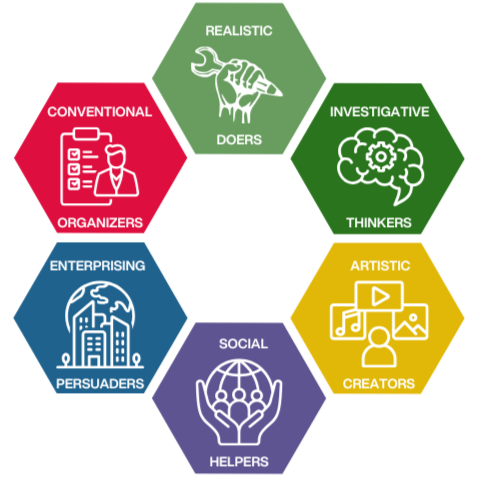
Majors & Careers that Align with Strong Assessment Results:
Realistic
“Doers” excel in hands-on activities, enjoying building or nurturing things outdoors. They should avoid therapeutic roles with a focus on interpersonal interactions. Common fields for them include engineering, agriculture, and the military, where their practical skills stand out.
Investigative
“Thinkers” excel in environments that allow for deep observation and investigation, often gravitating towards scientific fields. They prefer to avoid monotonous tasks and may not thrive in collaborative settings, but their critical thinking and analytical skills shine in areas like science, math, and medicine.
Artistic
“Creators” harness their imagination to innovate and generate new ideas. They often avoid rigid structures and physically demanding tasks. Commonly found in art, music, architecture, advertising, and journalism, where creativity flourishes.
Social
“Helpers” thrive in collaborative environments, finding joy in nurturing, training, and supporting others. They seek to make a positive impact and typically excel in fields like teaching, counseling, social work, and nursing, avoiding heavy physical tasks and machinery.
Enterprising
“Persuaders” excel as collaborators, thriving in roles that utilize their people skills instead of demanding precise intellectual tasks. They thrive in dynamic fields like management, marketing, law, and politics, where connecting and motivating others is key.
Conventional
“Organizers" excel in structured environments, favoring clarity and precise instructions. They thrive in fields like accounting, finance, and office administration, where order is essential.
Govs Guide to Choosing a Major
Choosing a major can be daunting, but it doesn't have to be. External factors, like uncertainty about career prospects or being overwhelmed by options, can complicate your decision. Internal struggles, such as doubts about your choices or conflicts between personal values and salary expectations, add to the challenge. Additionally, outside influences, like parents' opinions, can clash with your dreams, especially if you have many interests and don't know how to narrow them down. This guide helps you navigate your journey to find a path that aligns with your passions.
Start With Self-Reflection
Before you explore programs or research career statistics, look inward. Understanding what drives you is the foundation of a good decision.
What excites you?
Think about your interests, hobbies, and the subjects that hold your attention without effort. What kinds of problems do you enjoy working through? What topics make you want to learn more?
What are your strengths?
Reflect on your academic performance, your problem-solving style, and the skills that come naturally to you. What do people come to you for? What feels easy to you that seems difficult to others?
What impact do you want to make?
Consider your values and the kind of contribution you want to make—building things, helping people, analyzing data, creating art, teaching, leading. Your answer shapes which majors are worth exploring.
Explore Your Options
With a clearer sense of what energizes and suits you, start researching what's available.
Research a variety of majors.
Don't limit your search to what you already know. Explore fields across STEM, humanities, business, arts, education, and health sciences. Many students land on a major they hadn't considered before they started looking.
Connect with people.
Talk to professionals working in fields that interest you, APSU alumni, and students currently in those programs. Firsthand perspective is hard to replicate—ask about the day-to-day reality, not just the job title.
Conduct an Informational Interview with a professional, employer, or alum to learn more about a career or industry.
Informational interviews are a great way to learn about a career or industry. They can help you gain the “inside scoop” about a profession you might be interested in joining. They may also lead to valuable connections with people in the field that could help you land a job. Finally, informational interviews may help you confirm or rethink your plan.
It’s best to conduct at least a few informational interviews with different people and/or organizations. This allows you to to get a good sense of what you can expect from a particular field.
Asking a complete stranger for a meeting can be intimidating, but the results are worth it! To alleviate some of the discomfort, you can compose an email to the person you want to interview. Here’s an example of how you can reach out in a professional way, without coming across as overbearing:
Hello Mr. Williams,
I am an Austin Peay State University student majoring in psychology. I am interested in working with others in a clinical setting. In researching mental health clinics in the area, I discovered that your organization is providing the kind of services that interest me, and I’m very interested in learning more. Would you be willing to have a brief conversation with me in the next couple of weeks? I would love to ask you a few questions about working in the field. I would be grateful for the opportunity.
Thank you for support!
John CampbellKeep in mind that not all people/organizations will agree to meet with you. Don’t take this personally. Just reach out to another!
When someone grants you an informational interview, it is important to be prepared with some questions you want to ask them, especially since you’re leading the conversation. Your time will be limited, typically 30-60 minutes, so focus on the questions that will help guide your next steps. Here are some example questions to consider:
Career Path
-
How did you get started in this industry?
-
What do you like most and least about your job?
-
What challenges do you face in your role?
-
What skills and knowledge are most critical in this industry?
Skills and Experience
-
What experiences, skills, and educational background are necessary for a person who wants to do a job like yours?
-
What advice would you give to someone just starting their career in this field?
-
What kind of professional development is helpful in your current role?
Daily Tasks
-
What is a typical day or week like in your current role?
-
What kind of decisions do you make in your role?
-
Do you work independently or as part of a team?
-
How do you interact with customers or clients?
Industry Trends
-
What are the current employment prospects in this field?
-
What are some of the current trends for this field?
-
What are some of the emerging trends in this field?
After the interview is finished, be sure to send an immediate thank you note and consider extending an invitation to connect on LinkedIn if the conversation went well. Also, if you follow any advice that the interviewee suggests (and have positive results) always let them know what happened. Most people love knowing that they've provided sound counsel. This also gives you another opportunity to build rapport.
Use Career Coaching.
The Career Success Center offers one-on-one coaching, career assessments, and resources specifically designed to help you match your interests and strengths to academic and career pathways. Schedule an appointment with a Career Success Coach to get started.
-
Consider Your Future Goals
Your major should align not just with what you enjoy, but with where you want to go.
Short-term Aspirations
What do you want to accomplish in the next one to three years? Think about internships, research opportunities, volunteer positions, or part-time work in a field that interests you. These experiences will tell you a lot before you graduate.
Long-term Vision
Picture your career ten years from now. What does the work environment look like? What kind of organization are you part of? What role are you playing? Your degree should open doors toward that vision.
Stay flexible.
Career paths rarely run in straight lines. The major you choose now doesn't lock you into a single outcome—what matters is how you build on it through coursework, experience, and relationships.
Think Through the Practical Details
Once you've narrowed your options, evaluate the realities of each.
Course Requirements
Look carefully at the specific courses and prerequisites each major requires. Consider whether those classes genuinely interest you or feel like obstacles. Talking with students currently in the program gives you the most honest picture.
Job Market Outlook
Research employment prospects in the field, including typical entry-level roles, salary ranges, and growth potential.
Financial Factors
Factor in any additional costs beyond standard tuition—lab fees, specialized equipment, professional certification exams, or graduate school requirements that may follow your undergraduate degree.
Take Action
Thinking and researching only go so far. At some point, you have to move.
Start with exploratory courses.
Enroll in introductory classes across a few areas of interest before committing. Direct experience in a subject is a more reliable indicator than any course description or career quiz.
Seek mentorship.
Build relationships with professors, advisors, and professionals in fields you're considering. Their guidance can accelerate your decision and open doors you didn't know existed.
Stay open to change.
Switching your major — even more than once — is common and completely fine. What matters is that you're moving toward a fit that feels right, not just finishing a degree in something that doesn't.
The Career Success Center is here to help you talk through your interests, explore your options, and build a plan that works for you.