


Dr. Jeffrey Wood
Professor of Music, Composition, Theory, and Piano
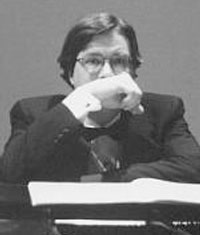
Jeffrey Wood, originally from Winnetka, Illinois, began piano lessons at the age of seven. After attending the Interlochen Arts Academy, he attended the Oberlin College Conservatory of Music where he studied composition under Richard Hoffmann. He pursued his graduate studies at the State University of New York at Stony Brook, New York, where he studied piano under Gilbert Kalish and composition under David Lewin, earning Master’s degrees in both piano performance and composition and a Ph.D. in composition.
Dr. Wood’s compositions have been performed throughout the country and have received numerous awards including Broadcast Music, Inc., Awards in 1975, 1978 and 1979, American Society of Composers, Authors and Publishers (ASCAP) Award in 1981, and the 1982 David S. Bates Memorial Prize. He was the highest prizewinner in the 1984 Stroud Festival International Composition Competition in Great Britain, the only American so cited, for his brass quintet In Memoriam Magistri. The Philip Jones Brass Ensemble subsequently performed this work during the 1984 Festival (the Passacaglia from this work was recorded by the APSU Brass Quintet in 2004). For his Sonata for Violoncello and Piano, commissioned by the Music Teacher’s National Association, Wood was named Distinguished Composer of the Year in 1985. Wood has received commissions from the Governor’s School for the Arts in Tennessee, National Musical Arts, Washington, D.C., the Quintet of the Americas, and the Center for the Creative Arts at Austin Peay State University. A CD recording of his woodwind quintet Comedies, as performed by the Quintet of the Americas, was released in 1991. More recent recordings have included Wood’s Kriegeslieder [Songs of War] (performed by Lisa Conklin-Bishop, mezzo-soprano and Jeffrey Wood, piano), The Habit of Grief for solo guitar (performed by Stanley Yates), Lullay, My Child (performed by Sharon Mabry, mezzo-soprano, and Lynn Rice-See, piano), and Freylekhs and Fugue for wind ensemble (performed by the APSU Wind Ensemble conducted by Dr. Gregory Wolynec).
Wood has written a substantial amount of vocal music, including five song cycles: MCMXIV [1914], Kriegeslieder [Songs of War], Till Time and Times are Done (which was given its New York première by soprano Marcella Calabi and tenor Paul Sperry in Merkin Hall in March of 2002), Night (recently featured in concerts by baritone Andrew Garland and pianist Donna Loewy) and most recently Ne reprenez si j’ay aymé [Do Not Reproach Me if I’ve Loved]. A chamber opera entitled Diaries: a Parable for Voices, based on the testimonies of women who served as nurses during World War I and poetry of E. E. Cummings, David Jones, Archibald MacLeish, Israel Zangwill, Marianne Moore and Carl Sandburg was given a fully staged première in 1996. Other works include an oratorio for chorus, vocal soloists and string orchestra Lamentationes Ieremiæ Prophetæ [Lamentations of the Prophet Jeremiah], based on the biblical text and the Holocaust poetry of Paul Celan, Nelly Sachs and Dan Pagis, which was given its first performance by the APSU Chamber Singers and the Nashville Chamber Orchestra, conducted by George Mabry. This work was subsequently nominated for the Pulitzer Prize.
During 1987-1988 Wood held the Individual Artist Fellowship in Composition from the Tennessee Arts Commission, with a matching grant from the Joan Harrell Schaeffer Foundation. Recent grants have included three research fellowships from the Tower Foundation of APSU. Twice nominated for the Distinguished Professor Award, Wood was awarded the Richard M. Hawkins Award for scholarship and creativity in 1988.
Wood was named a winner in the 1995 Young American’s Art Song Competition sponsored by G. Schirmer/Associated Music Publishers, which resulted in the inclusion of his song “The Rear-Guard” from the cycle MCMXIV in “The Art Song Collection” published in 1996. Also in 1996 a work for solo guitar, The Habit of Grief, was awarded second prize in the Guitar Foundation of America Set-Piece Competition. More recently his Every Night and Every Morn for tenor and piano, written on a commission from Ohio State University, was a finalist in the 2002 National Association of Teachers of Singing (NATS) competition. This work is also the subject of a doctoral paper by Dr. Gregory Rike, “Every Night and Every Morn: A Performance Study of the Song Cycle by Jeffrey Wood from the Poetry of William Blake” (2004). Most recently, Wood’s Four Deadly Serious Songs (1991) and Night (2004) have been performed by baritone Andrew Garland and pianist Donna Loewy in a series of concerts throughout the country during the 2005-2008 and concert seasons. Many of Wood’s vocal works are published through Classical Vocal Reprints, www.classicalvocalrep.com
In 2004 Wood organized a concert in honor of author and Holocaust survivor George Salton, a multi-media presentation involving music, spoken text and images. This concert was given as part of the Joseph Asanbe Memorial Symposium on Diversity and involved the première of Wood’s cycle Night for voice and piano. He has authored articles on the subject of music and war, “The Music of World War I,” and “The Music of World War II,” that appeared in Encyclopedia of World War I and Encyclopedia of World War II: A Political, Social and Military History (ABC-CLIO, 2005)
Wood studied piano under Emilio del Rosario, Fernando Laires, Aube Tzerko, Edith Oppens and Gilbert Kalish and has appeared in solo and chamber music recitals throughout the United States. In 1983 he was one of fourteen finalists chosen to compete in the United States Information Agency’s Artistic Ambassador Program at the Library of Congress in Washington, D.C. He has also been a featured composer/performer at the International Composer’s Symposia at the University of New Mexico, Albuquerque. Wood is deeply committed to the performance of contemporary music, and has been involved in the world premières of Alan Hovhaness’ Concerto No. 10 for Piano, String Quartet and Trumpet, op. 413 (1988) and Elizabeth Vercoe’s A Dangerous Man (1992), a monodrama based on the life of John Brown for baritone and piano and Frederic Goossen’s Reliquary (1996) for voice and piano. He has worked with such notable composers as Roger Sessions, Ernst Křenek, Thea Musgrave and Mario Davidovsky in performances of their keyboard music. Following the première in 2004 of selections from Frederic Goossen’s A Well-Tempered Clavier: Twelve Preludes and Fugues (2000/01), Dr. Goossen wrote that Wood’s “insight makes his performances always memorable and a source of great satisfaction, as it did in his performances of pieces from this collection.” About his performance of Ernst Křenek’s Sonata No. 3, op. 92 no. 4, Dr. Křenek wrote “I remember very well, of course, your exemplary playing of my Third Sonata … I am happy that you are still playing my Sonata, for your performance is authentic!” He has coordinated an annual National Young Composer’s Competition through the Center for the Creative Arts at Austin Peay since 1987. He is presently Professor of Music at Austin Peay State University in Clarksville, Tennessee.
Email: WoodJ@apsu.edu
Phone: (931) 221-7819
Music/Mass Communication Building, Room 313